

Brazil gold reserves: why the central bank doubled gold
The central bank says rising economic and geopolitical risk pushed it into gold, the euro and the renminbi, and away from the dollar.
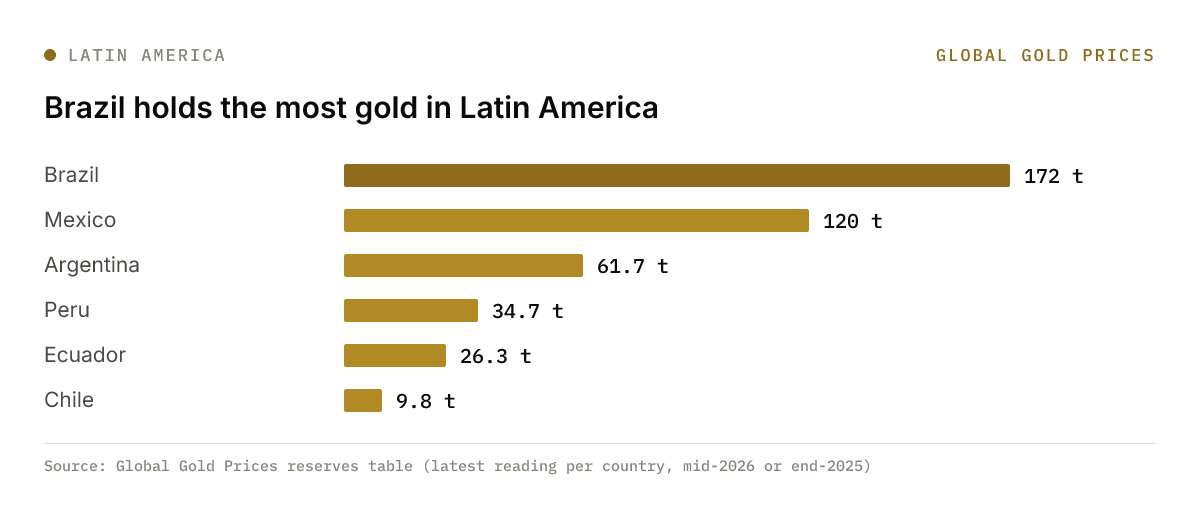
Brazil's gold reserves stood at about 172 tonnes in mid-2026, worth roughly $23 billion at Friday's price. The Banco Central do Brasil (BCB) bought the metal in late 2025 to protect its reserves from economic and geopolitical shocks, lifting gold to 7.19% of a US$358 billion pot, from 3.55% a year earlier.
That makes gold the second-biggest holding in Brazil's reserves after the US dollar. A monthly reading from the central bank put total reserves at about US$373 billion on 1 August. By our calculation, 172 tonnes at Friday's close of about $4,200 an ounce comes to roughly 6% of that total.
How big are Brazil's total reserves?
The BCB reported reserves of US$358.2 billion at the end of 2025, up from US$329.7 billion a year earlier, in its annual reserve management report published on 31 March. It has kept rising since, reaching about US$373 billion by August, according to the bank's own data series.
The reserves earned 9.18% in dollar terms in 2025: 5.26 points from interest and bond prices and 3.92 points from currency moves. Measured in reais the return was minus 2.97%, because the real strengthened against the dollar during the year.
Why did the central bank buy gold?
In its words (our translation from Portuguese), it acted "attentive to the increase in economic and geopolitical uncertainty, and with the aim of strengthening security and liquidity," and said this meant larger positions in gold, the euro and the Chinese renminbi.
It also listed its order of priorities for the reserves: security first, then liquidity, then return. Gold pays no interest, which is why it scores on the first two and not the third. The report noted that gold's price swung more in 2025, which pushed up the currency part of the portfolio's risk measure.
The buying was concentrated in a few months. Holdings rose from about 130 tonnes to about 172 tonnes between September and November 2025, a jump of a third, according to World Gold Council figures. Our reserves table still shows 172 tonnes in June 2026, so no further buying has shown up this year.
One local detail stands out. The country mines gold, much of it in the Amazon, yet the BCB says every ounce it buys for the reserves is traded "exclusively abroad". It does not buy in the domestic market.
How much of the jump came from the price?
Most of it. On our price data, gold rose about 66% during 2025, from roughly $2,610 to $4,330 an ounce. The tonnes went up by a third. Together they more than doubled the value of Brazil's gold, from about US$10.9 billion to US$23.9 billion, which is why its share of the reserves doubled too.
For context on why central banks buy gold, Brazil is part of a wider shift tracked in our central bank gold buying tracker. In Latin America it now leads by a distance: its 172 tonnes are about 40% of the 429 tonnes held by the seven central banks in our reserves table, ahead of Mexico at 120 tonnes and Argentina at about 62.
Any new Brazilian purchase would show up first in the monthly reserve data the BCB and the IMF publish. The full 2026 currency mix will come in the bank's next annual reserve management report, which on past form lands at the end of March.
More from the Latin America desk
All Latin America stories →Related reading
- A weak monsoon is the quiet risk to India's Diwali gold season
Rural buyers drive over half of India's gold demand, and this year's monsoon ran 15% below average. Jewellers are split on whether Diwali volumes will fall.
- How to sell gold and get a fair price
Melt value by karat at this week's price, what each kind of buyer pays, hallmarks, tax by country and the warning signs at the counter.
- Gold holds above $4,150 as the dollar climbs
At 5.22% yields and a rising dollar, gold would normally be crumbling. Central-bank buying is rewriting the playbook.