

Gold vs oil: why the war premium went missing
Every escalation in the Iran war lifted oil and sank gold. A year of events, and 58 years of our price data, show why.

Key points
- Gold closed last week near $3,997, down 23% since the eve of the Iran war while Brent crude is up more than half
- One month into the war gold was down 14.4%, the worst first month of seven war shocks on our data since 1990
- The two best days for gold this year were peace days: the April ceasefire and the June interim deal
- The Fed raised rates in September for the first time since 2023, and the market prices more hikes
The war premium in gold went missing because this war reached gold through oil, inflation and interest rates, not through fear. Since the eve of the US and Israeli strikes on Iran, gold has fallen about 23% to near $3,997 while Brent crude has climbed from about $72 to around $114, on our price data and oil market reports.
Why it matters: If you hold gold as war insurance, 2026 shows the policy has an exclusion clause. When a war drives up oil, inflation and rates, gold can fall even as the news gets worse, and the price you pay now reflects that.
That is the opposite of what most people expect. In a normal war year, bad news from the Gulf would lift gold. This year every escalation that pushed oil higher pushed gold lower, and the two days gold gained most were the days peace looked closest. This piece walks through the year event by event, sets it against six earlier war shocks on our data going back to 1990, and explains what would bring the haven bid back.
What is a war premium, and where did it go?
A war premium is the extra price investors pay for gold when conflict raises the odds of something going badly wrong. It usually shows up fast, in the first weeks of a war, and fades as the shock becomes familiar.
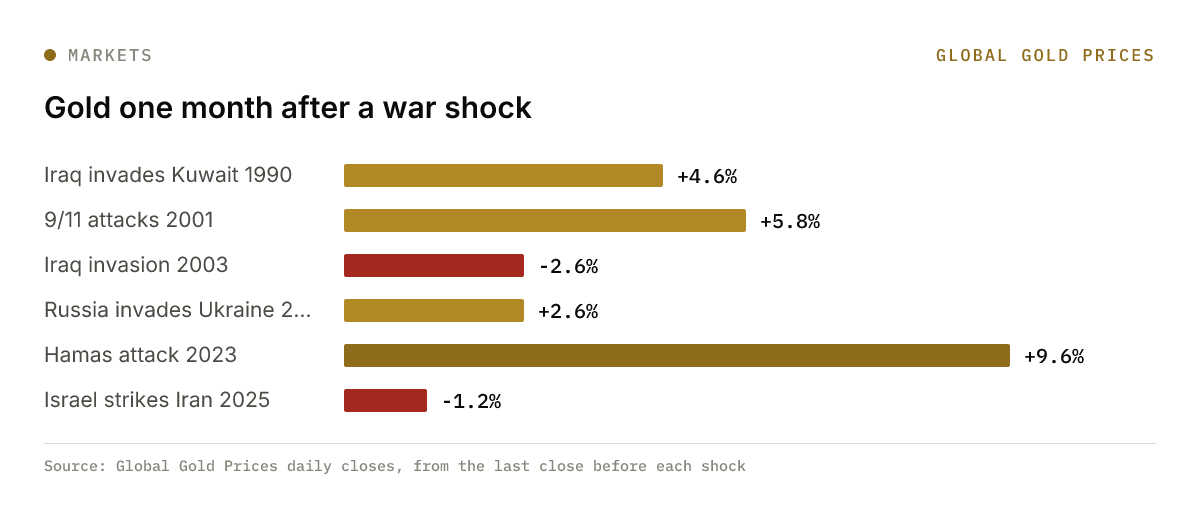
On our data it has shown up in most modern wars. Gold rose 4.6% in the month after Iraq invaded Kuwait in August 1990, 5.8% in the month after the 9/11 attacks and 2.6% in the month after Russia invaded Ukraine in February 2022. After the Hamas attack on Israel in October 2023, it climbed 9.6% in a month and kept going.
The 2026 Iran war broke the pattern. In the month after the strikes began on 28 February, gold lost 14.4%. Of the seven war shocks in our table, it is the only one where gold fell by more than 3% in the first month.
| Shock | 1 month later | 3 months later | 8 months later |
|---|---|---|---|
| Iraq invades Kuwait (1990) | +4.6% | +2.4% | -4.0% |
| 9/11 attacks (2001) | +5.8% | +0.4% | +14.4% |
| US-led invasion of Iraq (2003) | -2.6% | +7.1% | +18.1% |
| Russia invades Ukraine (2022) | +2.6% | -3.0% | -13.7% |
| Hamas attack on Israel (2023) | +9.6% | +13.0% | +29.1% |
| Israel strikes Iran (2025) | -1.2% | +7.0% | +44.1% |
| US and Israel strike Iran (2026) | -14.4% | -12.8% | -23.3% |
Over the full eight months since the war began, gold's 23.3% slide is worse than many previous similar events.
Was the premium already spent before the war began?
Partly, yes. Gold went into the war with much of its fear already priced in.
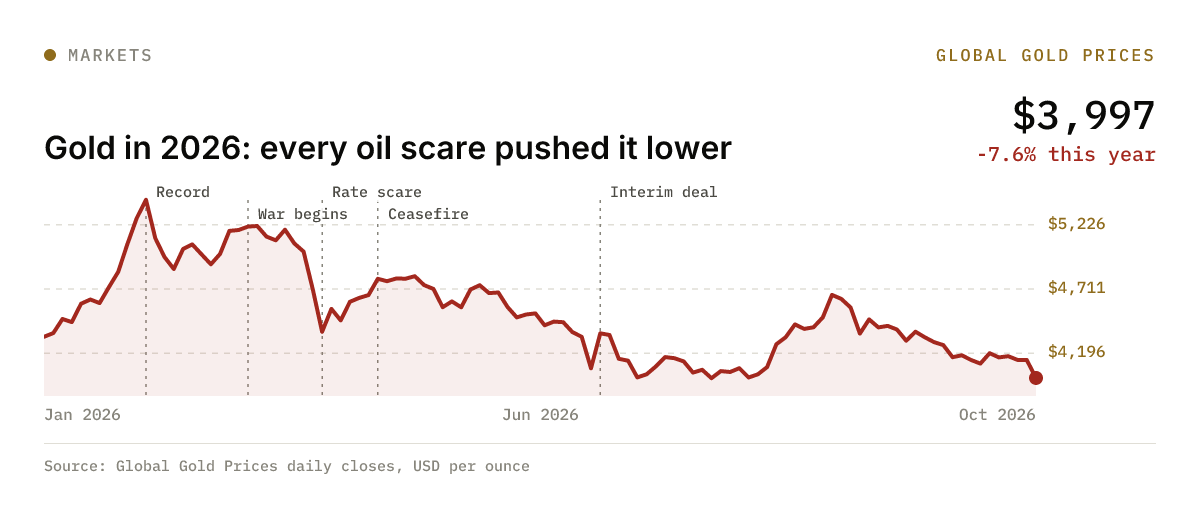
In the 30 days to its record close of about $5,426 on 29 January, gold rose 24.3%. That run beat 99.5% of 30-day stretches since 1968 on our data. It was driven by worries about Fed independence, the dollar and US debt, and it left the market crowded with fast money.
The first crack came before a single missile flew. On 30 January President Donald Trump named Kevin Warsh, seen by traders as a rate hawk, to lead the Fed. Gold fell 5.7% that day and another 6.3% on the next trading day, the two worst daily falls of the year. Silver dropped far harder.
Gold then rebuilt part of the loss through February and closed at about $5,211 on the eve of the strikes. It closed at about $5,355 on the first trading day of the war. That spike, around 3% from the last pre-war close, is the whole war premium this year: it lasted one session.
The lesson from the January run is simple. A haven bid needs room to grow. When gold has already gained a quarter in a month, much of the money that would buy it in a crisis already owns it, and some of that money has to sell when other markets go wrong.
How did the oil shock turn into a gold sell-off?
Through rates. This is the core of the story, and it is the part most war-and-gold rules of thumb leave out.
The strikes on Iran shut most traffic through the Strait of Hormuz. Brent, near $72 to $74 before the war, came close to $120 in early March. Over the month it rose 51%, one of the sharpest monthly oil jumps on record.
Dearer oil feeds straight into petrol, freight and airfares, and then into inflation. Traders stopped asking when the Fed would cut and started asking whether it would hike. Ten-year Treasury yields climbed to their highest level since the previous July, and by mid-March the market had pushed the first expected cut out as far as mid-2027.
Gold pays no interest. When safe bonds pay more, the cost of holding gold instead goes up, and some investors switch. Our explainer on why gold falls when rates rise walks through the arithmetic. In March that switch happened at speed.
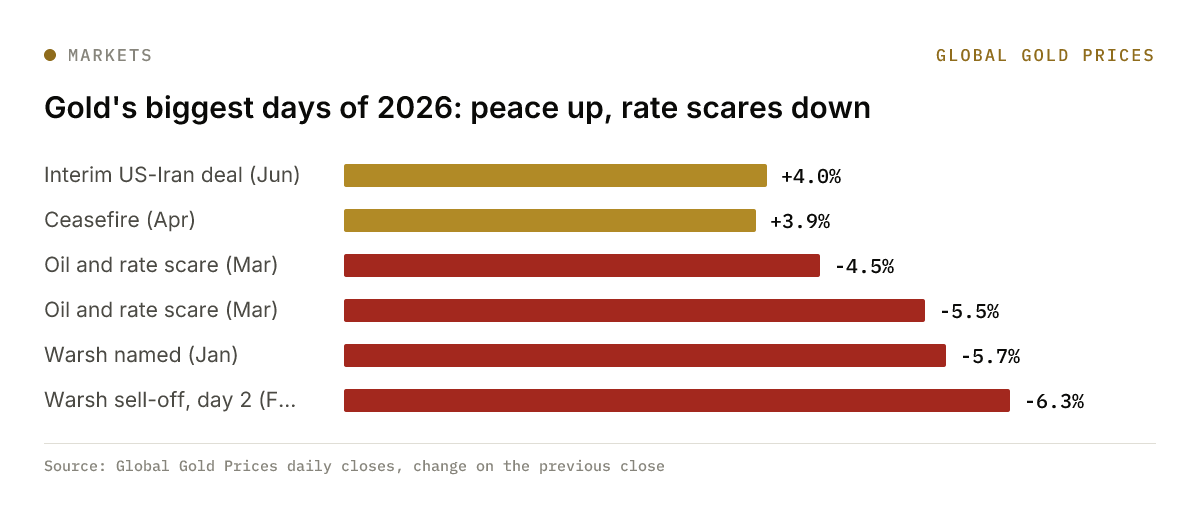
The week to 20 March was the worst for gold in more than a decade. Gold fell 9.5% over the week and stood 12.6% below its pre-war level, its sharpest such fall since June 2013, BullionVault calculated. On our closes, 19 March and 23 March brought falls of 4.5% and 5.5%, the third and fourth worst days of the year. Both came as oil rose and rate bets moved against gold.
Why did peace help gold more than war?
Because peace pulled oil down, and lower oil pulled rate expectations down with it. Look at the biggest up days of the year on our data:
- 8 April, up 3.9%. The US and Iran agreed a two-week ceasefire. Brent dropped back below $100, and gold reached its highest level since mid-March.
- 15 June, up 4.0%. The best day of the year came after the US and Iran agreed an interim peace deal. It was the first agreement that looked like more than a short truce.
A true haven trade would do the reverse: gold would rise when the shooting starts and give the gains back when it stops. In 2026 gold traded like an inverse oil price. When the ceasefire looked shaky in May, gold slid for a third straight month. When the interim deal held in July, it steadied near $4,000 to $4,150.
The summer rally makes the same point from another angle. In August gold climbed from about $4,028 to about $4,664, a gain of about 16% in three weeks on our closes. There was no new war. The trigger was a weak July jobs report and cooler US inflation, which cut the odds of a Fed hike. Gold funds took in 46.7 tonnes in one week, their biggest weekly demand in 10 months, according to the World Gold Council. Rates fell, and gold rose.
When did the Fed make it official?
On 16 September. The Federal Reserve raised its target range by a quarter point to 3.75% to 4.00%, its first increase since 2023, in a 12 to 0 vote. Its statement named geopolitical developments among its concerns.
The oil link was explicit. Crude was just below $80 when the Fed met at the end of July and above $100 by the September meeting. Core PCE inflation, the Fed's preferred gauge, had risen from 3.0% last December to 3.3% in July. The Fed's new projections showed 16 of its 18 officials expecting at least one more hike this year.
Gold had already given back much of its August gain by then, and it kept sliding. Late in September, after Washington rejected an Iranian offer to reopen Hormuz within seven days, gold fell about 3% in a session to around $4,150. Market pricing put the odds of another hike in October at about two in three, up from below one in ten a month earlier.
Early October brought a short break. Gold climbed back toward $4,190 after Trump said the US would not attack Iran before the 3 November midterm elections, and 10-year yields eased from about 5.35% to about 5.24%. The relief lasted less than two weeks.
What happened in the last two weeks?
The pattern repeated. Houthi forces claimed attacks on Saudi airports and oil sites, and tanker attacks in the Gulf cut flows further. Brent reached about $117 on 23 October, its highest since April.
Gold went the other way. It fell 2.8% on 22 October and closed the week at about $3,997, its first close under $4,000 since mid-July. Over the past week it lost 4.1% and over the past month 6.7%. Our Gold this week edition covers the day-by-day moves.
By Friday, futures priced a 92% chance the Fed holds on Wednesday but an 83% chance of another quarter-point rise in December, CNBC reported. Oil eased to around $114 on Monday on hopes of a pause in US-Iran hostilities, a reminder that both markets now move on the same headlines in opposite directions.
Is gold failing as a haven, or doing something else?
Neither, quite. Gold is doing what it has always done when a shock works through interest rates. It did the same in the early 1980s, when high oil prices and Fed tightening pushed it down for years despite the Iran-Iraq war and the Cold War.
Three things made 2026 different from 2022 or 2023:
- The war hit the oil supply directly. Russia's invasion of Ukraine also lifted oil, but the shock was spread across gas, grain and metals, and the Fed was already hiking for other reasons. This time the closure of Hormuz is the inflation story.
- Gold started the war at a record. In October 2023 gold was near $1,820 and out of favour. In February 2026 it had just come off its fastest month in decades.
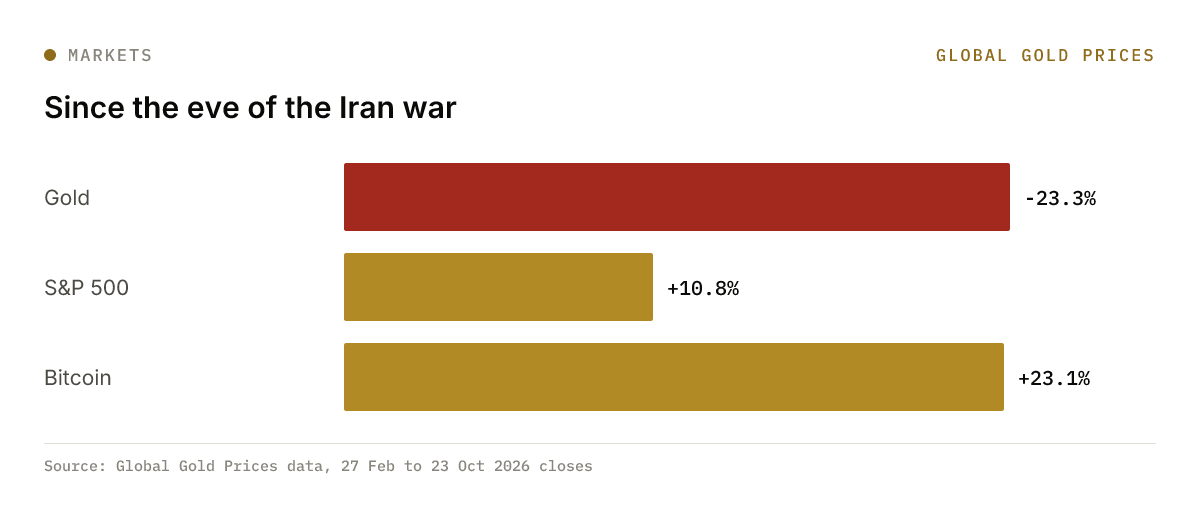
- Other assets kept working. Since the eve of the war the S&P 500 is up about 11% and bitcoin about 23% on our data. Investors did not flee to safety. They priced higher rates and stayed in risk.
Gold has also been far jumpier than usual. Its realised volatility since the war began is about 25% a year on our daily closes, against about 18% in 2025 and a long-run average of about 19%. A metal that swings like that is hard to treat as a calm store of value, and some holders sold for that reason alone.
There is still a floor under the market, and it comes from central banks, not traders. Official buyers have kept adding gold through the year, as our piece on central bank buying in Poland and China shows. UBS said in October it expects buyers to step in around $4,000 for that reason. That floor slows the fall. It has not created a war premium.
What would bring the war premium back?
Our read: gold gets its haven bid back only when the war stops feeding the rate story. There are two ways that could happen.
- Oil falls. If Gulf output and shipping find a way around Hormuz, oil could ease.
- The Fed looks through oil. If Fed officials say an energy shock is temporary and they will not chase it with more hikes, gold's biggest headwind fades. Wednesday's statement and press conference are the first chance.
What to watch
- 28 Oct: Fed decision; a hold is expected, but any hint it will look through oil would help gold
- 29 Oct: US September PCE inflation, third-quarter GDP and the ECB decision, all on one day
- 3 Nov: US midterm elections, the end of the window in which Trump ruled out strikes on Iran
- 9 Dec: the Fed's last decision of 2026, where futures price a hike
Frequently asked questions
+Why is gold falling during the Iran war?
Because the war works on gold through oil. Brent has risen from about $72 to around $114, which lifts inflation and Fed hike bets, and higher rates make gold, which pays no interest, costlier to hold. Gold is down about 23% since the war began.
+Does gold usually rise when a war starts?
Usually, yes. On our data gold rose in the month after four of six earlier war shocks since 1990, by up to 9.6%. In the month after the 2026 strikes on Iran it fell 14.4%.
+How far is gold below its record?
About 26%. Gold closed near $3,997 on 23 October against a record close of about $5,426 on 29 January, on our price data.
+What could push gold back up?
Lower oil, a Fed that signals it will look through the energy shock, or a crisis that spreads to banks or the dollar. Gold's two best days this year, up 3.9% and 4.0%, came on peace news that cut oil.
More from the Markets desk
All Markets stories →Related reading
- Gold technical analysis: $4,000 lost, $3,950 in view
The $4,070 floor broke on Thursday. Friday closed on the July low, with the year's lowest close next.
- Fed rate decision: what gold needs to hear on Wednesday
A hold is priced in. December is the real question, and gold has tended to react a day late this year.
- Gold this week: price breaks below $4,000 as oil lifts rate fears
Week to Friday 23 October, and the week of 26 to 30 October.