

Australia gold exports: A$68bn forecast as price slips
The government's September outlook assumes gold stays above US$4,000. Friday's close was just under it.
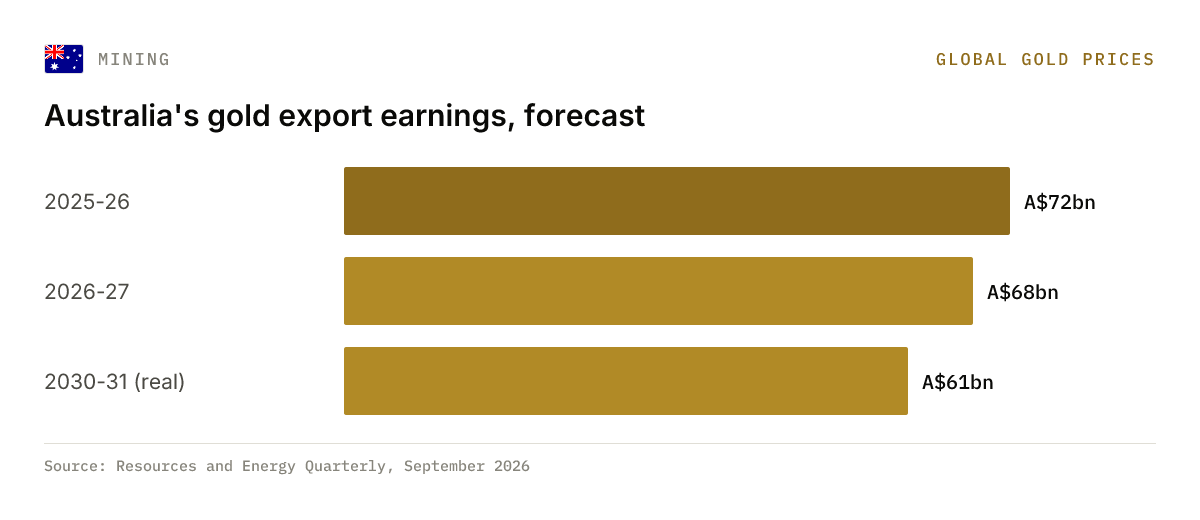
Australia's gold exports are forecast to earn about A$68 billion in 2026-27, down 6% from almost A$72 billion last financial year, in the government's September Resources and Energy Quarterly. The forecast assumes gold stays above US$4,000 an ounce. On Friday it closed just under that line, near $3,997.
Why it matters: Australian gold export earnings are a read on world supply as well as on the economy. If the price stays below the department's US$4,000 assumption, the A$68 billion forecast is the first number at risk.
What does the forecast say?
The Department of Industry, Science and Resources publishes the Resources and Energy Quarterly every three months, and its gold numbers are some of the best public guides to the supply side of one of the world's three largest producers. The September edition, released this month, makes three points about gold.
First, earnings ease from a record. Gold export earnings are estimated to fall from almost A$72 billion in 2025-26 to A$68 billion in 2026-27, and to A$61 billion in real terms by 2030-31. Second, the department puts the fall down to lower prices and a modestly stronger Australian dollar. Third, it still expects gold to become Australia's second-largest export by value, ahead of liquefied natural gas and behind only iron ore.
The scale is worth a moment. A year ago, the September 2025 edition projected gold earnings of about A$60 billion for 2025-26. The outturn came in near A$72 billion, a revision of roughly 20% in a single year, almost entirely from price.
Is the US$4,000 assumption already in trouble?
It is being tested. The report expects the price to stay above US$4,000 an ounce through its outlook. Gold closed Friday at about $3,997, after a 4.1% fall on the week and a 6.7% fall over the past month.
Our own data puts the gap in context. Gold averaged about $4,243 an ounce over the 2025-26 financial year, July to June, on our daily closes. Friday's price is about 5.8% below that average, close to the 6% fall in earnings the department forecasts. In other words, the forecast already allows for a price somewhere near today's level. A sustained move toward $3,900, which several market notes flagged this week, would start to eat into the A$68 billion.
The currency matters as much as the dollar price. At today's exchange rate of about 1.42 Australian dollars per US dollar, Friday's close works out at about A$5,687 an ounce, on our calculation. Australian miners pay most of their costs in local dollars, so it is that A$ price, not the US$ figure, that sets their margins.
Where does the supply come from?
Western Australia supplies most of the country's gold, from large open pits around Kalgoorlie and a long tail of smaller underground mines. Because the forecast decline is about price and currency, the volumes those mines ship are the part of the outlook that producers control.
That is also where the risk sits. January's record of about $5,426 was worth roughly A$7,700 an ounce at today's exchange rate, by our calculation. Operations planned or restarted near those prices have thinner cushions at A$5,700, and this month's oil rally adds to fuel costs. We have looked at the same squeeze in Africa, where Ghana's royalties doubled as gold passed $4,000 and Zimbabwe's deliveries are heading for a record year.
What would change the outlook?
The department itself flags a high degree of uncertainty, pointing to disruptions in Middle East shipping. For gold, the main moving parts are the US dollar price, the Australian dollar and interest rates in the US. Our guide to what moves the gold price sets out how each one works.
The first hard test comes over the next fortnight, as Australian producers report their September-quarter output and costs. Those numbers will show whether output is holding up as the price falls. The department's next quarterly update, due in December, will then reset the A$68 billion figure against whatever the price has done by then.
What to watch
- Wed 28 Oct: the US Federal Reserve decision, the biggest near-term driver of the US$ gold price.
- Thu 29 Oct: US third-quarter GDP and September PCE inflation, which will shape December rate bets and, through them, the A$ gold price.
More from the Mining & Supply desk
All Mining & Supply stories →Related reading
- Gold Performance 3rd November: gold price slips, US vote count up next
Tuesday 3 November: a firmer dollar and rising Treasury yields pulled gold back below $3,950 as Americans voted and bets on a December Fed hike climbed.
- Gold Performance 2nd November: gold price jumps 1.8%, US vote up next
Monday 2 November: a 7% slide in oil on hopes of US talks with Iran eased Fed hike bets and gave gold its best day since early September.
- Gold and inflation: why an energy shock is hurting gold
Gasoline is up 34% on the year and inflation is back near 4%, yet gold is down. The answer is in how the Fed responds, and history shows both outcomes.