

Gold Performance 2nd November: gold price jumps 1.8%, US vote up next
Monday 2 November: a 7% slide in oil on hopes of US talks with Iran eased Fed hike bets and gave gold its best day since early September.
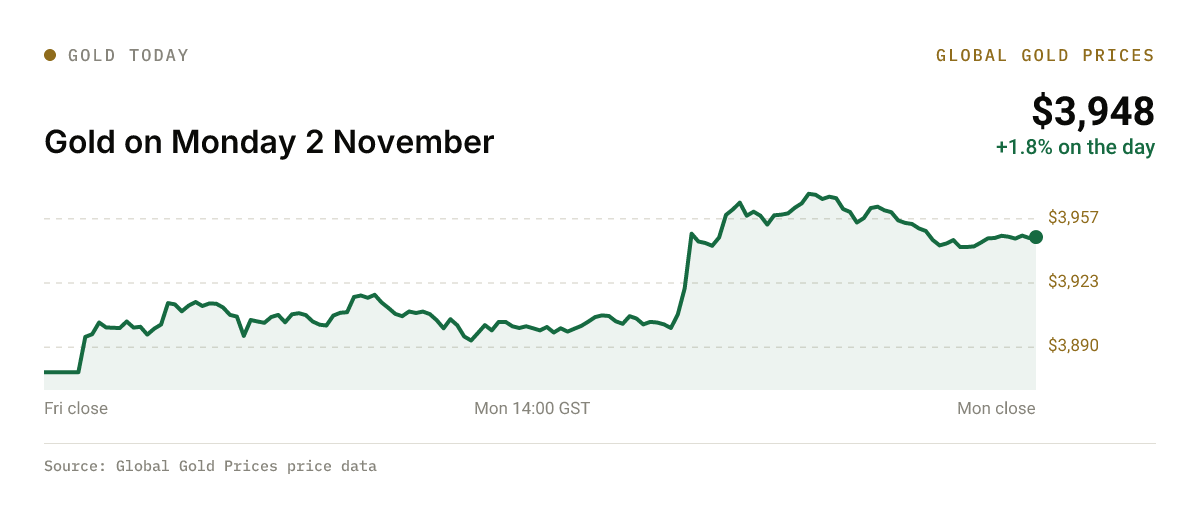
The gold price closed at about $3,948 an ounce on Monday 2 November, up $71, or 1.8%, from Friday's close. Oil fell more than 7% on hopes of US talks with Iran, which eased inflation fears and pulled US Treasury yields lower. It was gold's best day since early September, a day after its lowest close in a year.
Where did gold rise on Monday?
Most of the gain came in New York. Gold reopened on Sunday evening and picked up about $23 before Asia's morning, as buyers came back after Friday's 3.6% drop. Asian trade added another $8, and London gave a little back, leaving gold near $3,902 when New York opened.
Then it jumped. Gold climbed about $49 in the hour to just after 9 am New York time, the biggest one-hour move of the day, and kept going to a high near $3,971 around midday. It drifted lower through the afternoon but still finished about $45 higher on New York hours alone.
Why did the gold price rise?
Oil fell hard. US crude dropped about 7.4% to near $96 a barrel and Brent about 7.6% to near $105, Mitrade reported, on reports that Iran had approved more diplomacy and that Qatar was helping to arrange talks with Washington. Reuters, carried by MINING.COM, said Iran and Qatar held a third day of talks on ending the war. Cheaper oil takes some heat out of inflation, the force pushing the Federal Reserve toward a hike, the link we traced in gold and inflation.
Hike bets eased, a little. Traders put the chance of a December rate rise at 77%, down from 80% a week earlier, according to the CME FedWatch tool. Mitrade said the 10-year Treasury yield briefly got close to 4.87%, its lowest in several weeks, before settling near 4.9%. Lower yields make a metal that pays no interest easier to hold, the debate last week's Fed decision set up.
Silver and miners ran ahead. Silver rose about 3.7% to near $51, and The Rio Times reported that the big gold miners gained more than the metal. Carsten Menke of Julius Baer told Reuters that US budget deficits are likely to last whoever wins Tuesday's elections, which he sees as support for gold over the longer run.
How big was Monday's gain?
On our data, only about 5% of trading days since 1968 have brought a bigger one-day gain. The last bigger rise came on 3 September.
It repairs only part of the damage. Gold is still about 27% below January's record near $5,426, down 8.8% since the start of the year and well under its 50-day average near $4,244. It has not closed above $4,000 since Thursday.
Up next: what to watch tomorrow
- Tue 3 Nov: US midterm elections, with results coming in through New York's evening and Asia's Wednesday morning. Before that, US JOLTS job openings and factory orders, both at 10 am New York time.
- Tue 3 Nov: The Reserve Bank of Australia raised its cash rate to 4.85% in Asian trade, its fifth hike of the year, after a 6 to 3 vote.
More from the Markets desk
All Markets stories →Related reading
- Gold Performance 3rd November: gold price slips, US vote count up next
Tuesday 3 November: a firmer dollar and rising Treasury yields pulled gold back below $3,950 as Americans voted and bets on a December Fed hike climbed.
- Gold and inflation: why an energy shock is hurting gold
Gasoline is up 34% on the year and inflation is back near 4%, yet gold is down. The answer is in how the Fed responds, and history shows both outcomes.
- US GDP and PCE: what yields and GLD did to the gold price
Strong growth and sticky core inflation kept the Fed on course to hike, but the dollar and real yields eased. GLD holders sold anyway.