

Fed holds rates and two vote to hike: what it means for gold
A 10 to 2 split, a chair who refused to promise anything and a gold price that rallied for two hours, then lost nearly 5% in two days.

Key points
- The Fed held its rate at 3.75% to 4% on 28 October, but Lisa Cook and Beth Hammack voted for a hike
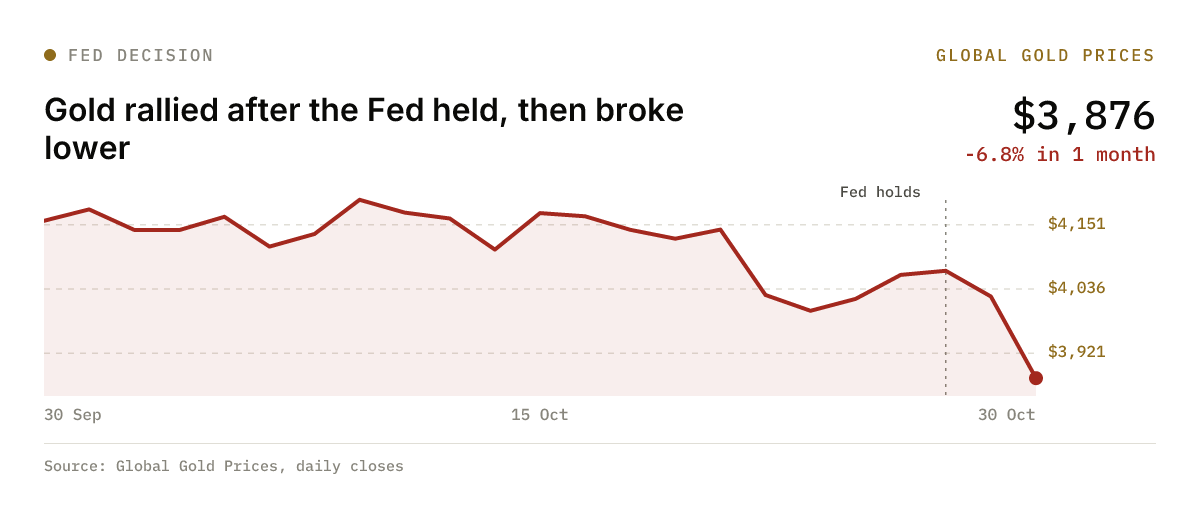
- Gold rose about 0.7% in the hours after the decision, then fell about 4.7% by Friday's close near $3,876
- Futures put the chance of a December hike near 76% by Friday, down from the mid 80s on the night
- Gold's 6.8% fall over the past month is steeper than about 94% of 30-day stretches since 1968, on our data
The Federal Reserve held interest rates at 3.75% to 4% on Wednesday, but two of the twelve voters wanted a hike, and Chair Kevin Warsh refused to rule one out for December. For the Fed and gold price, the split mattered more than the hold: gold rallied for two hours, then fell to a one-year low by Friday.
Why it matters: Gold pays no interest, so every hike makes holding it more expensive. A Fed that is arguing about how high to go, not when to cut, is the main reason gold is down about 29% from January's record.
What did the Fed decide?
The Federal Open Market Committee voted 10 to 2 to leave the federal funds target range at 3.75% to 4%, where it has sat since the 16 September meeting. That September move was the Fed's first increase since July 2023, passed 12 to 0, and the officials' median projection then pointed to a year-end rate of about 4.1%, which implies one more quarter-point rise before January.
Two people wanted that rise now. Cleveland Fed President Beth Hammack, a known hawk, was expected to push for it. Governor Lisa Cook was the surprise: governors rarely vote against the chair, and Cook had not dissented once since joining the board in 2022.
The statement itself leaned the same way. It kept the line that inflation "remains elevated" and upgraded its description of economic activity from "solid" to "strong", according to CNN's reading of the text. Nothing in it hinted at a pause in the tightening that began in September.
What did Warsh say at the press conference?
He refused to be pinned down, but almost everything he said pointed up. Asked whether the Fed was comfortable with inflation settling somewhere above its 2% goal, he answered: "If you think that we're tolerating some inflation target somewhere in the twos, let us disabuse you of it."
He also noted that inflation has run above the Fed's objective for close to six years, and he would not describe the current mix of yields, the dollar and credit as restrictive. "While overall financial conditions are tighter, I'm unwilling and unable to call them tight," he said, according to the Fed's preliminary transcript.
What he did not do was promise a December move. Reporters pointed out that most of his colleagues appeared ready to hike at the next meeting; Warsh said the committee was not on a preset course.
For gold, that combination is awkward. A chair who will not commit leaves the market to price the odds itself, and the odds were already high.
How did gold, the dollar and yields react?
Here is the sequence from our own intraday price data, which tracks spot gold minute by minute.
| Window | Gold | What else moved |
|---|---|---|
| Hour of the 2 pm decision | Dipped to about $4,030, then back to $4,041 | 2-year yield rose before easing |
| Next two hours | Climbed to a high near $4,081 | Dollar index slipped from a high near 102.3 |
| Wednesday New York close | About $4,069, up about 0.7% from the decision | Stocks closed higher |
| Thursday close | About $4,023 | Core PCE 3.1% a year |
| Friday close | About $3,876 | Dollar near 101.9, 2-year near 4.56% |
The first reaction was a relief rally. The statement was hawkish but expected, Warsh did not commit to December, and the dollar index fell about 0.35% from its Wednesday high to near 101.97 by Thursday morning, according to Vantage Markets. The 2-year Treasury yield, the most rate-sensitive part of the curve, ended Wednesday around 4.7%, slightly lower on the day after rising during the session, according to Daily Economics. Gold took the softer dollar as a cue and added about $27 from the decision to the close.
It did not last. Thursday's personal income and outlays report showed September PCE prices up 3.6% from a year earlier and 0.5% on the month, with the core measure at 3.1%, according to the Bureau of Economic Analysis. Gold slipped about 1.1% that day. Then on Friday it fell 3.6%, its biggest daily drop since March and bigger than 99% of daily moves since 1968 on our data, to close near $3,876.
The odd part is what did not happen on Friday. By the close, the dollar index was near 101.9 and the 2-year yield near 4.56%, both lower than on Wednesday, according to a market wrap from Capp Notes. A weaker dollar and lower short-term yields usually help gold. This time they did not, which tells us the selling was about something other than the Fed path alone.
Why did gold fall if yields and the dollar eased?
Three things were going on at once, and only one of them is the Fed.
The first is positioning. Gold had held around $4,000 for a week, and that round number had become a floor for many short-term traders. Once Friday's selling took it out in Asian hours, stop orders below it added to the move in New York, where most of the day's fall came after the US open on our intraday data.
The second is energy. Oil-led inflation is what pushed the Fed into hiking in September, and Friday's headlines were full of renewed Iran risk. Higher oil means higher inflation prints, which means more hikes. That chain hurts gold even when yields dip for a day.
The third is the Fed itself, read over a longer window. Gold closed near $4,328 on the day of the September hike. It is about 10% lower now. Over the past month it has lost 6.8%, a fall steeper than about 94% of 30-day stretches since 1968, on our price data. Markets that expected rate cuts in early 2026 are now pricing a second hike, and gold has been repricing with them.
Our read: the Fed meeting did not cause Friday's drop, but it removed the one thing that might have stopped it. A chair who had hinted at patience would have given gold a reason to hold $4,000. Warsh gave it the opposite.
What does a December hike mean for gold?
The next decision is due on 9 December. On Wednesday night, futures put the odds of a quarter-point hike between about 83% and 88%, depending on the source. By Friday they had eased to about 76%, according to the CME FedWatch reading cited by Capp Notes. That is still a strong expectation.
The useful question is what is already in the price. If the market is 76% sure of a hike, most of the damage from a hike is done. History offers a pattern rather than a rule: gold tends to fall into a hiking cycle and steady once the end is in sight. Our longer explainer on why gold falls when rates rise walks through the mechanics.
Three scenarios cover most of the ground.
A hike and a signal that it is the last. This is the outcome most likely to help gold. A rate near 4.25% with a clear pause would lower the risk of a third move, and real yields could ease. Gold has typically found buyers once the market can see the top of the cycle.
A hike with no signal. This is roughly what is priced now. Gold could drift rather than crash, because the move is expected, but the $4,000 area would stay hard to win back while the market wonders about a third hike in 2027.
A pause in December. Warsh's refusal to commit leaves this open, and a softer run of data in November could deliver it. A pause against 76% odds would be the biggest surprise, and gold's first reaction would likely be up, with the dollar down.
How has gold done in past hiking cycles?
Our price data covers the last three full Fed tightening cycles, and they make a useful check on the idea that hikes always sink gold.
| Cycle | Gold at first hike | Gold at last hike | Six months after the last hike |
|---|---|---|---|
| 2004 to 2006 | About $396 | About $589, up 49% | About $632, up 7% |
| 2015 to 2018 | About $1,075 | About $1,255, up 17% | About $1,344, up 7% |
| 2022 to 2023 | About $1,913 | About $1,966, up 3% | About $2,018, up 3% |
| 2026 so far | About $4,328 | Not over yet |
Two things stand out. Gold rose across two of the three cycles as a whole, because the hikes came with a weakening dollar or rising inflation that helped it. And in all three, gold was higher six months after the last hike than on the day of it, by 3% to 7% on our data.
The rough part of each cycle came early. In 2022 gold fell about 15% from the first hike in March to a low near $1,629 in November, as the dollar surged, before recovering once markets saw the end of the cycle. The current cycle looks like that early stage: gold is down about 10% since the September hike, with at least one more move priced.
The difference this time is the starting point. Gold went into the September hike after a record near $5,426 in January, so some of the fall is the unwinding of an overshoot rather than a pure rates effect. That makes the end of the cycle harder to call, but it also means the market has already taken a large slice of the pain.
The lesson from our data is about timing, not direction. Gold tends to bottom when the market can see the last hike, not when the hiking starts. If December delivers a hike with a clear signal that the Fed is done, the historical pattern would favour a recovery in the first half of 2027. If it does not, the early-cycle phase could run longer.
What decides it between now and December?
Data, mostly. The October jobs report is due on 6 November and the October consumer price index after it. With headline CPI at 3.7% in September and gasoline up 34% on the year, according to the Bureau of Labor Statistics, the question is whether energy prices feed into wages and services. If they do, Cook's dissent will look like an early vote for the majority.
There is also the inflation-adjusted picture, which is worse for gold than the headline. On our data gold is down about 3% over the past year while US consumer prices rose about 3.7%, so in real terms it has lost about 6.4%. That is the cost of holding a non-yielding asset when inflation and rates are both rising, and it is why a chair who says the Fed will not tolerate inflation "in the twos" matters for every ounce.
For a wider view of the forces at work, our guide to what moves the gold price sets the Fed beside the dollar, central bank buying and ETF demand. Before this meeting we laid out what gold needed to hear on Wednesday: a clear pause signal. It did not get one.
The bottom line
The Fed held, but it is a committee leaning toward another hike, with a chair who will not say otherwise. Gold took the first hours well and the next two days badly. Until December's decision, the price will trade on each data release as a vote for or against a hike, and the $4,000 level that held all week is now resistance rather than support.
What to watch
- 2 Nov: US ISM manufacturing survey, the first activity read after the meeting
- 6 Nov: US October jobs report, the biggest test of December hike odds
- 9 Dec: Fed decision, where a hike near 76% odds is the base case
More from the Macro & Policy desk
All Macro & Policy stories →Related reading
- Gold Performance 3rd November: gold price slips, US vote count up next
Tuesday 3 November: a firmer dollar and rising Treasury yields pulled gold back below $3,950 as Americans voted and bets on a December Fed hike climbed.
- Gold Performance 2nd November: gold price jumps 1.8%, US vote up next
Monday 2 November: a 7% slide in oil on hopes of US talks with Iran eased Fed hike bets and gave gold its best day since early September.
- Gold and inflation: why an energy shock is hurting gold
Gasoline is up 34% on the year and inflation is back near 4%, yet gold is down. The answer is in how the Fed responds, and history shows both outcomes.