

Germany's gold reserves lose about €14bn in a day
Friday's fall cut the euro value of the Bundesbank's 3,350 tonnes by about €14bn, two weeks after the Bundestag debated bringing all of it home.
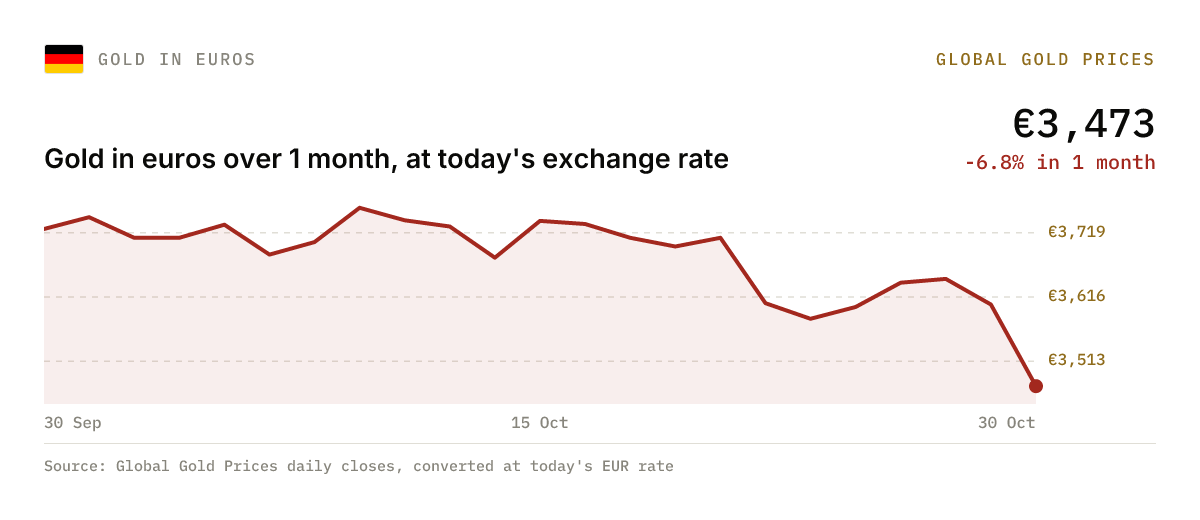
Germany's gold reserves, about 3,350 tonnes held by the Bundesbank, lost roughly €14 billion in value on Friday as world gold fell 3.6%. On our calculation the stock was worth about €388 billion at Thursday's close and about €374 billion at Friday's, measured at today's exchange rate.
Why it matters: Germany holds the second biggest gold reserve in the world, after the United States. A swing of €14 billion in a day shows how much of the national balance sheet now moves with the gold price, and why where it is stored has become a political question.
| Holder | Tonnes | Value at Friday's close |
|---|---|---|
| Germany (Bundesbank) | about 3,350 | about €374bn |
| Italy (Banca d'Italia) | about 2,452 | about €274bn |
| France (Banque de France) | about 2,437 | about €272bn |
Italy and France, the next two in Europe, hold reserves of almost the same size as each other, on our reserves table, and lost about €10 billion each on the day by the same calculation.
Where does the Bundesbank keep its gold?
About half at home. German reports put roughly 1,710 tonnes in Frankfurt, about 1,236 tonnes at the Federal Reserve Bank of New York and about 405 tonnes at the Bank of England in London. A motion debated in the Bundestag this autumn noted that about 51% of the reserve sits in Germany.
The Bundesbank brought home large amounts between 2013 and 2017, after an earlier public campaign, and has since said it sees no need for more. It argues that gold kept in New York and London can be sold or swapped quickly in a crisis, in the world's two biggest gold markets.
Did the Bundestag vote to bring it home?
The AfD's motion, titled "Deutsches Staatsgold vollständig nach Deutschland holen", asked the government to agree a timetable with the Bundesbank to repatriate all gold held abroad. The Bundestag's finance committee recommended rejecting it, and the house was due to decide on 14 October after a half-hour debate, according to the Bundestag. A precious metals trader's report said the motion was rejected with only the AfD in favour.
Opponents called the plan alarmist. SPD finance politician Frauke Heiligenstadt said Germany's reserves were well diversified, according to German press reports. Handelsblatt reported that part of the holding sits with the Fed in New York and the Bank of England, which is the point of contention.
Why does the price drop matter to Germany?
On paper only, for now. The Bundesbank does not sell gold, and valuation changes flow through its revaluation accounts rather than straight into the federal budget. But the swings shape the debate. A reserve that rises and falls by tens of billions of euros in a week keeps the question of where it is stored, and who can reach it in a crisis, in the news.
For euro investors, Friday's close near €3,473 an ounce left gold below where it stood when we looked at gold in euros after the ECB's 29 October decision. Our explainer on why central banks buy gold sets out why reserve managers hold it through swings like this.
More from the Europe desk
All Europe stories →Related reading
- Gold Performance 3rd November: gold price slips, US vote count up next
Tuesday 3 November: a firmer dollar and rising Treasury yields pulled gold back below $3,950 as Americans voted and bets on a December Fed hike climbed.
- Gold Performance 2nd November: gold price jumps 1.8%, US vote up next
Monday 2 November: a 7% slide in oil on hopes of US talks with Iran eased Fed hike bets and gave gold its best day since early September.
- Gold and inflation: why an energy shock is hurting gold
Gasoline is up 34% on the year and inflation is back near 4%, yet gold is down. The answer is in how the Fed responds, and history shows both outcomes.