

Gold premium over spot: why you pay more
Dealer markups, making charges and tax explained, with typical ranges by product and what a $4,200 gold price means in the US, Dubai, India and the UK.

Key points
- Bullion buyers pay spot plus a premium: about 1% to 3% on a kilo bar and 3% to 8% on a 1 oz coin
- Jewellery adds making charges, typically 5% to 8% in Dubai and 8% to 25% in India
- Tax does the rest: no VAT on investment gold in the UK or the UAE, but about 15% duty and 3% GST in India
- On our data since 1968, gold gained 5% or more in only about 17% of 30-day stretches
The gold premium over spot is the extra you pay above the market price of the metal itself. With spot near $4,200 an ounce, as in October 2026, a 1 oz bullion coin typically costs 3% to 8% more, roughly $125 to $335, while a kilo bar costs only 1% to 3% more.
Nobody buying a coin, a small bar or a ring pays the spot price. The gap pays for turning wholesale metal into something you can hold, for getting it to you, and for the tax your country charges. This guide breaks down each part, gives the typical ranges, and works through what a $4,200 gold price means at the counter in the US, Dubai, India and the UK.
What is the spot price, and why can't you buy at it?
Spot is the price for immediate delivery of large wholesale bars, the 400-ounce bars banks trade with each other in London. It is the number on our live charts and in our daily report on where gold is trading.
You cannot buy a single coin at that price for the same reason you cannot buy one egg at the wholesale price per tonne. Someone has to refine the metal, strike or cast it into a small piece, insure it, ship it and hold stock. Each step adds cost, and the smaller the piece, the more those fixed costs weigh per gram.
What makes up the premium?
Four things, in roughly this order of size:
- Fabrication: refining, rolling, minting or casting, and assay. This is why a 1 g bar costs far more per gram than a kilo.
- Mint markup. The United States Mint does not sell its bullion coins to the public; it sells to a network of authorized purchasers at the metal price plus what it calls a modest premium for minting, distribution and marketing.
- Dealer margin, plus shipping, insurance and card fees.
- Supply and demand. When buyers rush in, small coins and bars sell out and premiums climb even if spot is falling.
The size effect starts at the mint. USAGOLD, a US dealer, reports that the Mint charges its big buyers about 3% over the London price for a 1 oz Gold Eagle but about 9% for a tenth of an ounce. Retail margins then sit on top of that.
How much is the premium on gold bars and coins?
The table shows typical US retail ranges in normal markets, combining two dealer surveys (metalcharts.org and Gold Silver Select). The dollar column is ours, worked out at a gold price of $4,196 an ounce, the 9 October 2026 close.
| Product | Typical premium | Extra paid per piece at $4,196 an ounce |
|---|---|---|
| 1 kg bar | 1% to 3% | about $1,350 to $4,050 |
| 10 oz bar | 1% to 3% | about $420 to $1,260 |
| 1 oz bar | 2% to 5% | about $85 to $210 |
| 1 oz Krugerrand | 2% to 5% | about $85 to $210 |
| 1 oz Maple Leaf or Philharmonic | 3% to 6% | about $125 to $250 |
| 1 oz Gold Eagle, Buffalo or Britannia | 3% to 8% | about $125 to $335 |
| 10 g bar | 5% to 8% | about $67 to $108 |
| 1 g bar | 10% to 18% | about $13 to $24 |
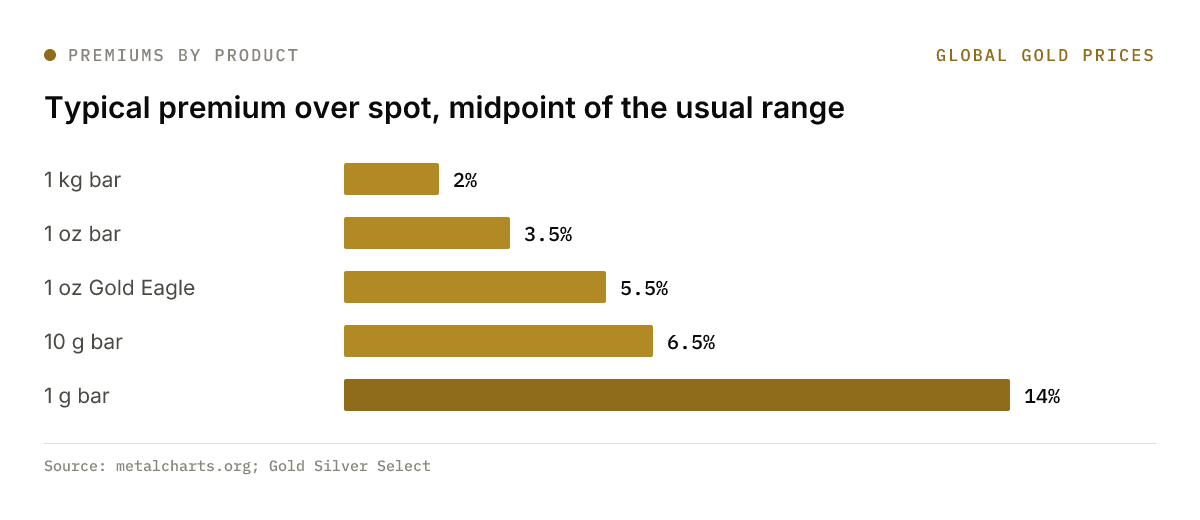
Look at the extremes per gram. By our calculation, the premium on a 1 g bar works out at $13 to $24 for each gram of gold, against roughly $1.35 to $4 a gram on a kilo bar. Same metal, up to 18 times the markup.
Famous government coins such as the Gold Eagle and the Britannia usually cost more than a Krugerrand or a plain bar of the same weight, because buyers pay for recognition and the coin is easier to resell. That premium partly comes back when you sell, so it is not all lost.
Why do premiums jump when gold is in demand?
Because mints and refiners cannot make small pieces faster just because more people want them. When retail demand outruns production, dealers raise premiums to ration stock. This often happens when spot is falling, since bargain hunters pile into dips. In the March 2020 panic, premiums on retail silver roughly tripled at the peak.
The other trap is the collectible pitch. The US Commodity Futures Trading Commission has warned about salespeople pushing "rare" coins at premiums of 40% to 200% over the metal value. For an investor, a coin's value is its gold, plus a small, resaleable premium.
What is the buy and sell spread?
The spread is the gap between what a dealer charges you and what the same dealer pays you. Dealers sell above spot and buy below it, or at best around it. A widely traded coin such as a Sovereign may be bought back at spot or a little above; a generic round a little below; scrap jewellery well below its melt value.
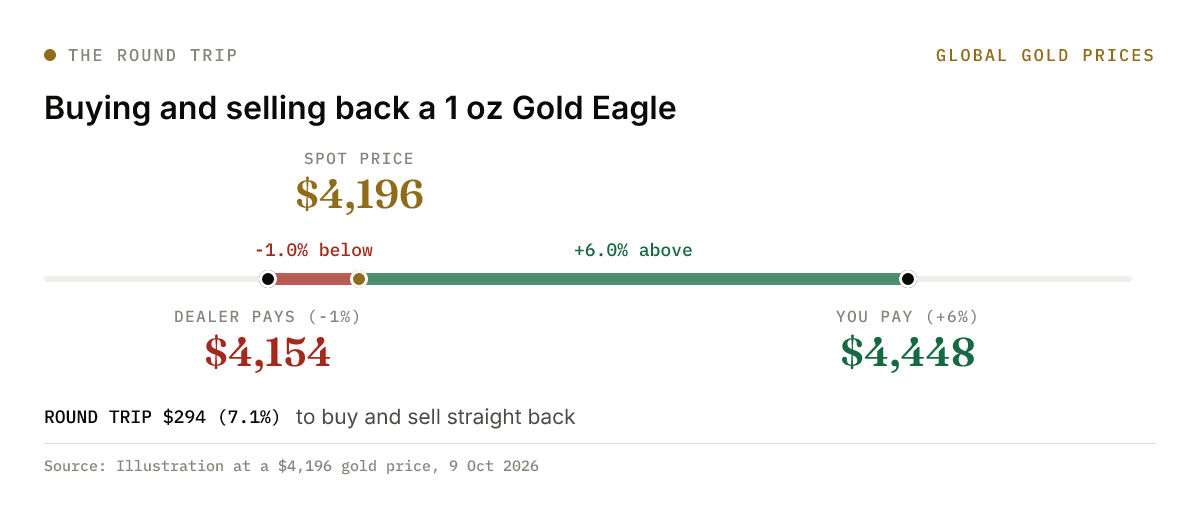
Your real cost is the round trip: the premium you paid plus any discount when you sell. Buy a 1 oz Gold Eagle at 6% over spot and sell it back to a dealer paying 1% under spot, and gold has to rise about 7% before you break even.
How long might that take? On our price data going back to 1968, gold rose 5% or more over a 30-day stretch only about 17% of the time. Over 12-month stretches, it gained 8% or more in about 46% of them. In other words, a small coin is a buy for years, not weeks. If you mainly want price exposure, compare the costs in our guide to gold ETFs, physical gold and gold bonds.
How do making charges on gold jewellery work?
Making charges are the jeweller's fee for design and labour, added on top of the metal value. They are the biggest single reason jewellery costs more than bullion.
- India: typically 8% to 25% of the gold value, according to Angel One. IIFL puts plain chains at 6% to 14%, bangles at 6% to 10%, kadas at 10% to 16% and rings at 14% to 25%.
- Dubai: usually lower, often 5% to 8%, and as little as 10 to 20 dirhams a gram for simple designs.
Jewellery is also usually 22K, 21K or 18K, so check you are paying for the purity you get; our primer on what each karat means for the price has the per-gram maths. Making charges rarely come back when you sell. A buyer pays for the gold content, often less a deduction.
What taxes and duties apply in the UAE, India, the UK and the US?
Tax can add more than the premium itself, and the rules differ between bullion and jewellery.
| Country | Investment bars and coins | Jewellery |
|---|---|---|
| UAE | 0% VAT on gold of 99% purity or more | 5% VAT; tourists can claim it back |
| India | About 15% customs duty, then 3% GST | Same, with 5% GST on making charges billed separately |
| UK | VAT exempt | 20% VAT |
| US | No sales tax in most states; 7 states and Washington DC charge it | State sales tax |
UAE
Investment-grade gold of 99% purity or more is zero rated, so bars and coins carry no VAT. Jewellery and anything below that purity pays the standard 5%. Visitors can reclaim VAT on jewellery from retailers in the Tax Refund for Tourists Scheme, provided they validate the purchase when leaving the country and take the goods out within 90 days.
India
Imported gold now carries an effective duty of about 15%. On 13 May 2026 the government raised the basic customs duty from 5% to 10% and lifted the agriculture infrastructure cess on top, according to Business Today, up from 6% in all before. GST of 3% applies on top. On jewellery, if making charges appear as a separate line they attract 5% GST; on a single combined invoice, 3% applies to the whole bill. Indian prices also swing between a premium and a discount to the landed price as local demand rises and falls.
UK
HM Revenue and Customs treats investment gold as exempt from VAT. That covers bars of at least 99.5% purity in weights the bullion market accepts, and coins minted after 1800 that are at least 90% pure, are or were legal tender, and normally sell for no more than 180% of their gold value. Jewellery pays the full 20%. Sovereigns and Britannias have a second advantage: as UK legal tender, gains on them are free of capital gains tax.
US
There is no federal sales tax on gold. By one dealer count, 44 states now exempt investment-grade bullion, while Hawaii, Maine, Maryland, New Mexico, Rhode Island, Vermont, Washington and Washington DC still charge full sales tax. Some exemptions only apply above a minimum, such as $2,000 per purchase in California and $1,000 in New York, so check your state before you buy.
Worked example: what $4,200 gold means at the counter
First, the metal value before any premium, from our prices at the 9 October 2026 close and that week's exchange rates:
| Gold before premiums, 9 October 2026 | Price |
|---|---|
| 24K, US dollars per gram | about $135 |
| 24K, dirhams per gram | about AED 495 |
| 22K, dirhams per gram | about AED 454 |
| 24K, rupees per 10 g at the world price | about ₹130,600 |
| 24K, rupees per 10 g with 15% duty and 3% GST | about ₹154,700 |
| Pounds per ounce | about £3,170 |
| Euros per ounce | about €3,740 |
Now three typical purchases.
- A 1 oz Gold Eagle in a US state with no sales tax, at a 6% premium: about $4,450, or roughly $250 above spot.
- A 20 g, 22K chain in Dubai: gold worth about AED 9,080, making charges of about AED 300 at 15 dirhams a gram, then 5% VAT of about AED 470. Total: about AED 9,850, or 8.5% above the metal value. A tourist who claims the VAT back pays about 3% over the metal.
- The same 20 g, 22K chain in India: gold worth about ₹239,500 at the world price, about ₹275,400 after the 15% duty, making charges of 12% (about ₹33,100), then 3% GST on the invoice (about ₹9,300). Total: about ₹317,700, some 33% above the metal at the world price, before any local premium or discount.
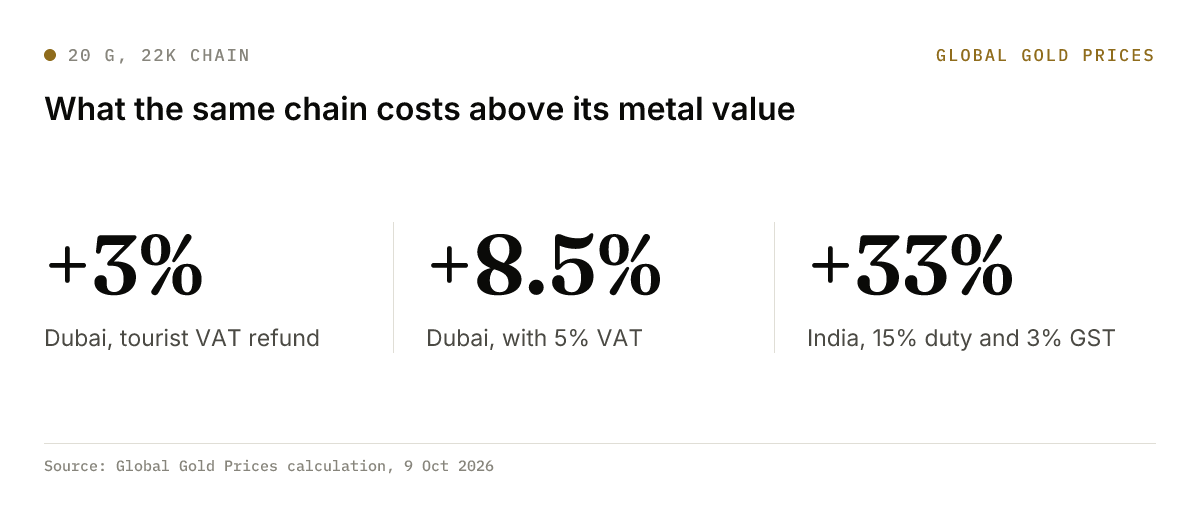
The same chain costs about 8.5% over the metal in Dubai and about 33% in India. That gap, mostly duty and making charges, is why so many Indian buyers shop in the Gulf.
How can you pay less over spot?
- Buy bigger. Premiums per gram fall sharply with size. If you can afford a 1 oz coin, it beats ten tenth-ounce coins.
- Choose common products. Krugerrands, Maple Leafs and plain bars from accredited refiners usually carry less than famous coins, and avoid "collectible" pitches.
- Ask for the buyback price before you buy. A dealer with a narrow spread costs less over the round trip than one with a low headline premium.
- Use the tax rules. In the UK, Sovereigns and Britannias are VAT and capital gains tax free; in the UAE, tourists can claim VAT back on jewellery; in the US, check your state's threshold.
- For jewellery, pick plain designs. Chains and bangles carry lower making charges than rings and detailed sets, and making charges are often negotiable per gram.
- Shop when retail is quiet. Premiums spike in panics and dips, so the calm weeks are often the cheapest.
- If you do not need the metal in your hand, an ETF or a bullion account can cost far less. Our guide to allocated and unallocated gold explains what you own in each.
Latest from our desks
- Gold tests the top of its October range near $4,200: where spot has been trading.
- Gold ETF vs physical gold vs gold bonds: the cost of owning gold three ways.
- Allocated vs unallocated gold: who owns the bars behind a bullion account.
- How we price gold by karat: purity and price per gram for each karat.
- Sovereign Gold Bonds: closed to new issues: what Indian savers can use instead.
Frequently asked questions
+What is a normal gold premium over spot?
In normal markets, about 1% to 3% on a kilo bar, 2% to 5% on a 1 oz bar or Krugerrand and 3% to 8% on famous 1 oz coins such as the Gold Eagle. Small 1 g bars can carry 10% to 18%.
+Why is gold jewellery more expensive than gold bars?
Jewellery adds making charges, typically 5% to 8% in Dubai and 8% to 25% in India, and is taxed more heavily: 5% VAT in the UAE and 20% in the UK, where investment gold pays none.
+Do you get the premium back when you sell gold?
Mostly not. Dealers buy popular coins at around spot and generic pieces a little below it, so a coin bought at 6% over spot needs gold to rise about 6% to break even, and more if the dealer pays below spot.
+Is there VAT on gold in Dubai?
Gold of 99% purity or more is zero rated, so bars and coins carry no VAT. Jewellery pays 5%, which tourists can claim back if the shop is in the Tax Refund for Tourists Scheme.
+How much tax is on gold in India?
Since 13 May 2026 imported gold pays an effective customs duty of about 15%, up from 6%, and then 3% GST. Making charges billed as a separate line attract 5% GST.
Related reading
- A weak monsoon is the quiet risk to India's Diwali gold season
Rural buyers drive over half of India's gold demand, and this year's monsoon ran 15% below average. Jewellers are split on whether Diwali volumes will fall.
- How to sell gold and get a fair price
Melt value by karat at this week's price, what each kind of buyer pays, hallmarks, tax by country and the warning signs at the counter.
- Gold holds above $4,150 as the dollar climbs
At 5.22% yields and a rising dollar, gold would normally be crumbling. Central-bank buying is rewriting the playbook.