

Gold Performance 4th November: gold price jumps 3.3%, BoE up next
Wednesday 4 November: Democrats took both houses of Congress, the dollar and yields fell, and gold had its best day since mid-June, back above $4,000.
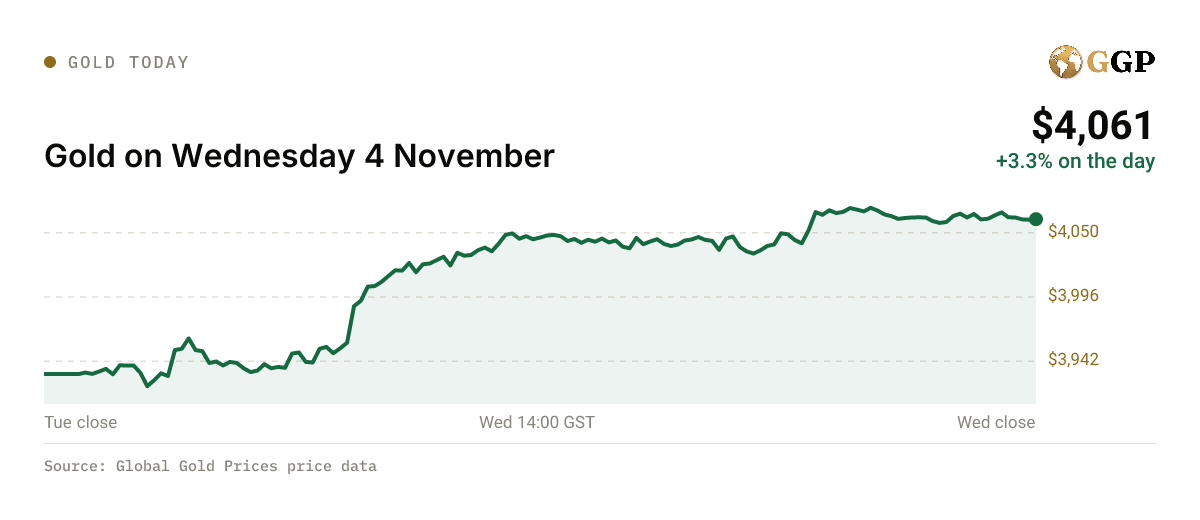
The gold price closed at about $4,061 an ounce on Wednesday 4 November, up roughly $130, or 3.3%, from Tuesday's close. Democrats won control of both the House and the Senate in the US midterm elections, the dollar and Treasury yields fell, and gold had its strongest day since mid-June.
Where the move happened
Almost all of it came before New York woke up. Gold reopened near $3,930 on Tuesday evening and drifted for a few hours while the first results came in. Then, as Asian trade got going and it became clear Democrats were winning seats in Republican strongholds, buyers rushed in. Gold added about $90 during Asian hours, including roughly $47 in a single hour, and crossed $4,000 for the first time since last Thursday.
London added a little under $20, with the price holding in a tight band just above $4,040 through the morning. New York pushed it on again by about $18, to a high near $4,070 around midday, before it settled back slightly into the close.
Why gold jumped
The election result. A split government makes it harder for the White House to pass tax and spending plans without deals. Hamad Hussain, senior economist at Capital Economics, told Reuters that "the elections appear to have boosted gold prices as investors become more worried about the fiscal outlook". He added that a hawkish Federal Reserve still limits how far gold can run.
A softer dollar and lower yields. The dollar index fell about 0.6% to near 101.3, its lowest in a month, and the 10-year Treasury yield slipped to about 4.92%. A cheaper dollar makes gold cheaper for buyers paying in other currencies, and lower yields cut the cost of holding a metal that pays no interest. Silver did even better, rising almost 5% to about $52.
Iran is not settled. A senior Iranian official said Tehran and Washington remain far from a deal to end their war, even as Qatar tries to restart talks. That kept a floor of demand under gold for protection.
What did not change is the Fed. Futures still put the chance of a rate hike at the 8 to 9 December meeting at about 82%, on CME FedWatch, after two policymakers voted for a hike last week (see our Fed decision story).
How big a day was this?
Big. On our data since 1968, a 3.3% daily rise is bigger than 98.8% of trading days, and it is only the sixth rise of this size or more in 2026. It also brings gold up about 4.8% this week, after Friday's one-year low and Tuesday's small slip (Gold Performance 3rd November).
Context matters, though. Gold is still about 25% below January's record of roughly $5,426, and below its 50-day average near $4,220.
Up next: what to watch tomorrow
- Thu 5 Nov, Bank of England decision: The decision comes at noon London time. Norway's Norges Bank also decides in the morning.
- Thu 5 Nov, US jobless claims: weekly claims at 8:30 am New York time, expected near 197,000, alongside preliminary third-quarter productivity.
- Fri 6 Nov, US jobs report: the October payrolls figures are the next big test for December hike bets, and for whether gold can hold above $4,000.
More from the Markets desk
All Markets stories →Related reading
- Gold Performance 3rd November: gold price slips, US vote count up next
Tuesday 3 November: a firmer dollar and rising Treasury yields pulled gold back below $3,950 as Americans voted and bets on a December Fed hike climbed.
- Gold Performance 2nd November: gold price jumps 1.8%, US vote up next
Monday 2 November: a 7% slide in oil on hopes of US talks with Iran eased Fed hike bets and gave gold its best day since early September.
- Gold and inflation: why an energy shock is hurting gold
Gasoline is up 34% on the year and inflation is back near 4%, yet gold is down. The answer is in how the Fed responds, and history shows both outcomes.