

How to tell if gold is real: hallmarks and tests
What the stamps mean in the UK, India and the UAE, which home tests are worth doing, and why a tungsten core needs a lab.
Key points
- A hallmark from an official assay office is the best quick proof that gold is real
- India requires a six-digit HUID code on hallmarked jewellery, checkable on the BIS Care app
- Magnet, acid and X-ray tests read the surface only; a tungsten core needs ultrasound
- A 750 stamp means 18 karat, which holds about 18% less gold than a 916 (22 karat) piece
How to tell if gold is real: start with the hallmark, a purity number such as 916 or 750 plus the mark of an official assay office. Home tests help rule out obvious fakes, but only a professional test can see inside a bar or coin, which is where the best forgeries hide their tungsten.
This guide explains what the marks mean in the three markets our readers buy in most, the UK, India and the UAE, which home tests are worth doing, and when to pay for a lab check. For what the karat numbers mean for price, see our guide on how we price gold by karat.
What does a gold hallmark tell you?
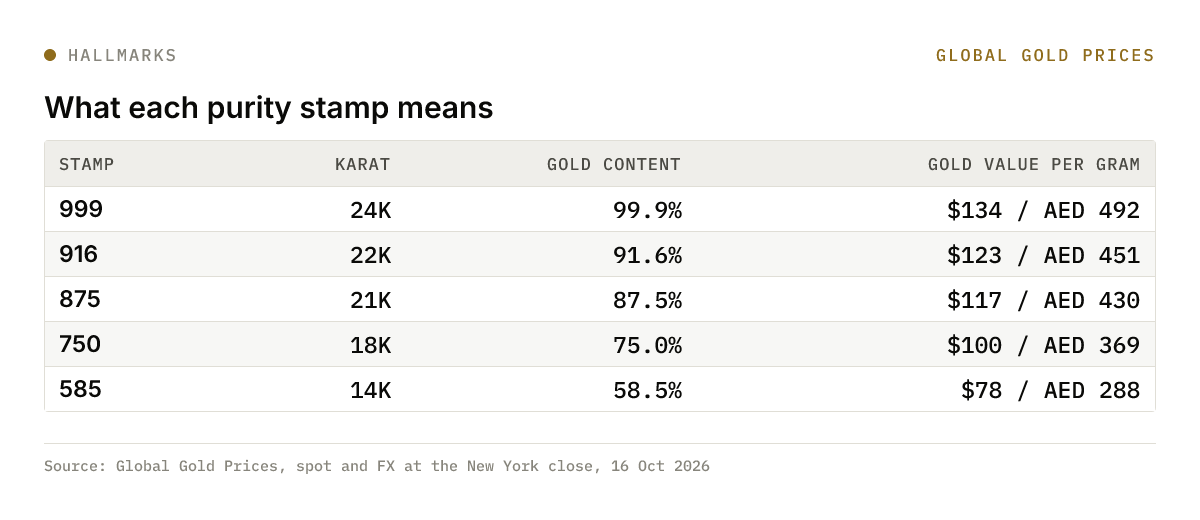
A hallmark tells you two things: how much of the metal is pure gold, and who tested it. The purity is written in parts per thousand, so 916 means 916 parts in 1,000 are gold, which is 22 karat. 750 is 18 karat, 585 is 14 karat and 375 is 9 karat. 999 is fine gold, the purity of most bars.
The second part matters as much. A number such as 750 stamped by the maker on its own is a claim. A number struck by an independent assay office, a lab licensed by the state to test precious metals, is a check. In most countries with hallmarking laws the two appear side by side: the maker's or sponsor's mark, the fineness number, and the assay office symbol.
That difference is worth real money. On our price data, the gap between a 916 and a 750 stamp was worth about AED 82 a gram of jewellery in mid-October 2026. On a 20 gram bangle that is roughly AED 1,640 of gold, which is why a wrong stamp is the most common way buyers are short-changed.
How do UK hallmarks work?
The UK has four assay offices: London, Birmingham, Sheffield and Edinburgh. Each strikes its own town mark. London's is a leopard's head, used since the 14th century. A legal UK hallmark carries three compulsory marks: the sponsor's mark (usually initials in a shield), the millesimal fineness mark in a shaped cartouche, and the assay office mark. A date letter is optional now.
The recognised gold standards are 375, 585, 750, 916, 990 and 999. If a piece sold in the UK is described as gold and is above a minimum weight, it must carry these marks by law. Older pieces may show the carat in words, such as 18 or 22, with a crown symbol for gold.
What is the HUID code on Indian gold?
India made hallmarking compulsory in stages, and the sixth phase in March 2026 widened it to 380 districts, according to the government's broadcaster. It covers six purities of gold jewellery: 14, 18, 20, 22, 23 and 24 karat. A 9 karat grade can be hallmarked but is voluntary.
Since 1 April 2023, hallmarked jewellery sold in India must carry a Hallmark Unique Identification, or HUID: a six-digit code made of letters and numbers, given to each piece at the assay centre. You can type it into the Bureau of Indian Standards' BIS Care app to see the item's purity, type and the jeweller who registered it. If the app shows a different purity or item, do not buy.
A full Indian hallmark has three parts: the BIS logo (a triangle), the purity grade (for example 22K916) and the HUID. Older pieces bought before the HUID rule may carry a four-digit code or a jeweller's own stamp; they can still be sold back, but they cannot be resold as new stock without a fresh hallmark. Our guide on how to sell gold covers what buyers check.
How is gold hallmarked in Dubai and the UAE?
Gold, silver and platinum jewellery sold in the UAE must carry a UAE hallmark issued through assay offices approved by the Emirates Authority for Standardization and Metrology. In Dubai the testing is done by the Dubai Central Laboratory, part of Dubai Municipality. The common fineness marks are 999 for 24 karat, 916 for 22 karat, 875 for 21 karat, 750 for 18 karat and 375 for 9 karat.
Dubai shops price jewellery by the gram at the day's rate for each karat, plus a making charge. At mid-October 2026 prices, a gram of 22 karat was worth about AED 451 in gold content, and a gram of 21 karat about AED 430, on our calculation from the spot price and the dirham's fixed rate. A quote far below those figures for the same karat is a warning sign, not a bargain.
| Stamp | Karat | Gold content | Gold value per gram, mid-October 2026 |
|---|---|---|---|
| 999 | 24K | 99.9% | about $134 / AED 492 |
| 916 | 22K | 91.6% | about $123 / AED 451 |
| 875 | 21K | 87.5% | about $117 / AED 430 |
| 750 | 18K | 75.0% | about $100 / AED 369 |
| 585 | 14K | 58.5% | about $78 / AED 288 |
| 375 | 9K | 37.5% | about $50 / AED 184 |
The values are the gold content only, before making charges and dealer premiums, worked out from our spot price of about $4,166 an ounce at the 16 October New York close and the dirham's fixed rate of 3.6725. Why shops charge more than this is covered in our guide to gold premiums over spot.
Which home tests actually work?
Home tests can catch cheap fakes. None of them proves a valuable piece is genuine.
- Read the marks with a magnifier. Blurred, uneven or misspelt stamps, or a fineness number with no assay mark, are the first warning.
- Try a strong magnet. Gold is not magnetic, so if the piece jumps to the magnet it is not solid gold. If it does not react, that proves little: many cheap metals are not magnetic either.
- Weigh it and measure it. Gold is very dense, so a fake made of brass or steel will be too light for its size. A kitchen scale accurate to 0.01 gram and the published size of a standard coin or bar will catch most of these.
- Look at the edges and wear points. Plated jewellery often shows a different colour where the plating has rubbed off, at clasps and on the inside of rings.
The acid test, where a jeweller rubs the item on a dark stone and drops acid on the streak, is more reliable than a magnet. Xetra-Gold's guide notes that it still tests only the surface. A thick layer of real gold over a cheaper core passes it.
How do professionals test gold bars and coins?
Professionals combine methods because each one sees a different layer. An X-ray fluorescence (XRF) scanner reads the elements in the surface in seconds without damage, but if the outer layer of real gold is thick enough, it misses what is underneath.
That is the weakness forgers exploit. Tungsten is almost exactly as dense as gold and costs a tiny fraction as much, so a bar with a tungsten core can have the right size and weight. Ultrasound testing sends sound waves through the metal and shows a core of a different material, and conductivity testing does the same job in a different way. Melting and assaying is final, and it destroys the piece.
For bars, a good first check is the refiner. Large bars traded between banks must come from refiners on the London Bullion Market Association's Good Delivery list, whose rules were last revised in January 2026. Small retail bars from the same refiners usually carry a serial number and come sealed with an assay card. Industry executives quoted by Reuters have said in the past that most counterfeit bars that reach the market enter through dealers in Hong Kong, Japan and Thailand, a claim the Shanghai Gold Exchange has disputed.
What should you do if you think your gold is fake?
Stop before you sell or buy more. Take the piece to an assay office or a dealer with an XRF machine and ask for a written result; many charge a small fee or test free if you then sell to them. In India, check the HUID on the BIS Care app and report a mismatch to the Bureau of Indian Standards. In the UAE, keep the invoice: licensed retailers must itemise the karat, weight and making charge, and the hallmark on the piece should match it.
For a bar or coin worth thousands, pay for an ultrasound or conductivity test before you hand over the money, or buy only from a dealer who will buy it back at a published spread. A low price on a "999" bar from a seller with no buyback is the most common route into a fake.
Frequently asked questions
+Does a 999 stamp prove a gold bar is real?
No. A stamp is the maker's claim. Look for a recognised refiner, a serial number and a sealed assay card, and have a valuable bar tested by XRF and ultrasound.
+How do I check a HUID number in India?
Enter the six-digit HUID in the BIS Care app. It should show the same purity and type of item as the piece in your hand; a mismatch is a reason not to buy.
+Is the magnet test reliable for gold?
Only for ruling things out. Gold is not magnetic, so a piece that sticks to a strong magnet is not solid gold, but a piece that does not stick can still be fake.
+What does 916 mean on gold jewellery?
916 means 91.6% pure gold, which is 22 karat. At mid-October 2026 prices, a gram of 22 karat held about $123 of gold, on our calculation.
Related reading
- Gold Performance 3rd November: gold price slips, US vote count up next
Tuesday 3 November: a firmer dollar and rising Treasury yields pulled gold back below $3,950 as Americans voted and bets on a December Fed hike climbed.
- Gold Performance 2nd November: gold price jumps 1.8%, US vote up next
Monday 2 November: a 7% slide in oil on hopes of US talks with Iran eased Fed hike bets and gave gold its best day since early September.
- Gold and inflation: why an energy shock is hurting gold
Gasoline is up 34% on the year and inflation is back near 4%, yet gold is down. The answer is in how the Fed responds, and history shows both outcomes.