

Jobs report and gold price: payrolls back a Fed hike
October's 165,000 jobs kept a December Fed hike close to priced in, and gold's dip was bought within hours.
Key points
- US employers added 165,000 jobs in October, against forecasts near 65,000
- Unemployment fell to 4.1%, and December Fed hike odds stayed near 75%
- Gold fell to about $4,033 after the release, then closed down 0.4% near $4,072
- Tuesday's October CPI is the next test for the December decision
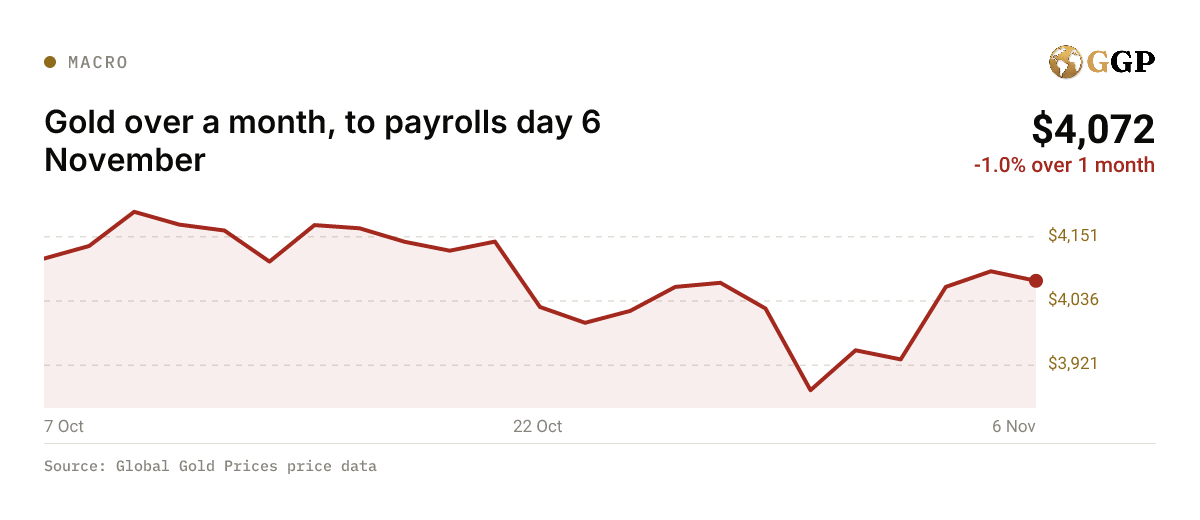
The jobs report and gold price moved in opposite directions on Friday. US employers added 165,000 jobs, more than twice the 65,000 forecast, and gold fell to about $4,033 before recovering to close near $4,072, down 0.4% on the day. A December Fed hike now looks likely, which is the main weight on gold.
Why it matters: Gold pays no interest, so every hint of higher US rates raises the cost of holding it. A strong labour market gives the Fed room to hike again, and that is what kept Friday's bounce small.
| Point | Price |
|---|---|
| 7 Oct | $4,112 |
| 22 Oct | $4,025 |
| 6 Nov | $4,072 |
| High | $4,196 |
| Low | $3,876 |
| Change over the chart | -0.97% |
What did the October jobs report show?
The Bureau of Labor Statistics said nonfarm payrolls rose by 165,000 in October, Kitco reported, well above the 65,000 economists had pencilled in. The unemployment rate fell to 4.1%, CNBC reported. Both numbers point the same way: the labour market is not cooling fast enough to let the Fed relax.
That matters because the Fed is already leaning towards a hike. At its 28 October meeting it held rates, but two members voted for an increase, as we reported in what the Fed's two hike votes mean for gold. Friday's report gives those two hawks fresh evidence.
How did gold trade on jobs day?
The move came fast and then faded, on our intraday price data. Gold was trading around $4,064 through the London morning. Within the hour of the 8:30 am New York release it had dropped below $4,050, and the day's low was about $4,033.
Then buyers returned. Gold climbed back through the New York afternoon and finished near $4,072. From the low to the close it regained about 53% of the day's high-to-low range, by our calculation from the intraday data. That recovery tells you the dip was bought, even with the dollar firm.
The dollar rose 0.7% to its highest level since 29 October, CNBC reported, and the 10-year Treasury yield traded near 4.88%, according to Schwab. A stronger dollar makes gold dearer for buyers outside the US, and higher yields make interest-paying assets more attractive than metal.
Why didn't gold fall further?
Three things cushioned it. First, gold had just had its best week since August, up 5.1% from the one-year low of about $3,876 on 30 October, so plenty of buyers were already positioned for a rebound. Second, the midterm result earlier in the week had pulled Treasury yields lower, and Friday only reversed part of that move.
Third, the hike was already priced. The CME FedWatch tool showed odds of a December increase near 75% after the report, little changed from where they stood before it. Markets do not move much on news they already expect.
There is a volatility angle too. Gold's 30-day realised volatility is running at about 24% a year, against a long-run average near 14% since 1990, on our price data. In a market that jumpy, a $40 intraday drop is a normal day, not a shock.
What does a December hike mean for gold?
A hike would lift the yield on cash and short-term Treasury bills, which compete with gold for safe money. Our explainer on why gold falls when rates rise walks through the maths: the higher the risk-free rate, the more an investor gives up by holding metal.
Yet the link is not mechanical. Gold also responds to the dollar, to central bank buying and to fear. The People's Bank of China added gold for a 24th straight month in October, and Poland's central bank said this week it had reached 700 tonnes. That official buying sets a floor that rate hikes alone have not broken.
For US buyers, the gold price in the US page tracks the dollar figure through the day.
What would change the picture?
Two things could undo the hike case before December. A soft CPI figure on Tuesday would be the quickest. Forecasters expect a rise of about 0.3% on the month, CMC Markets said, slowing from 0.6% in September. A lower figure would ease pressure on the Fed and help gold.
The other is a weaker run of data in the following weeks. One strong jobs report does not make a trend, and weekly jobless claims on Thursday will be the first check. If claims rise, the market may start to doubt the hike again.
Has this happened before?
Yes, and recently. In May, the April jobs report showed 115,000 new jobs against a consensus near 55,000, GoldSilver reported, and gold held above $4,700 while the dollar sold off. Two strong reports six months apart, two muted reactions in gold.
The difference this time is the starting point. In May the Fed was debating whether to hike at all. Now two members have already voted for a rise and the market has priced one in, so a strong jobs number confirms what traders already expect rather than changing it. Our coverage of the previous jobs report showed a similar pattern: the bigger move in gold came in the days after the release, not in the first hour.
The risk runs the other way too. A hot CPI figure on top of Friday's jobs data would make a December hike close to certain, and could push gold back towards $4,000.
What to watch
- 10 Nov: US October CPI, the main test for a December hike
- 12 Nov: US weekly jobless claims, a check on Friday's strength
- 13 Nov: US October PPI, which feeds into the Fed's preferred inflation gauge
More from the Macro & Policy desk
All Macro & Policy stories →Related reading
- China gold reserves: PBOC adds 26t, nears France
The People's Bank of China bought its most gold in three years as prices fell almost 7% in October, extending its streak to 24 months.
- Gold technical analysis: $4,200 is the line to beat
The rebound from the one-year low has met the first resistance; the 50-day and 200-day averages show what it has to do next.
- Gold price this week: best week since August, CPI next
The gold price rose about 5% this week to near $4,072, its best week since August, as the US midterm elections, a Bank of England rate rise and the jobs report moved markets. Next up: US inflation data on Tuesday.