

Gold price and the dollar: what the midterms changed
A Democratic Congress pulled the dollar and Treasury yields down and gold up about 4% in two days; history favors gold in the year after a midterm.

The gold price and the dollar moved in opposite directions after Tuesday's midterm elections. Democrats won control of Congress, the dollar and Treasury yields fell, and gold climbed about 4% in two days, from roughly $3,931 an ounce on Tuesday to $4,089 on Thursday, on our price data. Friday's jobs report gave some of it back.
Why it matters: For US buyers, the dollar and bond yields are the two biggest day-to-day forces on gold. A divided Washington changes the outlook for both, and history suggests gold has usually done well in the year after a midterm.
Why did the dollar fall after the vote?
Markets read the result as a check on new spending. A Congress split from the White House is less likely to pass large tax cuts or spending bills, which means fewer new Treasury bonds to fund them. Fewer bonds tend to mean lower yields, and lower yields make the dollar less attractive to hold.
On Wednesday the Democrats sweep sent both the dollar and Treasury yields lower, and gold and silver surged. The US dollar index had already slipped 0.2% to about 101.70 on election day as traders positioned for the result.
The link is not automatic. Before the vote the dollar's direction depends on why yields move. When growth pushes yields up, the dollar usually gains; when deficits do, it can lose ground. This week, the market bet on smaller deficits.
How did gold react, day by day?
On our daily closes:
| Day | Gold close | Change |
|---|---|---|
| Mon 2 Nov | $3,947.70 | +1.8% |
| Tue 3 Nov (vote) | $3,931.40 | -0.4% |
| Wed 4 Nov | $4,061.20 | +3.3% |
| Thu 5 Nov | $4,089.20 | +0.7% |
| Fri 6 Nov (jobs) | $4,072.10 | -0.4% |
Wednesday did most of the work. Gold rose about $130 that day, roughly two thirds of the whole week's gain. For Americans, our gold price in the US page tracks the dollar figure through the day.
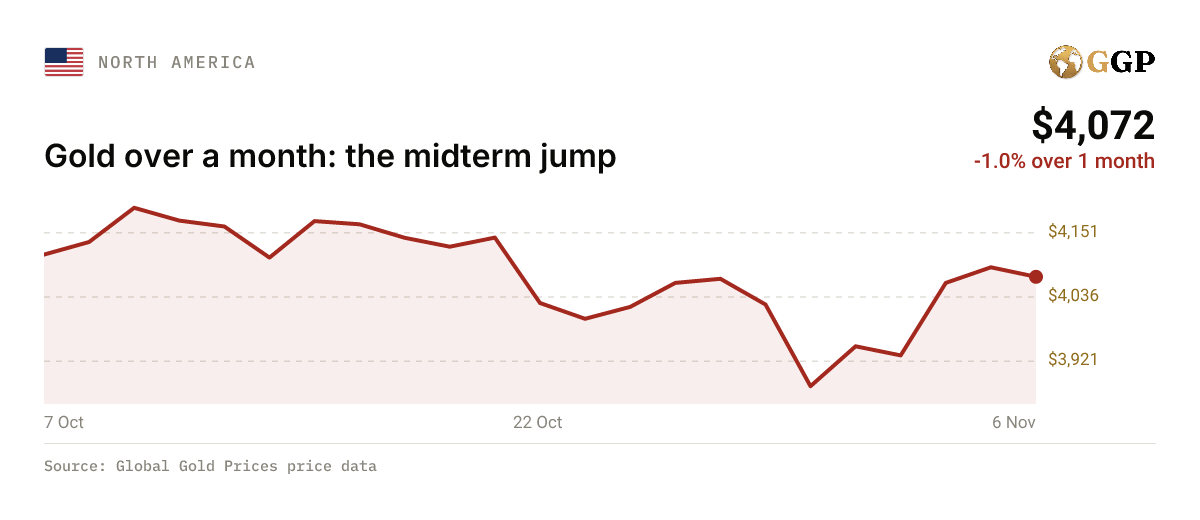
| Point | Price |
|---|---|
| 7 Oct | $4,112 |
| 22 Oct | $4,025 |
| 6 Nov | $4,072 |
| High | $4,196 |
| Low | $3,876 |
| Change over the chart | -0.97% |
What happened on jobs day?
Friday cut against the midterm move. US employers added 165,000 jobs in October, far above forecasts, and the dollar rose 0.7% to its highest since 29 October, CNBC reported. The 10-year Treasury yield traded near 4.88%, according to Schwab. Gold dipped and then recovered to close down 0.4%.
That tug of war is likely to continue. The politics point to lower yields over time; the economy and a Fed that may hike in December point to higher ones in the short run.
Does gold usually rise after a midterm?
It has more often than not. On our price data since 1970, gold rose in the 12 months after 10 of the past 14 midterm elections. The average gain was about 13.6% and the median about 13.5%.
The range is wide. Gold jumped about 83% in the year after the 1978 vote, during the inflation of that era, and fell 16% after 1974. After the 2022 midterms it rose about 17%. Past patterns are a guide, not a forecast, and this year's backdrop of an energy shock and rising rates is unusual.
What could turn the dollar back up?
Inflation is the next test. The October consumer price index comes out on Tuesday 10 November, and the CME FedWatch tool puts the chance of a December Fed hike near 75%. A hot figure would push yields and the dollar higher and could erase part of gold's midterm gain. A soft one would add to the political pressure on yields.
Bond trading will be thin midweek. US bond markets close on Wednesday 11 November for Veterans Day while stocks trade, so the clearer read on yields comes on Thursday.
What does it mean for Canadian buyers?
The US dollar's slide helps Canadians too, because it tends to lift the loonie against it. At Friday's close and today's exchange rate, gold works out at about C$5,742 an ounce. Our gold price in Canada page has the live figure.
For the bigger picture on how yields and fund flows have moved gold this autumn, see our earlier piece on US GDP, PCE and what yields did to gold.
More from the North America desk
All North America stories →Related reading
- China gold reserves: PBOC adds 26t, nears France
The People's Bank of China bought its most gold in three years as prices fell almost 7% in October, extending its streak to 24 months.
- Jobs report and gold price: payrolls back a Fed hike
October's 165,000 jobs kept a December Fed hike close to priced in, and gold's dip was bought within hours.
- Gold technical analysis: $4,200 is the line to beat
The rebound from the one-year low has met the first resistance; the 50-day and 200-day averages show what it has to do next.