

Bolivia mining code: gold cooperatives push back
Bolivia's draft mining code would let gold cooperatives partner with private and foreign investors, but their federation rejects it, just as the gold price sits about 35% below January's record. The government wants it before lawmakers soon.
A new Bolivia mining code, drafted to replace the 2014 mining law, would let the cooperatives that dig most of the country's gold sign partnerships with private and foreign companies for the first time. The National Federation of Mining Cooperatives (Fencomin), which speaks for those miners, has rejected the draft, and its members declared themselves in a state of emergency this week.
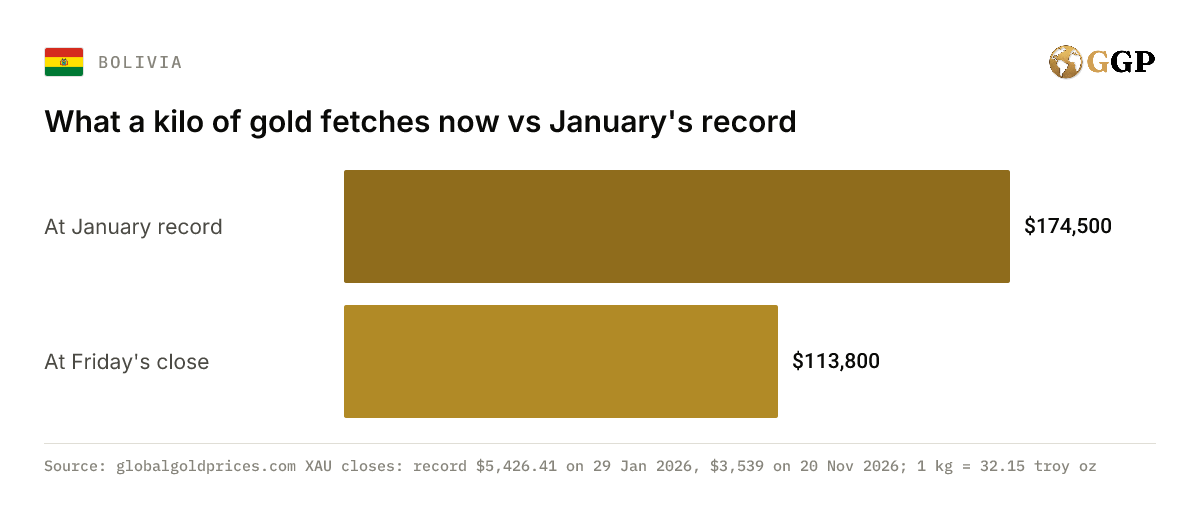
The fight lands at a hard moment for small gold miners. Gold closed on Friday near $114 a gram, or about $3,540 an ounce, on our data. A cooperative selling a kilo of gold now gets about $113,800, against roughly $174,500 at January's record, about 35% less for the same metal.
| Item | Value |
|---|---|
| At January record | $174,500 |
| At Friday's close | $113,800 |
What would Bolivia's new mining code change for gold?
The biggest change is in the rules on partners. Article 151 of Law 535, the 2014 mining law, bars cooperatives from signing association contracts with Bolivian or foreign private companies. The draft from the Ministry of Mining and Metallurgy lifts that ban, and extends it to areas held by Comibol, the state mining company, which would only need to be notified.
The ministry says the code moves away from a statist model and treats the three parts of the industry (state, private and cooperative) on equal terms. Its deputy minister for mining policy said so in October, adding state mining and Comibol would be strengthened, not wound down.
Why are the gold cooperatives against it?
Fencomin says at least 70 of the draft's articles are unconstitutional. Its president, Josué Caricari, asked the government to stop the tour of public meetings on the text, and the federation has called for an alternative draft written with the sector. Some cooperative leaders have also demanded that the mining minister, Marco Calderón, step down for not explaining what the code would do.
The objection is less about private money than about control. Cooperatives have worked under rules written around them since 2014, and a code that opens their areas to outside partners also opens the question of who runs them. Indigenous organisations object from the other side: they say they were left out of the drafting, and they have challenged an earlier government deal with Fencomin on mining in protected areas.
How soon could Bolivia's gold rules change?
Not quickly. The government planned to finish its public consultation by the end of November and then send the text to the Plurinational Legislative Assembly. Lawmakers have warned that they will not take up a code that has not been discussed with indigenous, environmental and political groups.
For gold, that means the old rules stay in place for now. The 2023 gold purchase law, under which the Central Bank of Bolivia buys domestic gold for its reserves, is a separate law. Bolivia's neighbours are wrestling with the same problem from different ends: Peru is running down the deadline on its informal miners' register, and Colombia estimates that three quarters of its river gold is mined illegally.
The price makes the timing awkward for everyone. Gold is down 18% this year on our live gold price data, so the cooperatives are being asked to accept new rules just as their income per gram falls. A code that brings in outside capital could help them cut costs; a code they see as imposed is more likely to push output into informal channels.
More From the Latin America Desk
All Latin America stories →Related Reading
- Gold price 26 November: why gold fell 0.6%
The gold price fell about 0.6% to near $3,566 on Thursday 26 November, as thin Thanksgiving trading let hot US inflation data and bets on another Federal Reserve rate rise pull it back from $3,600. Next up: a shortened US trading session on Friday.
- Why is gold down today? Gold price falls 0.3% on Fed bets
The gold price is down about 0.3% near $3,572 an ounce so far on Thursday, as hot US inflation data keep a December Fed rate rise all but certain and a rebound in stocks cools safe haven demand. US markets are closed for Thanksgiving, so trade should stay thin for the rest of the day.
- Gold price 25 November: why gold rose 0.9%
The gold price rose about 0.9% to near $3,589 on Wednesday 25 November, bouncing back from its lowest level since August 2025 after hot US inflation data, as Treasury yields fell and stocks recovered. Next up: a thin Thanksgiving session and the European Central Bank's meeting account on Thursday.