

Gold bar sizes: weights and prices, 1g to 400 oz
Gold bar sizes run from 1 gram to the 400 oz bar central banks hold. Here is what each weighs, what its gold is worth at about $3,540 an ounce, and which size gives the most gold for your money.

Key points
- Gold bar sizes run from 1 gram to the 400 troy ounce Good Delivery bar, which weighs about 12.4 kilograms
- At about $3,540 an ounce, a 1 kg bar holds about $113,800 of gold
- Small bars cost more per gram, because making a bar costs much the same at any size
- The 1 oz, 100 g and 1 kg bars are the easiest to resell, since dealers everywhere quote them
Gold bar sizes start at a single gram and go up to the 400 troy ounce bar that central banks and bullion banks trade in London. In between sit the sizes most buyers choose: 5 g, 10 g, 1 oz, 100 g and 1 kg. A 1 oz bar holds 31.1 grams of gold, and the size you pick decides how much you pay above the gold price.
This guide lists every common bar size with its weight in grams and troy ounces, works out what the gold inside each is worth in five currencies on our price data, and explains why bigger bars are cheaper per gram but harder to sell in part.
What sizes do gold bars come in?
Gold bars come in metric sizes (grams and kilograms), in troy ounces, and in a few traditional Asian units. The metric sizes dominate in Europe and Asia; troy ounce bars are most common in the US, the UK and anywhere investors think in dollars an ounce.
A troy ounce is not the ounce on a kitchen scale. It weighs 31.1035 grams, about 10% more than the 28.35 gram ounce used for food. Every gold price you see quoted in dollars, including ours, is per troy ounce. Our gold unit converter switches between grams, ounces, tolas and kilos.
The table below covers the sizes most dealers stock. Values are the gold content only, at our close of $3,539 an ounce on 20 November 2026, converted at that day's exchange rates.
| Bar size | Grams | Troy ounces | US dollars | British pounds | Euros | UAE dirhams | Indian rupees |
|---|---|---|---|---|---|---|---|
| 1 g | 1 | 0.032 | 114 | 87 | 104 | 418 | 10,624 |
| 5 g | 5 | 0.161 | 569 | 434 | 518 | 2,089 | 53,120 |
| 10 g | 10 | 0.322 | 1,138 | 867 | 1,036 | 4,179 | 106,241 |
| 20 g | 20 | 0.643 | 2,276 | 1,735 | 2,073 | 8,357 | 212,482 |
| 1 oz | 31.1 | 1 | 3,539 | 2,698 | 3,223 | 12,997 | 330,446 |
| 50 g | 50 | 1.608 | 5,689 | 4,337 | 5,181 | 20,893 | 531,205 |
| 100 g | 100 | 3.215 | 11,378 | 8,674 | 10,363 | 41,786 | 1,062,409 |
| 10 tola | 116.6 | 3.75 | 13,271 | 10,118 | 12,087 | 48,739 | 1,239,173 |
| 250 g | 250 | 8.038 | 28,445 | 21,686 | 25,907 | 104,466 | 2,656,023 |
| 1 kg | 1,000 | 32.151 | 113,781 | 86,744 | 103,626 | 417,863 | 10,624,090 |
| 400 oz | 12,441 | 400 | 1,415,600 | 1,079,214 | 1,289,256 | 5,198,791 | 132,178,459 |
To check a bar yourself, multiply its weight in grams by the price per gram. At $3,539 an ounce, gold costs $113.78 a gram, so a 20 g bar holds 20 x 113.78, or about $2,276.
Small gold bars: 1 gram to 20 grams
The smallest bars, from 1 g to 20 g, are bought as gifts, as a first purchase, or by savers who add a little gold each month. A 1 g bar is about the size of a postage stamp and holds roughly $114 of gold at our close.
Almost all of them are minted: stamped from a rolled strip of gold, with a smooth face, a logo, the weight, the fineness (usually 999.9, meaning 99.99% gold) and often a serial number. Most come sealed in a plastic card with the refiner's details printed on it. Keep the card sealed. A buyer will pay more for a bar whose packaging shows it has not been handled or swapped.
Their weakness is cost. The work of stamping, checking and packing a 1 g bar is close to the work of doing the same for a 100 g bar, so that fixed cost is spread over far less gold. That is why the premium, the amount you pay above the value of the gold, is highest on the smallest sizes. Our guide to gold premiums shows how dealers set it.
The 1 ounce gold bar
The 1 oz bar is the standard retail size in dollar markets, and the size most buyers compare against coins. It holds the same 31.1 g of gold as a 1 oz bullion coin, and dealers quote both against the same spot price.
A bar usually carries a lower premium than a coin of the same weight, because coins are legal tender, cost more to strike and are collected as well as held. On the other hand, coins can be easier to sell in small shops. If you are choosing between the two, our guide to buying gold bars and coins sets out the trade-offs.
At about $3,540, a 1 oz bar is also a useful unit for building up a position: a buyer who adds one bar each quarter ends the year with four ounces in sizes any dealer will quote.
50 grams to 250 grams: the middle sizes
The 50 g, 100 g and 250 g bars are the middle ground. The 100 g bar is the most popular of the three, because it brings the premium per gram well down from the small sizes while still being a sum most savers can buy in one go: about $11,400 of gold at our close.
In the US, the 10 oz bar plays the same role. It weighs 311 grams and held about $35,400 of gold at our close. Both sizes come minted or cast, depending on the refiner.
Cast bars are made by pouring molten gold into a mould. They have rougher edges, sometimes a slightly uneven surface, and are stamped with the refiner's mark, the weight, the fineness and a serial number. They cost a little less to make than minted bars, which is part of why cast bars are more common from 100 g upwards.
The 1 kilo gold bar
The kilobar is the workhorse of the physical market. It weighs 1,000 grams, or 32.15 troy ounces, and is the bar of choice for wealthy private buyers, for vaults in Switzerland, Singapore and Dubai, and for much of the trade into China and India. Swiss refiners recast large London bars into kilobars for those markets.
At our close, a kilobar holds about $113,800 of gold, or 417,900 UAE dirhams. Its premium per gram is among the lowest of any retail size, because the fixed cost of making it is spread across a full kilo.
Its drawback is that you cannot sell part of it. A buyer who needs $20,000 has to sell the whole kilo and take the cash, or hold smaller bars alongside it. Many holders split a position between kilobars and 100 g or 1 oz bars for that reason.
The 400 ounce Good Delivery bar
The largest bar in normal use is the London Good Delivery bar, the standard for the wholesale market run by the London Bullion Market Association (LBMA). Its rules allow between 350 and 430 fine troy ounces, with a minimum fineness of 995 (99.5% gold), so each bar's exact content is weighed and written on it. Most are close to 400 oz, or about 12.4 kg.
At our close, a 400 oz bar holds about $1.4 million of gold. These are the bars held by central banks, gold exchange-traded funds and bullion banks, and the ones that move between London, New York and Zurich. They rarely reach private hands, and they stay inside the approved vault chain because a bar that leaves it has to be assayed again before it can be traded.
The price swings show up most plainly at this size. At January's record close of $5,426 an ounce, a 400 oz bar held about $2.17 million of gold. At our latest close, about $1.42 million: a fall of about $755,000 on a single bar, on our data.
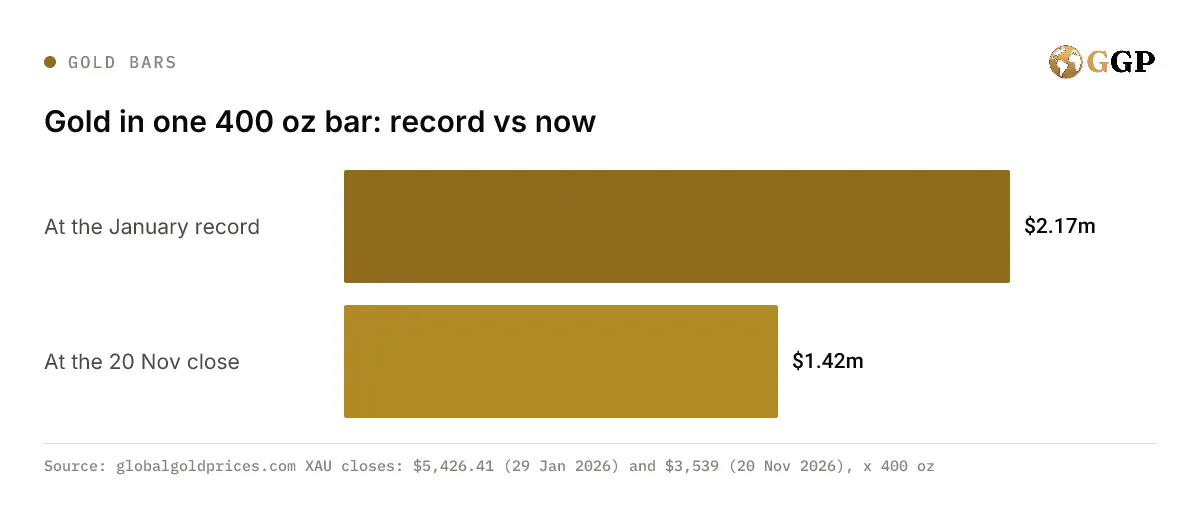
| Item | Value |
|---|---|
| At the January record | $2.17m |
| At the 20 Nov close | $1.42m |
Futures markets use their own size. The main COMEX gold futures contract in New York is for 100 troy ounces, and bars delivered against it come in 100 oz or kilo sizes.
Tola and tael bars
Two traditional units still shape bar sizes in Asia and the Gulf. A tola is about 11.66 grams, and the 10 tola bar of about 116.6 g is a standard size in India, Pakistan and the Gulf, where many jewellers and buyers still price gold per tola. At our close a 10 tola bar held about 48,700 UAE dirhams of gold.
In Hong Kong the traditional unit is the tael of about 37.4 grams, and tael bars are sold alongside gram bars.
Which gold bar size is best?
There is no single best size. The right one depends on how much you are spending and how you expect to sell.
- For the most gold for your money, buy the largest bar you can afford outright, as the premium per gram falls with size.
- To keep the option of selling part of your holding, mix sizes: a kilobar sold whole is cheaper to buy, but several 100 g or 1 oz bars let you sell a piece at a time.
- Regular small buyers can accept the higher premium on small bars, or save up and buy a larger bar less often.
- For selling abroad, choose a size quoted there: 1 oz in the US and UK, 100 g and 1 kg across Europe and Asia, 10 tola in South Asia and the Gulf.
Whatever the size, buy bars from refiners on the LBMA's Good Delivery list or others whose marks dealers recognise, keep the packaging and any certificate, and check the weight and fineness stamped on the bar against the paperwork.
How the gold bar price is worked out
A bar's price has two parts: the gold inside it and the premium. The gold part moves with the spot price every second the market is open. The premium covers the refiner's and the dealer's costs and margin, and it is set by each dealer.
When you sell, the same logic runs in reverse. A dealer buys back at or a little below the value of the gold, and pays closer to that value for bars it can resell easily: well-known brands, sealed packaging and standard sizes. This is why a bar from an unknown maker, or one with damaged packaging, can fetch less than its gold content.
The figures in this guide are the gold content only. Add the dealer's premium to see what a bar will cost, and expect to get back close to the gold value, minus the dealer's spread, when you sell.
Frequently Asked Questions
+What is the most common gold bar size?
The 1 troy ounce bar (31.1 g) is the most common retail size in dollar markets, and the 100 g and 1 kg bars are the most common in Europe and Asia. Dealers everywhere quote these sizes, which makes them the easiest to resell.
+How much does a 1 kilo gold bar weigh in ounces?
A 1 kg bar weighs 32.15 troy ounces. At a gold price of about $3,540 an ounce, it holds about $113,800 of gold, before the dealer's premium.
+How big is a standard gold bar?
The standard wholesale bar is the London Good Delivery bar of about 400 troy ounces, or 12.4 kg. LBMA rules allow 350 to 430 fine ounces and a minimum fineness of 995, so each bar's exact weight is stamped on it.
+Are small gold bars a good investment?
Small bars from 1 g to 20 g carry the highest premium per gram, because making and packing each bar costs about the same whatever its size. They suit gifts and regular small purchases; for larger sums, a 100 g or 1 kg bar puts more of your money into gold.
+What is the difference between a minted and a cast gold bar?
A minted bar is stamped from a rolled strip of gold and has a smooth, polished face, usually sealed in a card. A cast bar is poured into a mould, has rougher edges and costs a little less to make, so it is more common in sizes of 100 g and up.
Related Reading
- Gold price this week: first gain in three weeks, jobs next
The gold price rose about 3% this week to near $3,650, its first weekly gain in three, as buyers returned after a 15-month low and the dollar's rally paused. Next up: the US jobs report on Friday.
- Gold price 27 November: why gold rose 2.3%, China PMI next
The gold price rose about 2.3% to near $3,650 on Friday 27 November as buyers returned after Thanksgiving, the dollar's rally paused and silver jumped. Next up: China's factory survey and the CFTC's positioning report on Monday.
- Why is gold up today? Gold price rises 3.2% as dollar slips
The gold price is up about 3.2% near $3,680 an ounce so far on Friday 27 November, as the dollar eases off a near two-year high and Chinese stocks rally on new support pledges. US markets close early after Thanksgiving, so trade stays thin for the rest of the day.