

Gold price this week: 9% drop to a 52-week low, PCE next
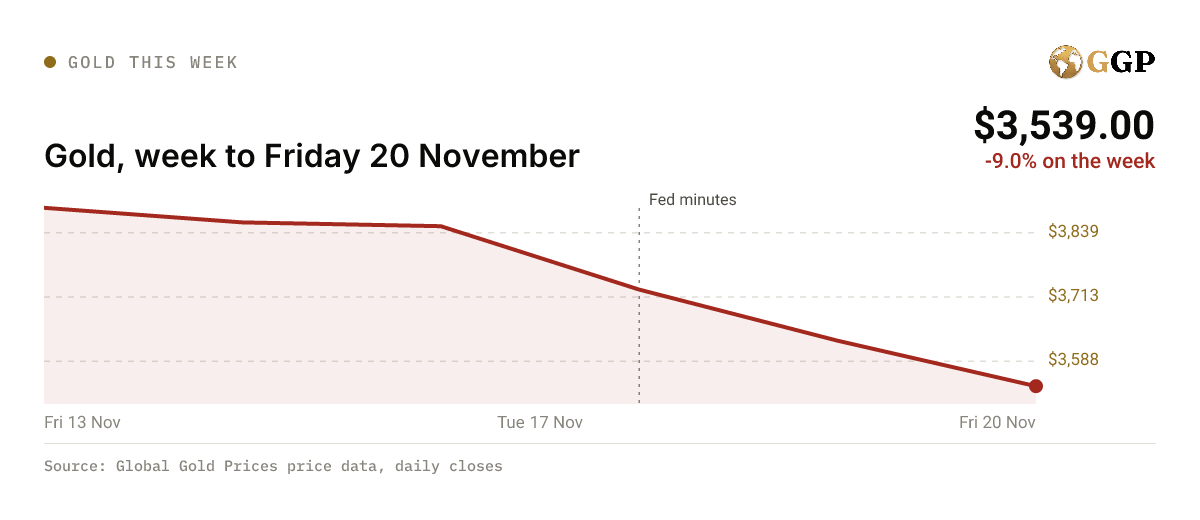
The gold price fell about 9% this week to near $3,539, its worst week since March, as Federal Reserve minutes and hot US price data locked in bets on a December rate hike. Next up: US PCE inflation on Wednesday, before Thanksgiving.
Key points
- Gold fell about 9% this week to near $3,539, its worst Friday-to-Friday week since March
- The Fed's October minutes and firm US price data made a December rate hike look all but certain
- Wednesday brings October PCE inflation and revised US growth figures, a day before Thanksgiving
- US markets shut on Thursday and close early on Friday, so trading will be thin
The gold price this week fell about 9% to near $3,539 an ounce, its worst Friday-to-Friday week since March and a 52-week low. Minutes from the Federal Reserve's October meeting and hot US price data cemented bets on a December rate hike. Next week's main test is October's PCE inflation figure on Wednesday.
Last week in numbers
| Measure | Gold |
|---|---|
| Friday close | $3,539.00 |
| 1 week | -8.97% |
| 1 month | -14.56% |
| Year to date | -18.22% |
| Below the record | -34.78% |
On our price data since 1968, a seven-day fall this steep is rare: it was worse than 99.6% of all seven-day stretches. Gold has not closed this low since early September 2025, and it would now need to climb about 53% to win back January's record near $5,426.
| Friday's gold price in local money | 22K per gram | 24K per gram | 24K per ounce |
|---|---|---|---|
| UAE (dirhams) | 383.04 | 417.86 | 12,997 |
| India (rupees) | 9,739 | 10,624 | 330,446 |
| Euro area (euros) | 94.99 | 103.63 | 3,223 |
| UK (pounds) | 79.52 | 86.74 | 2,698 |
Local prices are converted at Friday's exchange rates. Our pages on the gold price in India and the gold price in the UAE carry the daily figures.
| Point | Price |
|---|---|
| Fri 13 Nov | $3,888 |
| Tue 17 Nov | $3,852 |
| Fri 20 Nov | $3,539 |
| High | $3,888 |
| Low | $3,539 |
| Change over the chart | -8.97% |
What moved gold last week
Why did gold fall so hard after the Fed minutes?
The minutes of the Fed's 27 and 28 October meeting, out on Wednesday, showed almost all officials expect more rate rises to bring inflation back to 2%. Two policymakers, Lisa Cook and Beth Hammack, had already voted for a hike in October, and some officials floated a half-point move for December.
Gold lost about 3.2% that day, its sharpest one-day fall since 30 October, as we reported in Wednesday's edition. Higher rates raise the cost of holding a metal that pays no interest, which our guide to the Fed and the gold price explains in more detail.
Why did US data push gold lower?
The numbers gave the Fed no reason to wait. The Census Bureau said core retail sales rose 0.6% in October, ahead of forecasts, and the Bureau of Labor Statistics said import prices jumped 1.1%. On Thursday the Philadelphia Fed's prices paid index rose 15 points to 58.2, its highest since April.
By Friday, CME's FedWatch tool showed traders treating a December hike as close to certain. The dollar sat near its strongest level since April 2025 and the 10-year Treasury yield held above 5%, which made each ounce dearer for buyers paying in rupees, euros or yen.
Why did gold fall with stocks instead of rising?
Shares were the third weight. The S&P 500 fell for six sessions in a row by Thursday as technology and artificial intelligence stocks slid. When equities drop this fast, funds often sell gold, one of their best performers of the past two years, to raise cash and meet margin calls. That is why gold acted as a source of cash rather than a haven this week.
Levels to watch for gold
The first support is $3,500. Gold touched about $3,504 on Friday afternoon and bounced, so a close below that round number would be a fresh signal for sellers. Below it, our daily closes show the next shelf near $3,430 to $3,490, where gold traded at the end of August 2025.
Resistance starts at $3,850 to $3,876: the closes on Monday and Tuesday and the 30 October low that broke on Wednesday. Above that sit $4,000 and the 50-day moving average near $4,090.
Gold now closes about 13.5% under its 50-day average. On our data since 1970, only 48 trading days have closed that far below it, which says the fall is stretched. Stretched markets can bounce hard, but the 200-day average near $4,409 keeps the longer trend pointing down. We look at what moves the gold price over longer periods in our explainer.
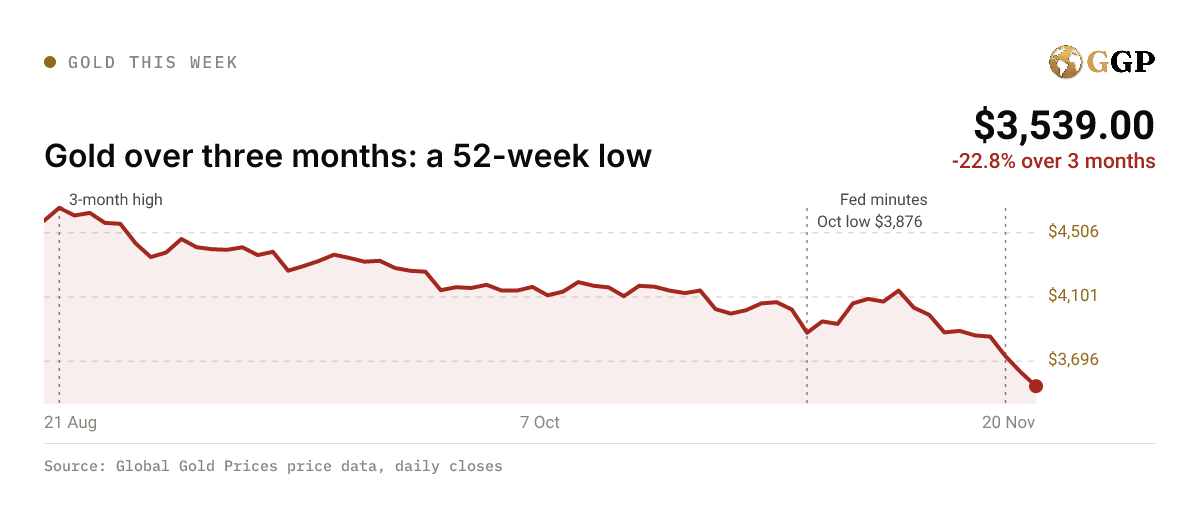
| Point | Price |
|---|---|
| 21 Aug | $4,582 |
| 7 Oct | $4,165 |
| 20 Nov | $3,539 |
| High | $4,664 |
| Low | $3,539 |
| Change over the chart | -22.76% |
The week ahead for gold
Will Wednesday's PCE inflation figure deepen gold's fall?
The Bureau of Economic Analysis publishes October's personal income and outlays report, with the PCE price index the Fed prefers, alongside its second estimate of third-quarter GDP on Wednesday. September's figures put PCE inflation at 3.6% and core at 3.1%. Forecasters look for core PCE to edge up to about 3.2%.
If core PCE comes in hotter, gold is likely to test $3,500 again, because traders would start pricing a half-point Fed move or more hikes in early 2027. A softer figure would ease some of that pressure and could give oversold gold room to bounce. Last time, when the advance GDP and September PCE figures came out on Thursday 29 October, gold slipped about 1.1% that day and lost another 3.6% the next.
What do the flash PMIs and Thanksgiving mean for gold?
Monday's flash purchasing managers' surveys from S&P Global give the first look at November activity in Europe, the UK and the US. Strong US readings would back the case for a December hike and keep the dollar firm.
Thanksgiving closes US markets on Thursday, and they shut early on Friday. Thin trading can exaggerate moves either way, so a large swing on low volume says less than usual about the trend. Japan is also closed on Monday for Labour Thanksgiving Day.
What to watch: important dates for gold
- Mon 23 Nov: flash PMIs for the euro area, the UK and the US, the first read on November growth; Japan closed
- Wed 25 Nov: US October PCE inflation and second-estimate Q3 GDP, 8:30 am New York time, the week's main test
- Thu 26 Nov: US Thanksgiving, US markets closed
- Fri 27 Nov: US markets close early, thin trading into the weekend
Frequently Asked Questions
+How much did the gold price fall this week?
Gold fell about 9% in the week to Friday 20 November, from about $3,888 to near $3,539 an ounce on our closing prices. It was the worst Friday-to-Friday week since March and left gold about 35% below January's record.
+Why is gold falling when there is so much uncertainty?
Rate expectations have outweighed demand for safety. Fed minutes showed almost all officials expect more hikes, the 10-year Treasury yield is above 5% and the dollar is near a 19-month high, all of which raise the cost of holding gold.
+What is the next big event for gold?
October's PCE inflation figure and the second estimate of third-quarter GDP, both due from the Bureau of Economic Analysis at 8:30 am New York time on Wednesday 25 November. The Fed then meets on 8 and 9 December.
+Are US markets open for Thanksgiving?
US markets are closed on Thursday 26 November for Thanksgiving and close early on Friday 27 November. Gold still trades elsewhere, but volumes are usually thin, which can make price moves larger than normal.
More From the Markets Desk
All Markets stories →Related Reading
- Gold price 26 November: why gold fell 0.6%
The gold price fell about 0.6% to near $3,566 on Thursday 26 November, as thin Thanksgiving trading let hot US inflation data and bets on another Federal Reserve rate rise pull it back from $3,600. Next up: a shortened US trading session on Friday.
- Why is gold down today? Gold price falls 0.3% on Fed bets
The gold price is down about 0.3% near $3,572 an ounce so far on Thursday, as hot US inflation data keep a December Fed rate rise all but certain and a rebound in stocks cools safe haven demand. US markets are closed for Thanksgiving, so trade should stay thin for the rest of the day.
- Gold price 25 November: why gold rose 0.9%
The gold price rose about 0.9% to near $3,589 on Wednesday 25 November, bouncing back from its lowest level since August 2025 after hot US inflation data, as Treasury yields fell and stocks recovered. Next up: a thin Thanksgiving session and the European Central Bank's meeting account on Thursday.