

Gold 2x ETF and 3x funds: how leveraged gold works
Gold rose about 2% over the past year, but a fund resetting to twice the daily move would have lost about 3%, and a 3x fund about 13%, on our price data. Here is why, and which leveraged gold funds trade today.
Key points
- A gold 2x ETF aims for twice gold's move on each single day, not over a month or a year
- Over the past year, gold rose about 2.2% but a daily 2x fund would have fallen about 2.6%, on our data
- From January's record, gold is down about 25%; a daily 2x fund would be down about 47%
- In the US, ProShares Ultra Gold (UGL) is the main 2x fund; 3x exposure comes through an exchange-traded note
A gold 2x ETF is a fund that tries to deliver twice the gold price's percentage move each day, using futures and swaps rather than bars. If gold rises 1% today, the fund should rise about 2%. The catch is the word "each": the fund resets its leverage every evening, so over weeks and months its return drifts away from twice gold's.
That drift is the whole story with leveraged gold funds. It can work for you in a steady trend and against you in a choppy market, and gold has been very choppy in 2026.
How a gold 2x ETF works: the daily reset
A leveraged fund holds gold futures and total return swaps worth twice its assets. At the close of every trading day, it rebalances so that exposure is back to exactly 2 times. After a gain, it buys more exposure. After a loss, it sells some.
That daily rebalancing is what the prospectus means when it says the fund seeks twice the daily performance of its benchmark, the Bloomberg Gold Subindex in the case of ProShares Ultra Gold (UGL), before fees. ProShares, the SEC and FINRA all warn that over periods longer than a day, the return can be very different from twice the index.
Volatility decay: a worked example from our gold prices
The simplest case shows the arithmetic. Suppose gold falls 10% one day and rises 10% the next. Gold ends at 99% of where it started, down 1%. A 2x fund falls 20% to 80, then rises 20% to 96, down 4%. The fund lost four times as much, not twice as much.
Now the real thing. We ran our own daily gold closes through a fund that resets to 2 times every day, before fees. Here are the six sessions from Friday 30 October to Friday 6 November:
| Session | Gold daily move | Gold, start = 100 | Daily 2x fund, start = 100 |
|---|---|---|---|
| Friday | -3.63% | 96.37 | 92.74 |
| Monday | +1.84% | 98.14 | 96.15 |
| Tuesday | -0.41% | 97.74 | 95.35 |
| Wednesday | +3.30% | 100.96 | 101.65 |
| Thursday | +0.69% | 101.66 | 103.05 |
| Friday | -0.42% | 101.23 | 102.19 |
Source: Global Gold Prices daily gold closes; our calculation, before fees.
Gold gained about 1.2% over those six sessions. Twice that is about 2.5%, but the 2x fund made about 2.2%. The swings in between cost it a little. Over a longer and rougher stretch, they cost a lot.
How much did volatility decay cost over the past year?
Over longer periods the gap grows. These are the same daily-reset calculations on our gold price, before any fees:
| Period to 6 Nov 2026 | Gold price | Daily 2x | Twice gold's move | Daily 3x |
|---|---|---|---|---|
| 1 month | -1.0% | -2.4% | -1.9% | -4.3% |
| 3 months | -6.1% | -12.7% | -12.2% | -19.8% |
| 6 months | -14.1% | -28.3% | -28.2% | -41.9% |
| Since January's record | -25.0% | -46.9% | -49.9% | -64.7% |
| 1 year | +2.2% | -2.6% | +4.3% | -13.5% |
Source: Global Gold Prices daily gold closes since 1968; our calculation, before fees.
The last row is the one to remember. Over a year in which gold finished slightly higher, a 2x fund would have lost money and a 3x fund would have lost about 13%. Gold's realised volatility over that year was about 26% annualised on our data, a very jumpy year for the metal, and that is exactly the condition in which daily-reset funds bleed.
| Point | Daily 2x fund |
|---|---|
| Nov 2025 | 100.00 |
| May 2026 | 135.90 |
| Nov 2026 | 97.40 |
| High | 167.00 |
| Low | 88.40 |
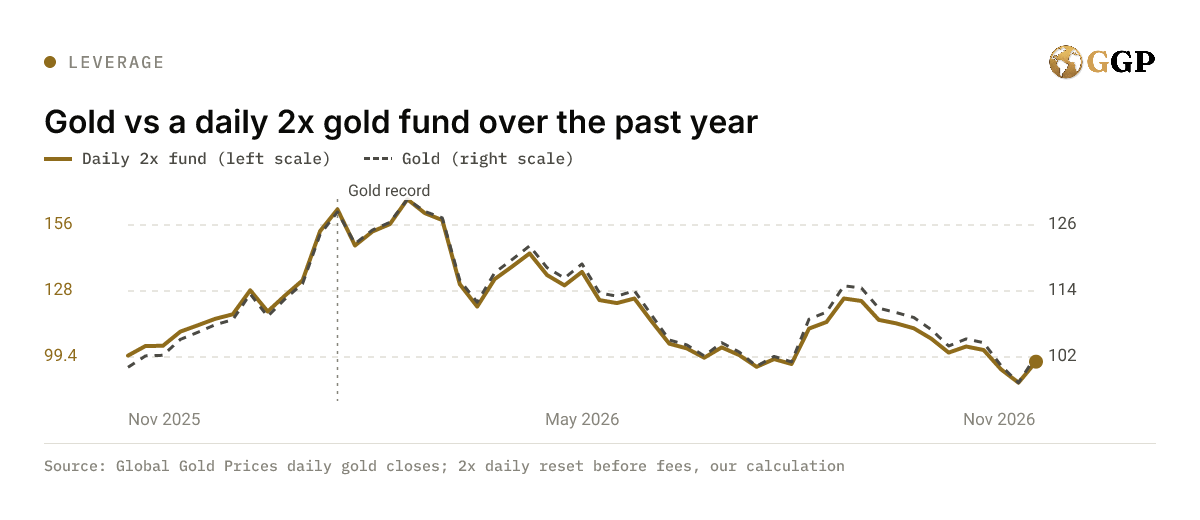
| Change over the chart | -2.60% |
| Gold, start to end | 100.00 to 102.10 |
The chart shows how it happens. In the run-up to January's record, the 2x line rose far faster than gold, from 100 to about 163 while gold went to about 128. Then the slide from March to June gave most of it back, and the 2x line went on to finish below its starting point while gold ended a little above.
Steady trends work the other way. In a smooth move, compounding helps: from January's record, gold's slide was steady enough that a 2x fund lost about 47%, less than twice gold's 25% fall. Leverage magnifies whatever path gold takes; it does not magnify the destination.
Which leveraged gold ETFs trade today?
We checked the issuers' pages and filings through search in November 2026. These are the main products still trading:
| Fund | Ticker | Daily target | Structure | Yearly fee |
|---|---|---|---|---|
| ProShares Ultra Gold | UGL | 2x | Commodity pool (futures and swaps) | 0.95% management fee |
| ProShares UltraShort Gold | GLL | -2x | Commodity pool (futures and swaps) | 0.95% |
| MicroSectors Gold 3X Leveraged ETN | SHNY | 3x | Exchange-traded note issued by Bank of Montreal | 0.95% plus a financing charge |
| WisdomTree Gold 2x Daily Leveraged | LBUL | 2x | Exchange-traded product, Europe | about 0.98% |
| WisdomTree Gold 3x Daily Leveraged | 3GOL | 3x | Exchange-traded product, London | 0.99% management fee; 3.87% ongoing charge with financing |
Source: ProShares, MicroSectors (BMO) and WisdomTree product pages and SEC filings, via search; fees vary by date and share class.
A few names you may come across are gone or are not gold funds at all. Direxion's 3x gold ETFs closed in 2014 and 2015. Direxion's NUGT and JNUG are leveraged funds on gold mining shares, not on the metal. Older Deutsche Bank double long and short gold notes, DGP and DZZ, have shrunk to small sizes, so check their status with your broker before trading them.
Fees matter more here than in a plain gold fund. At 0.95% a year, UGL costs $95 on every $10,000, against $10 for the cheapest physical gold ETFs on our gold ETFs compared page, and swap financing costs come on top inside the fund.
Inverse gold funds: betting on a falling gold price
The same daily reset runs in reverse in inverse funds such as ProShares UltraShort Gold (GLL), which aims for minus twice gold's daily move. They suffer the same decay. From January's record, gold fell about 25%, so a perfect "twice the fall" bet would have gained about 50%; our daily-reset calculation gives about 49.5%, close because the slide was steady. Over the full year, when gold ended slightly higher after violent swings, a daily -2x fund would have lost about 22%, while gold itself gained about 2%.
Leveraged gold ETF vs ETN: what is the difference?
UGL is a commodity pool that holds futures and swaps itself. SHNY is an exchange-traded note, an unsecured debt of Bank of Montreal that promises to pay three times the daily return of its reference asset. The note holds no gold and no futures for you: if the issuer ran into trouble, you would be an unsecured creditor. That credit risk is the price of getting 3x in a US-listed wrapper.
How leveraged gold funds are taxed in the US
The structures bring different tax paperwork. UGL is a commodity pool, so holders receive a Schedule K-1 rather than a 1099-DIV, and sales are reported on a 1099-B. Exchange-traded notes are debt, so their treatment follows the note's terms. Physical gold ETFs are different again: the IRS taxes long-term gains on them as collectibles, at up to 28%. Check with a tax adviser before using any of these in a taxable account.
Who should use a gold 2x ETF?
FINRA told brokers in 2009 that daily-reset leveraged and inverse funds are usually a poor fit for ordinary investors who expect to keep them beyond a single day of trading, unless the positions are watched closely. They are built for traders who want a short, sharp bet on the gold price for a day or a few days, and who will cut the position if it goes wrong.
For anyone who wants to own gold for months or years, a plain gold fund does the job without the decay. For more on what drives the gold price day to day, our guide to what moves the gold price covers the dollar, real yields and central bank buying.
This is general information, not investment advice. Fees and product lists change; check the issuer's current documents before trading.
Frequently Asked Questions
+What is a gold 2x ETF?
It is a fund that aims to return twice the gold price's percentage move each day, using futures and swaps. ProShares Ultra Gold (UGL) is the main US example, with a 0.95% yearly management fee.
+Can I hold a leveraged gold ETF for more than a day?
You can, but its return will drift from twice gold's. Over the year to 6 November 2026, gold rose about 2.2% while a daily 2x fund would have fallen about 2.6% before fees, on our gold price data.
+Why does a 2x gold ETF not return double gold over a month?
Because it resets its leverage every day, it compounds daily returns rather than doubling the period's return. If gold falls 10% and then rises 10%, gold is down 1% but a 2x fund is down 4%.
+Is there a 3x gold ETF?
In the US, 3x gold exposure comes through the MicroSectors Gold 3X Leveraged ETN (SHNY), a note issued by Bank of Montreal that charges 0.95% a year plus financing. In London, WisdomTree lists a 3x daily gold product, 3GOL.
+What is the difference between UGL and SHNY?
UGL is a commodity pool that holds gold futures and swaps and sends investors a Schedule K-1. SHNY is an exchange-traded note, an unsecured debt of its issuing bank, so it adds the bank's credit risk to the gold exposure.
Related Reading
- Resolute Mining guidance rests on $4,000 gold
Resolute Mining's 2026 guidance assumes a $4,000 gold price, about 3% above Friday's close, though its mines in Mali and Senegal still clear their costs by about $1,380 an ounce on our numbers.
- Gold ETF India guide: costs, tax and how they compare
Indian gold ETFs charge about 0.44% to 0.81% a year, ₹440 to ₹810 on every ₹1 lakh, with 24 carat gold near ₹12,300 a gram at the world price. How they compare with Sovereign Gold Bonds, gold funds and jewellery.
- Gold stock or gold ETF? GLD vs GDX explained
Gold mining stocks matched gold's January rise, then moved up to nearly three times as far in the swings that followed, by our numbers. Here is how GDX and GLD differ on fees, risk, dividends and tax.