

Gold ETF India guide: costs, tax and how they compare
Indian gold ETFs charge about 0.44% to 0.81% a year, ₹440 to ₹810 on every ₹1 lakh, with 24 carat gold near ₹12,300 a gram at the world price. How they compare with Sovereign Gold Bonds, gold funds and jewellery.
Key points
- Indian gold ETFs hold 99.5% pure gold and trade on the NSE and BSE like shares
- Expense ratios run about 0.44% to 0.81% a year, or ₹440 to ₹810 on every ₹1 lakh
- Investors put about ₹4,451 crore into gold ETFs in September 2026, AMFI data showed
- No new Sovereign Gold Bonds have been issued since early 2024, which has pushed savers towards ETFs
- In rupees, gold is up about 185% over five years on our gold price and exchange-rate data
A gold ETF India investors buy is a mutual fund unit that holds physical gold of 99.5% purity and trades on the National Stock Exchange (NSE) and BSE through a demat account. Its price follows the domestic gold price, so it gives the return of gold without making charges, GST or the worry of storing jewellery at home.
Gold ETFs have become the main way Indian savers buy paper gold since the government stopped issuing Sovereign Gold Bonds. This guide sets out what they cost in rupees, how they are taxed and how they compare with the alternatives.
How gold ETFs work in India
Each fund buys gold bars and keeps them with a custodian. Under rules from the Securities and Exchange Board of India (SEBI), at least 95% of a gold ETF's assets must be in physical gold and approved gold instruments, and the bars must be 995 fineness, the standard of the London Bullion Market Association.
Since 1 April 2026, SEBI has required funds to value their gold at the polled spot price published by Indian stock exchanges, rather than an international benchmark converted into rupees. That brought ETF prices closer to the price Indian buyers pay, which includes import duty.
Unit size varies by fund: some units stand for a small fraction of a gram, others for nearer a gram. Check the fund's fact sheet for the gold per unit before you compare prices, since a cheaper unit is not a cheaper fund.
For context, 24 carat (24K) gold costs about ₹12,313 a gram, or about ₹1,23,128 per 10 grams, at the latest London price converted at today's rupee rate, by our calculation. Indian prices run higher because of the import duty, about 15% since 13 May 2026 (a 10% basic customs duty plus a 5% cess, up from 6%), and local premiums; the gold price in India page tracks the local figure.
The biggest gold ETFs in India compared
| Fund (NSE symbol) | Expense ratio | Cost on ₹1 lakh a year | Assets, 30 Sep 2026 (₹ crore) |
|---|---|---|---|
| Aditya Birla Sun Life Gold ETF | 0.44% | ₹440 | 3,087 |
| ICICI Prudential Gold ETF (GOLDIETF) | 0.49% | ₹490 | 27,615 |
| Kotak Gold ETF | 0.52% | ₹520 | 14,473 |
| Axis Gold ETF | 0.52% | ₹520 | 5,526 |
| HDFC Gold ETF (HDFCGOLD) | 0.59% | ₹590 | 23,900 |
| UTI Gold ETF | 0.59% | ₹590 | 4,406 |
| SBI Gold ETF (SETFGOLD) | 0.65% | ₹650 | 26,466 |
| Nippon India ETF Gold BeES (GOLDBEES) | 0.81% | ₹810 | 56,982 |
Source: expense ratios as listed by INDmoney on 16 November 2026, with Nippon's confirmed in its AMFI disclosure; assets at 30 September 2026 from ICRA Analytics, as reported by The Tribune; cost by our calculation. Indian gold ETFs held about ₹1.86 lakh crore in all at that date, and the five largest held about 80% of it.
Nippon India's GOLDBEES is the oldest and largest, and the most traded, which keeps its bid-ask spread tight. That liquidity is why many investors pay its higher fee. The cheaper funds can cost less to hold but more to trade if few units change hands.
Expense ratios change often, sometimes month to month. Check the latest figure on the fund house's page or on AMFI before buying.
What the fees cost in rupees
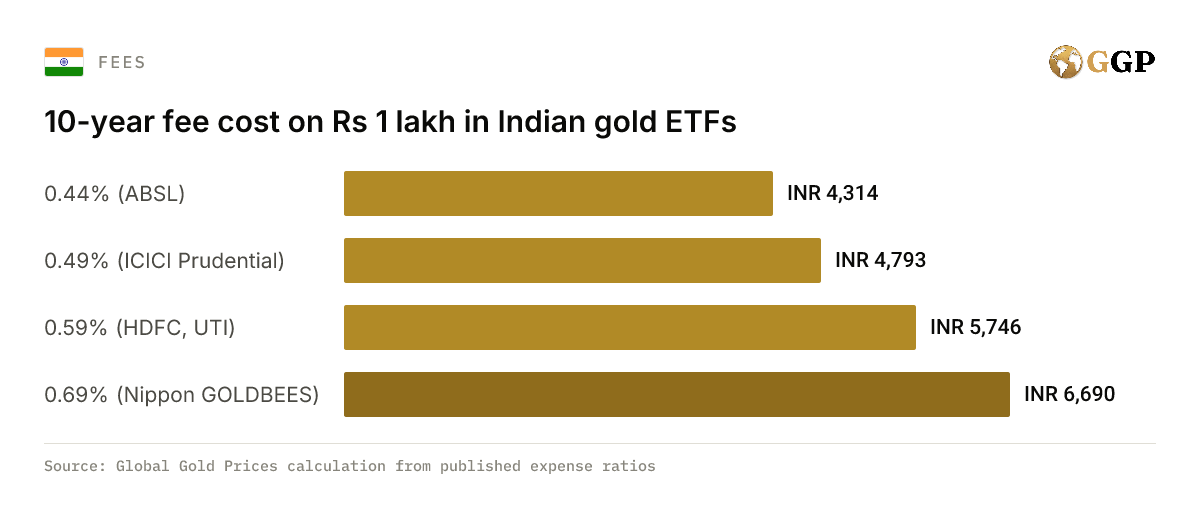
On ₹1 lakh held at a flat gold price, our calculation compounds each fee:
| Expense ratio | 1 year | 5 years | 10 years |
|---|---|---|---|
| 0.44% | ₹440 | ₹2,181 | ₹4,314 |
| 0.49% | ₹490 | ₹2,426 | ₹4,793 |
| 0.59% | ₹590 | ₹2,915 | ₹5,746 |
| 0.81% | ₹810 | ₹3,985 | ₹7,811 |
Source: our calculation from published expense ratios.
| Item | Value |
|---|---|
| 0.44% (ABSL) | INR 4,314 |
| 0.49% (ICICI Prudential) | INR 4,793 |
| 0.59% (HDFC, UTI) | INR 5,746 |
| 0.81% (Nippon GOLDBEES) | INR 7,811 |
Brokerage and depository charges come on top: most brokers charge a small fee per trade and a demat charge when you sell. These are far below the 3% GST and making charges of jewellery, but they add up for people who buy small amounts often.
The fees are also several times those on US gold ETFs, where the cheapest charge 0.09% to 0.10% a year; our gold ETFs compared page lists them. Indian funds pay for local custody, insurance and the domestic gold premium.
Gold ETF vs Sovereign Gold Bonds vs physical gold
| Gold ETF | Sovereign Gold Bond | Physical gold | |
|---|---|---|---|
| New purchases | Any market day | No new issues since early 2024 | Any day |
| Yearly cost or income | Costs 0.44% to 0.81% | Pays 2.5% interest | Locker and insurance costs |
| Buying costs | Brokerage | Market price on exchange | 3% GST plus making charges |
| Purity | 99.5% backing | Linked to 999 gold price | Depends on hallmark |
| Selling | Instantly on NSE or BSE | Thin trading; exit after year 5 | Jeweller buyback, often below price |
Source: SEBI, RBI and fund house data; our summary.
Sovereign Gold Bonds
Sovereign Gold Bonds paid 2.5% a year on top of the gold price, for eight years, and redemption at maturity was tax-free for individuals. They were the best deal for long-term holders. But the government has issued no new tranches since early 2024, as we reported in our piece on Sovereign Gold Bonds closed to new issues.
Existing bonds still trade on the exchanges, but volumes are thin and prices often sit at a premium to gold. Budget 2026 also narrowed the tax break: the tax-free redemption now applies only to investors who subscribed at issue and hold to maturity, not to people who buy bonds second-hand.
Physical gold and jewellery
Buying jewellery means paying 3% GST plus making charges that can run from a few per cent to over 20% for detailed designs. On ₹1 lakh of gold, the GST alone is ₹3,000, about five years of fees on the cheapest ETF. Coins and bars avoid most making charges but still carry GST and the dealer's margin.
What physical gold offers is something to wear and hold, and use as collateral for a gold loan. A gold ETF offers a price close to the market, purity guaranteed by SEBI rules, and a sale in seconds.
Gold ETF returns: what to expect
A gold ETF's return is the gold price's return in rupees, minus the expense ratio and a small tracking difference. There is no interest or dividend. So the question of returns is really a question about the gold price and the rupee.
In dollars, on our London price, gold is up about 126% over five years and about 2% over the past year, but about 25% below January's record of about $5,426 an ounce. In rupees the gain is bigger, because the rupee fell from about ₹74.9 to about ₹94.5 per dollar over the same five years. On our gold price and month-end exchange rates, gold is up about 185% in rupees over five years and about 9% over the past year, by our calculation. Each fund's fact sheet shows its own return after fees.
Tracking error is the other number to check. It measures how closely a fund's NAV followed the domestic gold price over a period. Lower is better, and among the large funds it is usually a fraction of a percentage point a year. A fund with a low fee but a high tracking error can still leave you behind a dearer fund that follows gold closely.
How gold ETFs are taxed in India
Gains on listed gold ETF units held for more than 12 months are long-term and taxed at 12.5% without indexation, under section 112 of the Income-tax Act as changed by the Finance (No. 2) Act 2024. The Central Board of Direct Taxes (CBDT) set out the new regime in its FAQs: a one-year holding period for listed securities and the 12.5% long-term rate, for transfers from 23 July 2024. Units sold within 12 months are taxed at your income tax slab rate.
Gold mutual funds that invest in ETFs, known as fund of funds, and physical gold need a longer holding period, generally 24 months, before gains count as long-term at 12.5%. There is no GST on buying ETF units, unlike the 3% on physical gold.
Rules have changed several times in recent years, so check the current position with the Income Tax Department or a tax adviser before you sell.
Gold fund of funds and SIPs
A gold fund of funds is a mutual fund that invests in a gold ETF, so you can buy it without a demat account and set up a SIP, a systematic investment plan, from as little as a few hundred rupees a month. The cost is two layers of fees: the fund's own plus the ETF's underneath, about 0.67% to 0.79% in total for some large direct plans.
In mid-October 2026, 17 fund houses paused fresh lump sums and new SIP registrations into their gold fund of funds, according to Business Today, while existing SIPs and gold ETFs themselves carried on. Check whether a fund is open before you apply.
How to buy a gold ETF in India
- Open a demat and trading account with a SEBI-registered broker, using your PAN and KYC documents.
- Search for the fund's NSE or BSE symbol, such as GOLDBEES or GOLDIETF.
- Check the gold per unit and the price against the fund's indicative NAV, published during market hours.
- Place a limit order during market hours, 9:15 am to 3:30 pm India time, to avoid paying above the fair value.
- Hold the units in your demat account; there is no locker or insurance to arrange.
Many brokers also let you buy units every month on a fixed date, which works like a SIP without the extra fund of funds fee.
Selling works the same way in reverse: place a sell order on the NSE or BSE and the money reaches your bank account after settlement, the next working day on Indian exchanges. Selling a large holding in a thinly traded fund can move its price, so split big orders or use a limit price close to the indicative NAV.
Are gold ETFs safe in India?
They are regulated by SEBI, the gold is held by a custodian and audited, and the units sit in your demat account in your name. The main risk is the gold price itself: it has fallen about 25% in dollars from January's record, on our data, and the rupee's moves add to or offset that. Gold ETFs remove the risks of theft, impure metal and unfair buyback prices, not the risk of the gold price falling.
This guide is general information, not investment or tax advice.
Frequently Asked Questions
+What is a gold ETF in India?
It is a mutual fund unit backed by physical gold of 99.5% purity, held by a custodian and traded on the NSE and BSE through a demat account. Its price follows the domestic gold price, and SEBI rules require at least 95% of its assets to be in gold and approved gold instruments.
+Which gold ETF has the lowest expense ratio in India?
On fund house figures as listed in mid-November 2026, Aditya Birla Sun Life Gold ETF charged about 0.44% and ICICI Prudential Gold ETF about 0.49%, against about 0.81% for Nippon India ETF Gold BeES. That is ₹440 to ₹810 a year on every ₹1 lakh.
+How are gold ETF gains taxed in India?
Gains on listed gold ETF units held for more than 12 months are taxed at 12.5% without indexation. Units sold within 12 months are taxed at your slab rate.
+Do I need a demat account to buy a gold ETF?
Yes, gold ETFs trade on the stock exchanges, so you need a demat and trading account. A gold fund of funds can be bought without one, at a higher total cost of about 0.67% to 0.79% for some direct plans.
+Is a gold ETF better than a Sovereign Gold Bond?
A Sovereign Gold Bond paid 2.5% interest a year and a tax-free redemption at maturity, which beat an ETF for long-term holders. But no new bonds have been issued since early 2024, so new money now goes into ETFs or existing bonds bought on the exchange, where the tax-free redemption no longer applies after Budget 2026.
+Is a gold ETF cheaper than buying jewellery?
Yes, for investment. Jewellery carries 3% GST plus making charges that can exceed 20%, while an ETF costs 0.44% to 0.81% a year and has no GST on purchase.
More From the Asia-Pacific Desk
All Asia-Pacific stories →Related Reading
- Resolute Mining guidance rests on $4,000 gold
Resolute Mining's 2026 guidance assumes a $4,000 gold price, about 3% above Friday's close, though its mines in Mali and Senegal still clear their costs by about $1,380 an ounce on our numbers.
- Gold 2x ETF and 3x funds: how leveraged gold works
Gold rose about 2% over the past year, but a fund resetting to twice the daily move would have lost about 3%, and a 3x fund about 13%, on our price data. Here is why, and which leveraged gold funds trade today.
- Gold stock or gold ETF? GLD vs GDX explained
Gold mining stocks matched gold's January rise, then moved up to nearly three times as far in the swings that followed, by our numbers. Here is how GDX and GLD differ on fees, risk, dividends and tax.