
Gold stock or gold ETF? GLD vs GDX explained
Gold mining stocks matched gold's January rise, then moved up to nearly three times as far in the swings that followed, by our numbers. Here is how GDX and GLD differ on fees, risk, dividends and tax.
Key points
- GLD holds gold bars; GDX holds shares in the world's largest gold mining companies
- In 2026, GDX matched gold's January rise, then moved 1.2 to 2.7 times as far in each swing after it, on our numbers
- GDX charges 0.51% a year, $51 on every $10,000; GLD charges 0.40%, $40
- Miners earn a cushion of about $2,300 an ounce over their costs at today's gold price
A gold stock is a share in a company that mines gold, and its price rises and falls with the gold price, only harder. That is the main thing separating a miners fund such as the VanEck Gold Miners ETF (GDX) from a fund that holds bars, such as SPDR Gold Shares (GLD). One gives you gold. The other gives you businesses whose profits depend on it.
Both trade on NYSE Arca like any stock, and both appear on our gold ETFs compared page and in most brokerage accounts. But they behave differently, cost differently and are taxed differently in the US.
What is the difference between GLD and GDX?
GLD is a trust that owns gold bars in London vaults, about $145 billion of them at the end of September. Each share stands for a slice of that metal, about 0.0915 troy ounces by our calculation, worth about $373 at the latest London gold price. If gold rises 1%, a GLD share should rise about 1%, less a sliver of fee.
GDX owns shares in gold mining companies. It tracks the MarketVector Global Gold Miners Index, and its biggest holdings are Agnico Eagle Mines and Newmont, at about 11% each, followed by Barrick and the royalty companies Wheaton Precious Metals and Franco-Nevada. Its sister fund, the VanEck Junior Gold Miners ETF (GDXJ), holds smaller producers and explorers.
| SPDR Gold Shares (GLD) | VanEck Gold Miners ETF (GDX) | |
|---|---|---|
| What it holds | Gold bars in vaults | Shares in gold miners and royalty firms |
| Yearly fee | 0.40% a year, $40 on every $10,000 | 0.51% a year, $51 on every $10,000 |
| 10-year fee cost on $10,000 | about $393 | about $498 |
| Moves with gold | About 1 to 1 | Often 1 to 3 times as far, both ways |
| Dividends | None | Yes, passed on from the miners |
| Top US tax rate on long-term gains | 28% (collectible) | 20% (ordinary shares) |
Source: fund fees from issuers; fee cost and moves by our calculation; tax from the IRS.
How far do gold miners move compared with gold?
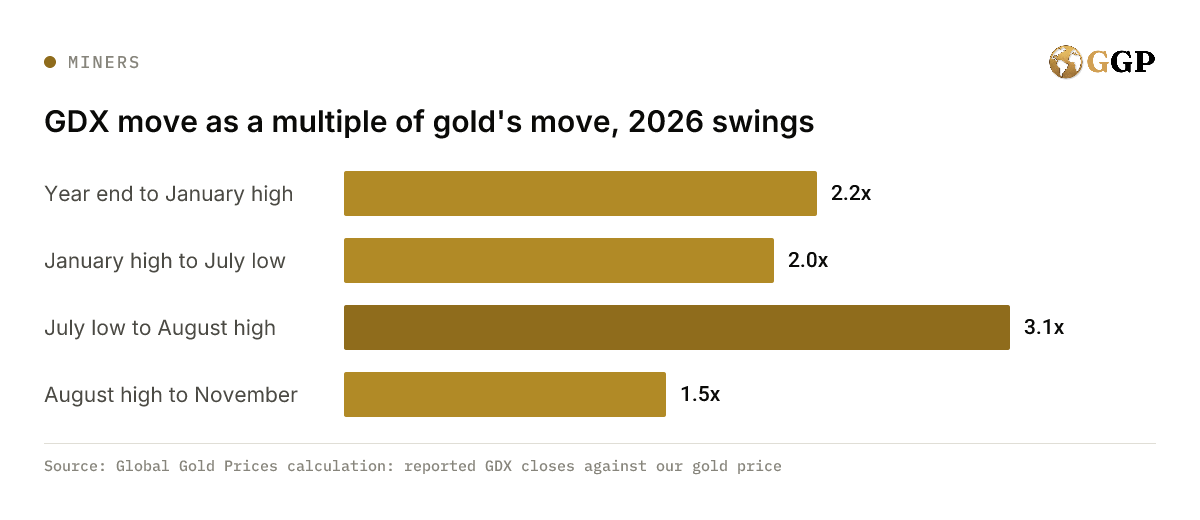
Usually further, in both directions. We lined up GDX closing prices with our own gold price on the same days, at each of gold's big turns in 2026. The miners matched gold on the January run-up, then moved further in every swing after it, and nearly three times as far in the summer rebound:
| Swing in 2026 | Gold price | GDX | Miners' move vs gold |
|---|---|---|---|
| 31 Dec to the 29 Jan record | +25.4% | +25.9% | about the same |
| 29 Jan record to the 16 Jul low | -26.4% | -33.9% | about 1.3 times |
| 16 Jul low to the 24 Aug high | +16.8% | +45.0% | about 2.7 times |
| 24 Aug high to 6 Nov | -12.7% | -15.4% | about 1.2 times |
| Year to 6 Nov | -5.9% | +2.1% | miners ahead |
Source: GDX closes from Quiver Quantitative and Stock Analysis; gold from Global Gold Prices daily data; our calculation.
| Item | Value |
|---|---|
| Year end to January high | 2.2x |
| January high to July low | 2.0x |
| July low to August high | 3.1x |
| August high to November | 1.5x |
That multiple is not fixed. Older studies put GDX's sensitivity to gold, its beta, near 1.4 over five years, and it changes with the period you measure. In 2025, when our gold price rose about 66%, GDX more than doubled, with reported full-year gains ranging from about 110% to about 150%. The direction of the multiple is the reliable part: miners amplify gold.
Why gold mining stocks amplify the gold price
The reason is operating leverage. A miner's costs do not move much when gold does, so a rise in the gold price falls mostly to profit.
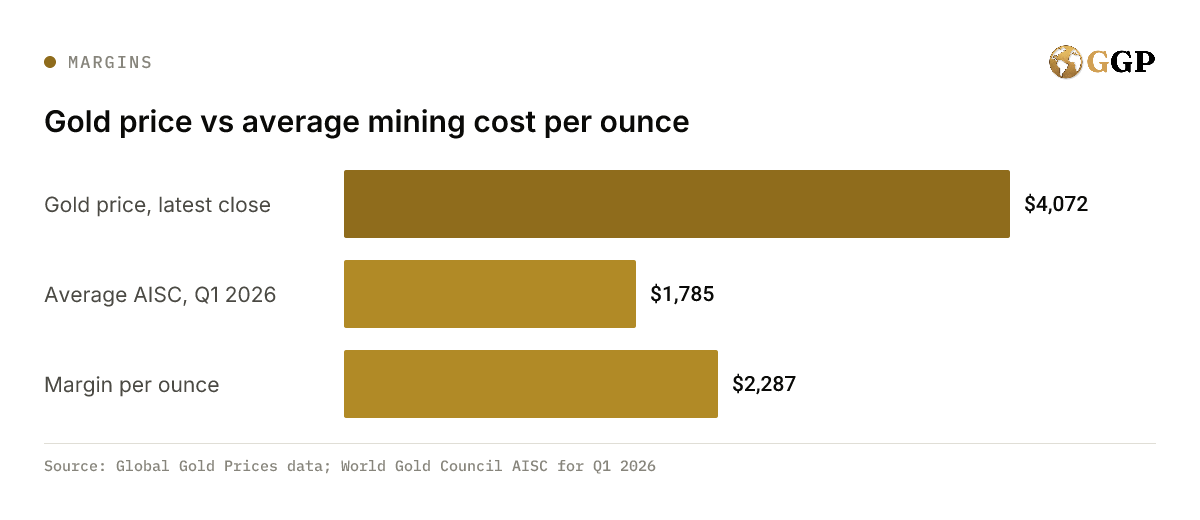
The industry measure is the all-in sustaining cost (AISC): what it costs to dig an ounce and keep the mines running. The World Gold Council put the global average at about $1,785 an ounce in the first quarter of 2026. Newmont, the largest producer, cut its 2026 guidance to about $1,520 in October.
On our latest gold price of about $4,072, that average cost leaves a margin of about $2,290 an ounce, by our calculation. A 10% rise in gold, about $407, lifts that margin by about 18%. A 10% fall cuts it by the same amount. That is why the shares move about twice as far.
| Item | Value |
|---|---|
| Gold price, latest close | $4,072 |
| Average AISC, Q1 2026 | $1,785 |
| Margin per ounce | $2,287 |
Costs rise too, which is the catch. The same World Gold Council series showed costs up about 16% from a year earlier, driven by energy, wages and royalties. When costs rise faster than gold, miners can lag even as the metal climbs.
The risks you take on with gold stocks
A miners fund carries company risks that a bar does not:
- Operations. A pit wall fails, a mill breaks down, a grade comes in lower than planned.
- Jurisdiction. Governments raise royalties or taxes when gold is high. Ghana moved to double its mineral royalty rates with gold above $4,000, as we reported in Ghana's royalty rise.
- Deals. Takeovers and share issues can dilute holders or change what you own, as the bid for Australia's largest miner showed in our Northern Star takeover report.
- The stock market. Miners are equities, so a broad sell-off can drag them down even when gold holds up.
GLD avoids those, but it carries the costs of storing gold and pays you nothing while you wait.
Junior miners and royalty companies: two other kinds of gold stock
Junior miners are the smaller producers and explorers, often with one mine or none yet. They swing even harder than the majors, because a single drill result or permit can make or break them. GDXJ, which holds them, carries an expense ratio of about 0.52% a year, $52 on every $10,000, close to GDX's 0.51%.
Royalty and streaming companies such as Franco-Nevada and Wheaton Precious Metals sit in the middle. They pay miners up front for a share of future gold, so they gain from higher prices without running pits or paying the wage and energy bills. Their shares have usually shown less volatility than the producers in GDX, though more than the bar-backed GLD.
Do gold stocks pay dividends?
Yes, many do, and GDX passes them on. Large producers such as Newmont and Agnico Eagle pay quarterly dividends, and royalty companies pay from the cash their streams earn. Dividend levels move with profits, so they rise in good years and are cut in bad ones. A gold bar pays nothing, so GLD has no income to distribute.
How gold stocks and gold ETFs are taxed in the US
This is the difference most investors miss. The IRS treats physical gold trusts such as GLD as collectibles, so long-term gains face a top rate of 28%. GDX holds ordinary company shares, so its long-term gains are taxed like other stocks, at up to 20% for the highest earners. Short-term gains are taxed as ordinary income in both. Inside an IRA, neither pays tax until you withdraw.
Which suits you: gold or gold miners?
GLD suits investors who want the gold price itself: a hedge for a stock portfolio, a store of value, or a way to own gold without storage. It tends to fall less in a stock market crash, and its value does not depend on any company's management.
GDX suits investors who want a bet on gold rising and can stomach bigger losses when it falls. It suits a smaller slice of a portfolio, held by people who accept that the 2026 swings of 15% to 45% can happen in a few months.
Some investors hold both: bars for ballast, a smaller stake in miners for upside. Whichever you choose, compare the fees on our gold ETFs compared table and check the latest holdings on the issuer's page before you buy. This is general information, not investment advice.
Frequently Asked Questions
+Are gold stocks a good investment?
Gold stocks can beat gold when the gold price rises, because miners' costs stay fairly fixed: GDX rose about 36% while gold rose about 12% between July and August 2026. They also fall harder, and they carry company and market risks a gold bar does not.
+What is the difference between gold stocks and gold ETFs?
A physical gold ETF such as GLD holds bars and follows the gold price almost one for one, less a fee of 0.40% a year. A gold stock or a miners fund such as GDX owns companies that dig gold, so it usually moves further than gold, up to nearly three times as far in 2026's swings, and pays dividends.
+Do gold stocks move with the price of gold?
Yes, in the same direction and usually further. In each of four big swings in 2026, GDX moved between about 1.5 and 3.1 times as far as our gold price, by our calculation, though stock market moves and company news can break the link for a time.
+Which is the largest gold mining ETF?
The VanEck Gold Miners ETF (GDX) is the largest US-listed gold miners fund. It charges 0.51% a year and tracks the MarketVector Global Gold Miners Index; its junior sister fund GDXJ charges about 0.52%.
+Are gold mining stocks taxed differently from gold ETFs?
Yes. The IRS taxes long-term gains on physical gold trusts such as GLD as collectibles, at up to 28%. Mining shares and funds such as GDX are taxed like ordinary stocks, at up to 20% on long-term gains.
More From the Gold Companies Desk
All Gold Companies stories →Related Reading
- Resolute Mining guidance rests on $4,000 gold
Resolute Mining's 2026 guidance assumes a $4,000 gold price, about 3% above Friday's close, though its mines in Mali and Senegal still clear their costs by about $1,380 an ounce on our numbers.
- Gold 2x ETF and 3x funds: how leveraged gold works
Gold rose about 2% over the past year, but a fund resetting to twice the daily move would have lost about 3%, and a 3x fund about 13%, on our price data. Here is why, and which leveraged gold funds trade today.
- Gold ETF India guide: costs, tax and how they compare
Indian gold ETFs charge about 0.44% to 0.81% a year, ₹440 to ₹810 on every ₹1 lakh, with 24 carat gold near ₹12,300 a gram at the world price. How they compare with Sovereign Gold Bonds, gold funds and jewellery.