

Gold units: troy ounce, gram, tola and tael explained
Why gold is priced in troy ounces, how to turn that into grams, tolas, taels and luong, and the mistakes that cost buyers money.
Key points
- Gold prices worldwide are quoted per troy ounce, which weighs 31.1035 grams, about 10% more than an ordinary ounce
- A tola, used in India, Pakistan and the Gulf, weighs 11.6638 grams, or exactly three eighths of a troy ounce
- A Hong Kong tael weighs 37.429 grams and a Vietnamese luong 37.5 grams, both about 1.2 troy ounces
- To convert any gold price, divide the ounce price by 31.1035 for a gram, then multiply by the unit's weight
Gold units trip up more buyers than almost anything else in the market. The world price is quoted per troy ounce, which weighs 31.1035 grams, but shops sell by the gram, the tola, the tael or the luong. Knowing how to convert between gold units, ounce, gram and tola, is the first step to checking whether a price is fair.
On our data, gold closed at about $124.63 a gram on 30 October 2026, when the ounce price was about $3,876. The examples below use a round $4,000 an ounce so the arithmetic is easy to follow.
What is a troy ounce?
A troy ounce is the standard unit for precious metals, and it is heavier than the ounce used for food. One troy ounce weighs 31.1034768 grams; one ordinary, or avoirdupois, ounce weighs about 28.35 grams. The difference is close to 10%.
The troy system dates back to medieval trade fairs in Troyes, France, and survived in precious metals long after other trades moved on. The US National Institute of Standards and Technology still defines it in grains: 480 grains to the troy ounce.
There is a trap in the other direction. A troy pound has only 12 troy ounces and weighs about 373 grams, lighter than the ordinary 454 gram pound. Nobody prices gold in troy pounds today, but the term turns up in old documents and coin catalogues.
Every major benchmark uses the troy ounce. The London price, the COMEX futures contract (100 troy ounces per contract) and the spot price on this site all quote dollars per troy ounce. Our guide to how the gold price is set explains how those benchmarks are formed.
How do I convert an ounce price to grams?
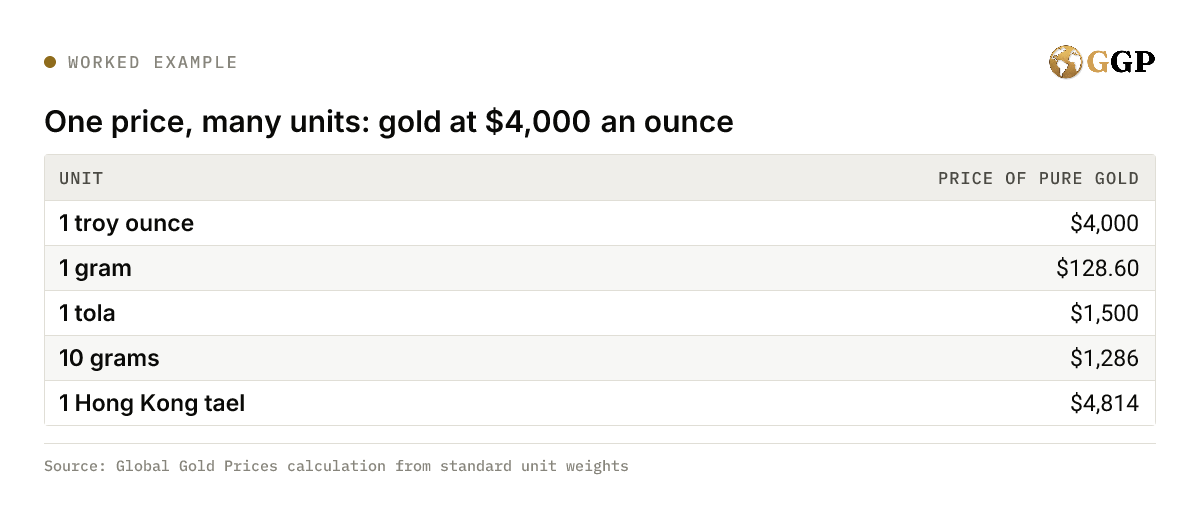
Divide by 31.1035. At $4,000 an ounce, one gram of pure gold costs $4,000 / 31.1035, which is about $128.60.
To go the other way, multiply the gram price by 31.1035. A shop quoting 24 karat gold at $130 a gram is charging about $4,043 an ounce, a premium of about 1% over a $4,000 world price.
That one-line check is worth doing every time. Retail gold always costs more than the world price, because of fabrication, dealer margin and tax, and our explainer on gold premiums breaks those costs down. Converting the shop's price back to an ounce figure tells you how big the premium really is.
What is a tola?
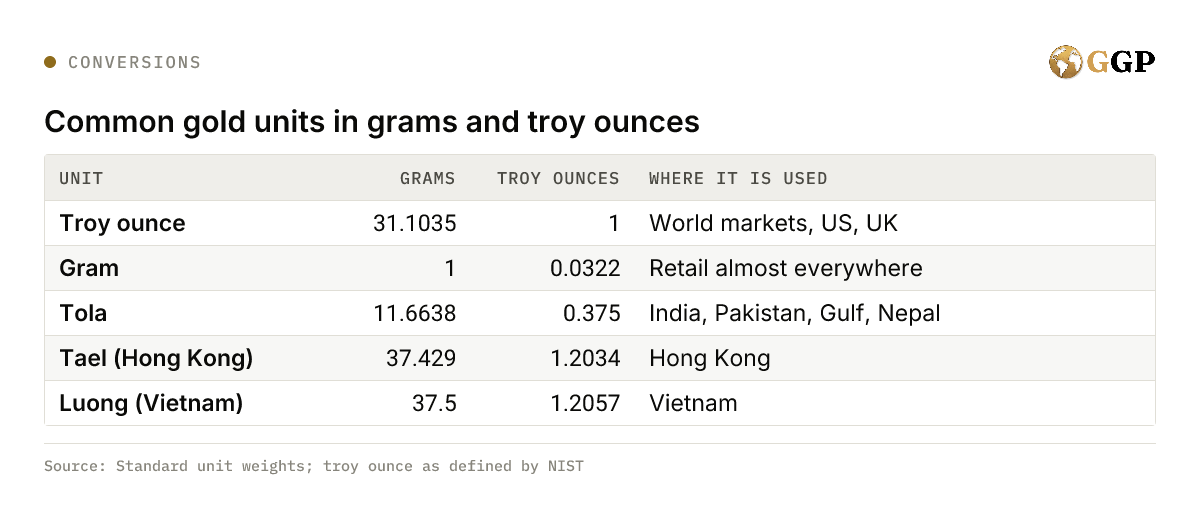
A tola is a traditional South Asian weight of 11.6638 grams, which is 180 grains, or exactly three eighths of a troy ounce. It is still the everyday unit for gold in Pakistan, Nepal and parts of India, and the Gulf's popular ten tola bar, about 116.6 grams, is sold across the UAE and Saudi Arabia.
At $4,000 an ounce, a tola of pure gold costs $1,500. The arithmetic is neat because a tola is 0.375 of an ounce.
India now prices gold mainly per 10 grams rather than per tola, and jewellery is weighed and hallmarked in grams under the Bureau of Indian Standards system. Many families still think in tolas, and some jewellers round the tola to 10 grams in conversation. That gap is about 1.66 grams, or 14% of a tola, so always ask which one a price refers to.
What is a tael, and why are there two?
The tael, or liang, is the traditional Chinese unit, and it comes in different sizes.
In Hong Kong, the gold tael used by the Chinese Gold and Silver Exchange Society weighs 37.429 grams, about 1.2 troy ounces. At $4,000 an ounce, a Hong Kong tael costs about $4,814.
In mainland China, the market moved to grams. The Shanghai Gold Exchange quotes yuan per gram, and when people on the mainland say liang today they usually mean 50 grams, a modern metric value. Those two meanings of the same word differ by a third, so check which one a seller means.
What units do Vietnam, Thailand and Japan use?
Vietnam prices gold per luong, also called a cay or tael, which weighs 37.5 grams. The smaller unit is the chi, a tenth of a luong, or 3.75 grams. Prices for the SJC bar are quoted in millions of dong per luong.
Thailand uses the baht, which for gold bars weighs 15.244 grams. Thai bars are usually 96.5% pure rather than 99.99%, so a one-baht bar holds about 14.7 grams of pure gold. Jewellery baht is weighed slightly differently, so compare like with like.
Japan's retail market uses grams, but the traditional monme, 3.75 grams, still appears in pearl and jewellery trades.
How heavy are investment bars?
Bars follow either troy ounces or grams.
| Bar | Weight | Troy ounces |
|---|---|---|
| London Good Delivery bar | about 12.4 kg | about 400 (350 to 430 allowed) |
| Kilobar | 1,000 g | 32.15 |
| Ten tola bar | 116.64 g | 3.75 |
| One ounce bar or coin | 31.1035 g | 1 |
| 10 gram bar | 10 g | 0.32 |
The large London bar is the unit central banks and big vaults trade, under the London Bullion Market Association's Good Delivery rules. It is not a fixed weight: each bar is weighed and priced on its actual gold content, between 350 and 430 troy ounces. The kilobar is the most common bar in Asian markets, and in Switzerland and Hong Kong.
Does purity change the conversion?
Yes, and it is the most common source of confusion. Every unit above measures weight. The price of pure gold in that weight is the world price; the price of jewellery is lower per gram of total weight, because it is not all gold.
A 22 karat item is 22/24 gold, or about 91.7%. One tola of 22 karat jewellery holds about 10.69 grams of pure gold. At $4,000 an ounce, that gold is worth about $1,375, before making charges.
Karat and carat are also different things. A karat measures gold purity; a carat is a gemstone weight of 0.2 grams. Our guide on how to tell if gold is real explains hallmarks, which state purity as a number such as 916 for 22 karat or 750 for 18 karat.
How do I convert a price into my currency?
Do the weight conversion first, then the currency. Take the ounce price in dollars, divide by 31.1035 for a gram, multiply by the unit weight, then multiply by the exchange rate.
Here is a worked example for a 10 gram price in India at $4,000 an ounce and 95.29 rupees to the dollar, close to the rate in late October 2026: $4,000 / 31.1035 x 10 = $1,286; $1,286 x 95.29 = about 122,550 rupees for 10 grams of pure gold, before duty and tax.
For a tola in Dubai at the fixed rate of 3.6725 dirhams to the dollar: $1,500 x 3.6725 = about 5,509 dirhams for a tola of pure gold.
The local price you see in a shop will be higher. Import duty, sales tax and the dealer's premium are added on top, and they differ by country. The conversion gives you the floor from which to judge them.
Which conversion mistakes cost buyers money?
Five come up again and again.
- Using the food ounce. Dividing an ounce price by 28.35 instead of 31.1035 makes a gram look about 10% dearer than it is, so a fair shop price can look like a bargain or a rip-off depending on which way the error runs.
- Mixing up the two taels. A Hong Kong tael of 37.429 grams and a mainland liang of 50 grams differ by a third. Quotes from Chinese sources need checking for which one they mean.
- Treating a tola as 10 grams. The real tola is 11.6638 grams. A price per tola compared with a price per 10 grams will always look about 17% higher.
- Forgetting purity. A price per gram of 22 karat or 18 karat jewellery covers metal that is only 91.7% or 75% gold. Convert to pure gold before comparing it with the world price.
- Comparing a buying price with a selling price. Dealers quote two prices, and the gap between them is their margin. Our guide on how to sell gold explains how to judge the buyback side.
A good habit is to convert every quote back to dollars per troy ounce of pure gold. Once every price is in the same unit, the premium a seller is charging becomes obvious, whatever unit the shop uses.
Quick reference
- 1 troy ounce = 31.1035 grams = 480 grains
- 1 gram = 0.03215 troy ounces
- 1 tola = 11.6638 grams = 0.375 troy ounces
- 1 Hong Kong tael = 37.429 grams; 1 Vietnamese luong = 37.5 grams
- 1 Thai baht (bar) = 15.244 grams
- 1 kilogram = 32.1507 troy ounces
Related Reading
- Gold price 26 November: why gold fell 0.6%
The gold price fell about 0.6% to near $3,566 on Thursday 26 November, as thin Thanksgiving trading let hot US inflation data and bets on another Federal Reserve rate rise pull it back from $3,600. Next up: a shortened US trading session on Friday.
- Why is gold down today? Gold price falls 0.3% on Fed bets
The gold price is down about 0.3% near $3,572 an ounce so far on Thursday, as hot US inflation data keep a December Fed rate rise all but certain and a rebound in stocks cools safe haven demand. US markets are closed for Thanksgiving, so trade should stay thin for the rest of the day.
- Gold price 25 November: why gold rose 0.9%
The gold price rose about 0.9% to near $3,589 on Wednesday 25 November, bouncing back from its lowest level since August 2025 after hot US inflation data, as Treasury yields fell and stocks recovered. Next up: a thin Thanksgiving session and the European Central Bank's meeting account on Thursday.