

Gold ETF: what it is and how it tracks the gold price
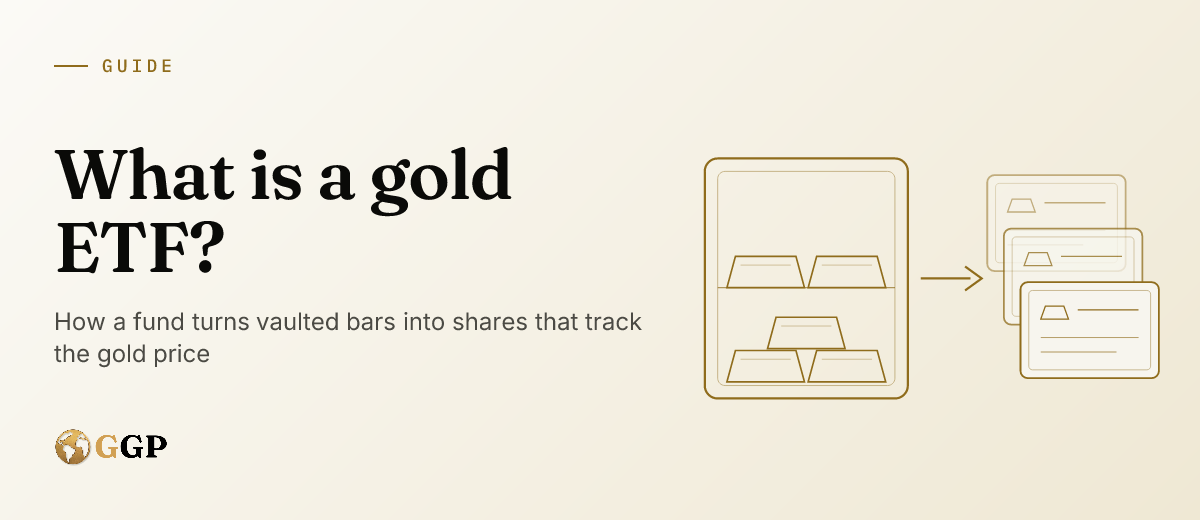
A gold ETF holds gold bars in a vault and splits them into shares, so each share follows the gold price, less a fee of 0.09% to 0.40% a year at the big US funds.
Key points
- A gold ETF is a listed fund that holds gold, so each share tracks the gold price with no metal to store
- The biggest US funds hold allocated bars in bank vaults and charge 0.09% to 0.40% a year
- One GLD share held 0.1000 oz of gold at launch in 2004 and about 0.0915 oz now, the fee taken in gold
- Futures-based and mining funds also carry "gold" in the name but behave very differently
A gold ETF is an exchange-traded fund that owns gold, usually physical bars in a bank vault, and splits that gold into shares you can buy through a brokerage account like any stock. Each share moves with the gold price, minus a yearly fee that ranges from 0.09% to 0.40% at the largest US funds.
That is the whole idea. For $77 or so, the value of the gold in one iShares Gold Trust share, you get the price of gold without buying coins, paying a dealer's markup, insuring a safe or worrying about whether a bar is genuine. The fund does the buying and storing, and you can sell your shares in seconds during market hours.
What is an ETF, in one paragraph?
An ETF, or exchange-traded fund, is a pool of assets owned by a trust or fund that is divided into shares and listed on a stock exchange. You buy and sell those shares through a broker at the market price, the same way you would buy Apple or Coca-Cola. The fund publishes the value of what it holds, its net asset value (NAV), every day, and large dealers create or cancel shares to keep the market price close to that value. Swap the company shares for gold bars and you have the fund this guide is about.
How does a gold ETF work?
A physically backed fund buys gold bars that meet the London market's good delivery standard, roughly 400 troy ounces each, and keeps them with a custodian bank. Each share is a claim on a slice of that gold. When the gold price rises 1%, the gold behind each share is worth 1% more, and the share price follows.
New shares are made in large blocks, often tens of thousands of shares at a time. A dealer called an authorized participant delivers gold (or cash to buy it) to the trust and receives a block of new shares, which it sells on the exchange. When investors are selling, the process runs the other way: the dealer hands shares back and takes out gold. This creation and redemption is what keeps the share price close to the value of the gold behind it.
The fund values its gold once a day at the LBMA Gold Price, set in London each afternoon. Our guide to how the gold price is set explains how that benchmark relates to the spot price you see quoted all day and to COMEX futures.
You can see every large US fund side by side, with fees and assets, on our gold ETFs compared page.
Who holds the gold in a gold ETF?
A custodian bank holds it, in vaults named in the fund's prospectus, and the bars are allocated, meaning specific numbered bars belong to the trust rather than a general claim on a bank's metal. The SPDR Gold Shares (GLD) uses HSBC Bank USA as custodian, with the gold in London vaults. For the iShares Gold Trust (IAU), the custodian is JPMorgan Chase Bank, with vaults that can be in London, New York or Toronto.
The large funds publish a full bar list, so anyone can check the serial number, refiner and weight of each of the thousands of 400-ounce bars. That is a level of proof few coin dealers offer. Our explainer on allocated vs unallocated gold covers why that distinction matters if a bank fails.
How closely does a gold ETF track the gold price?
Very closely, because the fund's value is its gold. The main difference is the fee. A fund cannot send you a bill, so it sells a small amount of gold each month to pay its costs, and the gold behind each share slowly shrinks.
GLD shows the effect plainly. Each share was backed by one-tenth of an ounce when it launched in November 2004. By our calculation from its latest published NAV and our London gold price, a share now holds about 0.0915 oz. So about 8.5% of the original gold has gone to fees over 22 years at 0.40% a year.
Over the same stretch the gold price went from about $442 an ounce on GLD's first day to about $4,072 at the latest close, on our price data. That is roughly nine times higher. The fee took a slice; the gold price did the rest.
There is a second, smaller gap during the day. Gold trades around the clock, but US ETFs trade only during New York hours. So the share price can drift a little above or below NAV, especially at the open, before dealers close the gap.
Three kinds of gold fund
Not every fund with "gold" in its name holds gold.
| Type | What it holds | Tracks | Main risk |
|---|---|---|---|
| Physical gold ETF | Allocated gold bars in a vault | The gold price, minus the fee | Gold price falls |
| Futures-based gold ETF | Gold futures contracts | Gold futures, after roll costs | Roll costs and futures tax rules |
| Gold miners ETF | Shares in gold mining companies | Mining stocks | Company costs, debt and the stock market |
Physical funds are the plain version, and they are what most people mean by the term. Futures-based funds buy contracts on an exchange instead of bars. They can trail the gold price because each contract has to be sold and replaced before it expires, and that roll can cost money. Leveraged funds, which aim for two or three times the daily move, use futures and reset every day, so over weeks they drift away from a simple multiple of the gold price.
Miners funds hold companies, not metal. Their shares often move more than gold, up and down, because a miner's profit is the gold price minus its costs. When gold rises 10%, a miner's margin can rise far more, and the opposite happens on the way down.
What does a gold ETF cost?
The yearly fee, called the expense ratio, is the main cost. At the large US funds it runs from 0.09% a year, $9 on every $10,000, at the iShares Gold Trust Micro (IAUM), to 0.40%, $40 on every $10,000, at GLD.
Then come the costs of trading: a broker's commission, now zero at most US brokers, and the bid-ask spread, the small gap between buying and selling prices. For the biggest funds that gap is usually a cent or two a share.
Compare that with physical gold. A one-ounce coin typically sells for several percent above the spot price, and a dealer buying it back pays below spot. Our guide to gold premiums sets out those markups. An ETF share carries no such markup, though you pay its fee every year you hold it.
What are the risks of holding gold this way?
The biggest risk is the gold price itself. On our data gold is about 25% below its January record of about $5,426 an ounce, and an ETF holder has felt every dollar of that fall.
Beyond the price, there are a few smaller risks:
- Counterparty and custody: the gold is held by a bank and depends on the trust's legal structure and the custodian's controls. Allocated bars and published bar lists reduce this risk but do not remove it.
- You cannot easily take delivery: most funds redeem only in large blocks for authorized participants. A few, such as the VanEck Merk Gold ETF (OUNZ), let ordinary holders swap shares for metal for a fee.
- Market hours: you can only trade when US markets are open, while gold can move sharply overnight.
- Tax: in the US, the IRS treats gains on physical gold ETFs held more than a year as collectibles, taxed at up to 28%, rather than the lower rates on most stocks.
Gold ETF or physical gold?
It depends on what you want the gold for. An ETF is cheaper to buy and sell, easy to hold in a brokerage account or IRA, and simple to size, from one share upward. Physical coins and bars cost more to buy and store, but they sit outside the financial system and need no broker or bank.
We compare the two, along with bonds linked to gold, in ETFs vs physical gold vs gold bonds. Our guides to the best gold ETFs and to GLD vs IAU vs GLDM go into which fund suits which buyer.
Frequently Asked Questions
+What does ETF stand for?
ETF stands for exchange-traded fund. It is a fund divided into shares that trade on a stock exchange, so you can buy and sell it through a broker at the market price during the trading day.
+Is an exchange-traded gold fund backed by real gold?
A physical gold ETF is. The large US funds hold allocated bars of about 400 troy ounces in bank vaults and publish bar lists; futures-based and mining funds do not hold metal.
+How much does a gold ETF cost?
The yearly fee at the large US funds runs from 0.09% to 0.40%, or $9 to $40 on every $10,000. Most US brokers charge no commission, so the other cost is the small bid-ask spread.
+Can I turn ETF shares into gold bars?
Usually not. Most funds redeem only in large blocks for authorized participants, though a few, such as the VanEck Merk Gold ETF (OUNZ), let holders swap shares for metal for a fee.
+Is an ETF safer than owning physical gold?
It removes the risks of storing and authenticating metal yourself, but adds reliance on a custodian bank and the trust's structure. Both lose value when the gold price falls, which on our data is about 25% below its January record.
Related Reading
- Resolute Mining guidance rests on $4,000 gold
Resolute Mining's 2026 guidance assumes a $4,000 gold price, about 3% above Friday's close, though its mines in Mali and Senegal still clear their costs by about $1,380 an ounce on our numbers.
- Gold 2x ETF and 3x funds: how leveraged gold works
Gold rose about 2% over the past year, but a fund resetting to twice the daily move would have lost about 3%, and a 3x fund about 13%, on our price data. Here is why, and which leveraged gold funds trade today.
- Gold ETF India guide: costs, tax and how they compare
Indian gold ETFs charge about 0.44% to 0.81% a year, ₹440 to ₹810 on every ₹1 lakh, with 24 carat gold near ₹12,300 a gram at the world price. How they compare with Sovereign Gold Bonds, gold funds and jewellery.