

Best gold ETF: 10 funds ranked by fee and size
The cheapest gold ETFs charge 0.09% to 0.10% a year, about $10 on every $10,000, against 0.40% for the biggest. We rank ten US funds on fee, size and how they hold the gold price.
Key points
- GLDM and IAUM charge 0.10% and 0.09% a year, about $10 on every $10,000
- GLD holds 55% of the $263 billion in those ten funds and charges 0.40%, or $40 on every $10,000
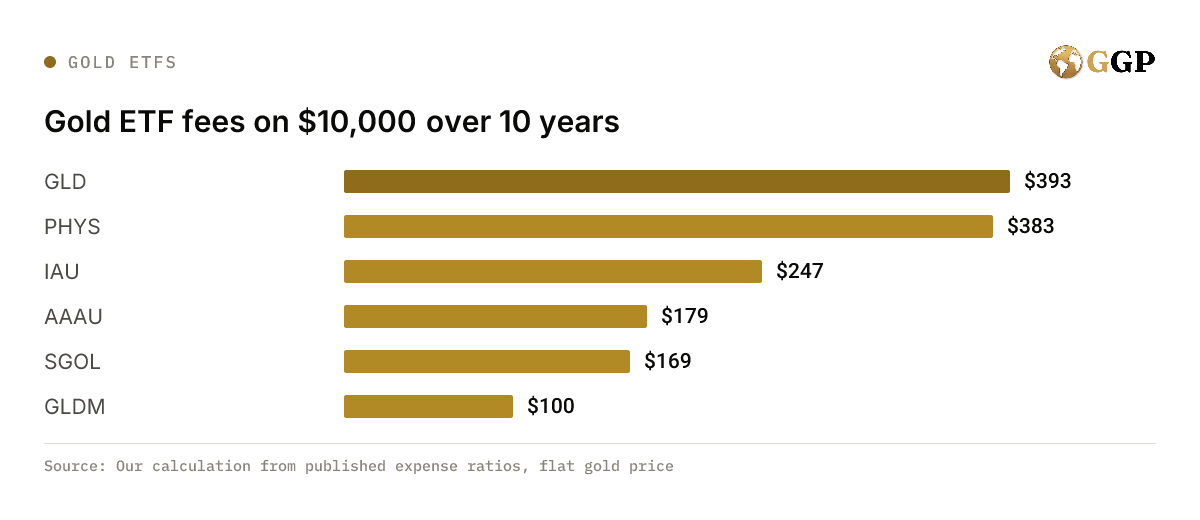
- On our figures, $10,000 in GLD loses about $393 to fees over 10 years, against about $100 in GLDM
- The right fund depends on whether you hold for years, trade often or buy a share at a time
- Over the past year every fund trailed our gold price by roughly its fee: 0.06 points for IAUM, 0.39 for GLD
There is no single best gold ETF for everyone, but on cost the field splits clearly: the SPDR Gold MiniShares Trust (GLDM) and the iShares Gold Trust Micro (IAUM) charge 0.09% to 0.10% a year, while the SPDR Gold Shares (GLD) charges 0.40%. All three hold physical gold bars, so the price you track is the same.
That leaves three questions that really separate them: what you pay each year, how easily you can trade, and how the fund holds its gold. We ranked ten US-listed funds on all three, using the fee each issuer publishes, the assets in our gold ETFs compared table and our own gold price data.
How we ranked the best gold ETFs
Every fund below is a physically backed trust. Each one buys allocated gold bars, keeps them with a bank custodian in a vault, and values them at the LBMA Gold Price set in London each afternoon. Its net asset value (NAV) per share is simply the gold it holds, at that price, minus fees owed.
Because the gold is the same, the fee is the biggest thing a long-term holder controls. The expense ratio is taken out of the fund's gold, a sliver at a time, so it shows up as a slowly shrinking amount of gold behind each share rather than a bill. We turned each fee into dollars on a $10,000 holding over 1, 5 and 10 years, assuming the gold price stays where it is.
Size and trading volume matter next. A bigger fund usually trades more shares, which keeps the bid-ask spread (the gap between what buyers pay and sellers get) tight. For someone buying once and holding, a spread of a cent or two matters far less than a fee charged every year. For a trader moving in and out every week, it can matter more.
Last, we looked at structure: who holds the gold, where, and whether you can swap shares for metal.
The 10 US gold ETFs compared
| Fund | Ticker | Fee a year | Fee on $10,000, 1 year | Assets | Share of the 10 funds |
|---|---|---|---|---|---|
| SPDR Gold MiniShares Trust | GLDM | 0.10% | $10 | $31.3bn | 11.9% |
| iShares Gold Trust Micro | IAUM | 0.09% | $9 | $8.0bn | 3.0% |
| Franklin Responsibly Sourced Gold ETF | FGDL | 0.15% | $15 | $0.4bn | 0.2% |
| abrdn Physical Gold Shares ETF | SGOL | 0.17% | $17 | $7.4bn | 2.8% |
| GraniteShares Gold Trust | BAR | 0.1749% | $17 | $1.4bn | 0.5% |
| Goldman Sachs Physical Gold ETF | AAAU | 0.18% | $18 | $2.8bn | 1.0% |
| iShares Gold Trust | IAU | 0.25% | $25 | $63.8bn | 24.3% |
| VanEck Merk Gold ETF | OUNZ | 0.25% | $25 | $2.8bn | 1.1% |
| Sprott Physical Gold Trust | PHYS | 0.39% | $39 | $14.7bn (30 Jun) | not in total |
| SPDR Gold Shares | GLD | 0.40% | $40 | $145.2bn | 55.2% |
Assets are from the end of September and come from our ETF holdings table, except for PHYS, a Canadian trust that reports quarterly: its latest filing shows $14.7bn at 30 June, so it is left out of the shares, which are our calculation across the other nine funds. Fees are the issuers' published expense ratios (PHYS is its management expense ratio). Fees change, so check the fund's own page on the day you buy.
| Item | Value |
|---|---|
| GLD | $393 |
| PHYS | $383 |
| IAU | $247 |
| AAAU | $179 |
| SGOL | $169 |
| GLDM | $100 |
| IAUM | $90 |
Which is the cheapest gold ETF?
IAUM is the cheapest at 0.09% a year, $9 on every $10,000, with GLDM a hair behind at 0.10%, $10 on every $10,000. Over 10 years at a flat gold price, that gap to GLD adds up: by our calculation, $10,000 in GLD gives up about $393 to fees, IAU about $247 and GLDM about $100.
The cheap funds are not small experiments any more. GLDM alone held about $31 billion at the end of September, making it the third-largest US gold fund. Our earlier piece on low-fee mini funds taking 15% of the market traced how fast that share has grown since GLDM launched in June 2018 and IAUM in June 2021.
Which gold ETF is easiest to trade?
GLD is the easiest gold ETF to trade in size. It holds about 55% of the assets in the ten funds, trades millions of shares a day and has by far the deepest listed options market of any gold fund, which is why banks, hedge funds and options traders keep using it despite the fee.
IAU is the second-most traded and also has an active options market. The smaller funds trade far less. That rarely matters for a $5,000 order placed during US market hours with a limit price, but it can widen the spread on a large order or in a fast market.
Gold per share: what each fund actually holds
Share prices differ a lot, from around $30 for PHYS to around $370 for GLD, but that says nothing about value. Each share is a claim on a fixed amount of gold that shrinks slightly every year as the fee is paid.
| Ticker | Gold per share | Worth at today's gold price |
|---|---|---|
| GLD | 0.0915 oz | $373 |
| GLDM | 0.0198 oz | $81 |
| IAU | 0.0188 oz | $77 |
| FGDL | 0.0133 oz | $54 |
| IAUM | 0.0100 oz | $41 |
| AAAU | 0.0099 oz | $40 |
| BAR | 0.0099 oz | $40 |
| OUNZ | 0.0096 oz | $39 |
| SGOL | 0.0095 oz | $39 |
| PHYS | 0.0076 oz | $31 |
We worked out gold per share by dividing each fund's last published NAV by our London gold price on the same day, then valued it at the latest close of about $4,072 an ounce. A low share price, like IAUM's or AAAU's, suits small accounts and brokers that do not sell fractional shares.
How each gold ETF holds its gold
The structures are close, with a few differences worth knowing.
GLD's gold sits in London vaults with HSBC Bank USA as custodian, according to the trust's SEC filings. IAU uses the London branch of JPMorgan Chase Bank as custodian, and its filings allow vaults in New York, Toronto and London. GLDM's original custodian is ICBC Standard Bank; State Street added a second custodian, with vaults in London, New York and Zurich, in December 2023.
SGOL keeps its bars in Zurich and London. OUNZ is built around delivery: holders can exchange shares for physical gold, including coins such as American Gold Eagles, for a fee. PHYS is different again. It is a closed-end trust run by Sprott from Canada, with gold held at the Royal Canadian Mint, and holders can redeem units for bars once they own enough.
For most buyers these details matter less than the fee. They matter if you want metal back one day, or if you prefer a particular custodian or country. Our guide to allocated vs unallocated gold explains what "allocated" bars mean for your claim.
Which gold ETF suits which buyer?
- Long-term holder, any account size: the lowest fee wins over time. GLDM and IAUM charge 0.10% and 0.09%, with IAU at 0.25% for those who prefer a larger, older fund.
- Active trader or options user: GLD's trading volume and options market are hard to match, and the 0.40% fee costs a short-term holder little. $10,000 held for three months costs about $10 in fees.
- Small or regular purchases: low share prices of around $40 (IAUM, AAAU, BAR, SGOL, OUNZ) make it easy to buy one share at a time.
- Want the option of metal back: OUNZ and PHYS offer delivery or redemption routes; check the minimums and fees in each prospectus.
- Taxable US account: every fund here holds physical gold, so long-term gains are taxed as collectibles at up to 28%, under IRS rules. PHYS, as a Canadian trust, has its own tax treatment as a passive foreign investment company. Our tax guide sets out how gold ETFs are taxed in the US.
None of this is a recommendation to buy a particular fund. It is the arithmetic of what each one costs and how it works, from published figures and our own data.
What to check before you buy a gold ETF
A few minutes on the fund's own page answers most of the questions that matter. Five things are worth checking each time.
- The fee, today. Expense ratios change, usually downward. BAR's fee is 0.1749%, not a round number, and OUNZ was cut from 0.40% to 0.25% in 2020, according to its sponsor. Check the figure on the day you buy, and turn it into dollars: multiply your holding by the fee.
- Assets and liquidity. A fund with billions in assets and steady volume is cheap to trade. Of the ten funds here, five held more than $7 billion at the end of September, and the smallest, FGDL, held about $0.4 billion.
- The bid-ask spread. Your broker's quote screen shows it. On a $40 share, a 2-cent spread is 0.05% of the price, about six months of fees at the cheapest funds, so it adds up if you trade often.
- Gold per share. Most issuers publish it daily. Multiply by the gold price to see what each share should be worth, and compare with the price you are paying.
- The prospectus summary. It names the custodian, the vault cities, how fees are paid and whether you can ever take delivery.
One practical point on orders: use a limit order during regular US market hours rather than a market order at the open. Gold trades all night, so the first minutes of the US session can see the share price catching up with an overnight move.
If you already own GLD in a taxable account, switching to a cheaper fund is a sale. With gold about 126% higher than five years ago on our data, the tax on a long-held gain can outweigh years of fee savings, so run the numbers first. In an IRA, the switch has no immediate tax cost.
Do gold ETFs track the gold price closely?
Yes. Physical gold ETFs track the spot price closely because their NAV is the gold they hold, valued at the London price. The main gap is the fee, so over a year a fund charging 0.40% will trail the gold price by about 0.40%, before small effects from timing and trading.
We checked that against the funds' own share prices. Over the year to 6 November 2026, our gold price rose 2.15%. Every fund trailed it, and the gap lines up with the fee: the two cheapest funds finished within a tenth of a point of gold, and GLD about 0.39 points behind.
| Fund | 1-year change | Gap to our gold price | Yearly fee |
|---|---|---|---|
| Gold (our London price) | +2.15% | ||
| IAUM | +2.09% | -0.06 points | 0.09% |
| GLDM | +2.06% | -0.09 points | 0.10% |
| SGOL | +2.00% | -0.15 points | 0.17% |
| AAAU | +1.99% | -0.16 points | 0.18% |
| BAR | +1.96% | -0.19 points | 0.1749% |
| FGDL | +1.93% | -0.22 points | 0.15% |
| OUNZ | +1.91% | -0.24 points | 0.25% |
| IAU | +1.88% | -0.27 points | 0.25% |
| PHYS | +1.82% | -0.33 points | 0.39% |
| GLD | +1.76% | -0.39 points | 0.40% |
Source: fund closing prices from Yahoo Finance, via our ETF table; gold from Global Gold Prices daily data; our calculation, year to 6 November 2026. Fund shares close at 4 pm New York time and our gold price at 5:30 pm, so small differences from the fee also reflect timing.
Share prices can also sit a little above or below NAV during the day, mostly because the funds trade on US hours while gold trades around the clock. Large dealers, called authorized participants, create or redeem shares when the gap opens, which pulls the price back. Our gold premiums guide covers how that compares with the markup on coins and bars.
On our data, gold is up about 2% over the past year at about $4,072 an ounce, and about 25% below its January record. A fund's job is to pass that move on, less its fee, and the cheapest funds pass on the most.
Frequently Asked Questions
+What is the cheapest gold ETF?
Among large US funds, the iShares Gold Trust Micro (IAUM) is the cheapest at 0.09% a year, $9 on every $10,000. The SPDR Gold MiniShares Trust (GLDM) is close behind at 0.10%, $10 on every $10,000.
+What is the biggest gold ETF?
The SPDR Gold Shares (GLD) is the biggest, with about $145 billion in assets at the end of September. That is about 55% of the money in the ten US gold funds we track.
+Is GLD or GLDM better?
They hold the same kind of gold, from the same sponsor, but GLD charges 0.40% a year and GLDM 0.10%. GLD suits traders who need its volume and options market; for a long-term holder, GLDM costs about $293 less on $10,000 over 10 years, by our calculation.
+Do gold ETFs pay dividends?
No. Physical gold ETFs hold metal that earns no income, so there is nothing to pay out. Your return is the change in the gold price, less the yearly fee.
+How are gold ETF gains taxed in the US?
The IRS treats long-term gains on physical gold ETFs as collectibles gains, taxed at a maximum of 28%. Short-term gains, on shares held a year or less, are taxed as ordinary income.
More From the Flows & Data Desk
All Flows & Data stories →Related Reading
- Resolute Mining guidance rests on $4,000 gold
Resolute Mining's 2026 guidance assumes a $4,000 gold price, about 3% above Friday's close, though its mines in Mali and Senegal still clear their costs by about $1,380 an ounce on our numbers.
- Gold 2x ETF and 3x funds: how leveraged gold works
Gold rose about 2% over the past year, but a fund resetting to twice the daily move would have lost about 3%, and a 3x fund about 13%, on our price data. Here is why, and which leveraged gold funds trade today.
- Gold ETF India guide: costs, tax and how they compare
Indian gold ETFs charge about 0.44% to 0.81% a year, ₹440 to ₹810 on every ₹1 lakh, with 24 carat gold near ₹12,300 a gram at the world price. How they compare with Sovereign Gold Bonds, gold funds and jewellery.