

GLD vs IAU vs GLDM: which gold ETF fits you?
All three gold ETFs hold vaulted gold and track the same price, but fees of 0.40%, 0.25% and 0.10% a year cost $393, $247 and $100 on $10,000 over a decade, by our calculation.
Key points
- GLD vs IAU vs GLDM comes down to fee against liquidity: 0.40%, 0.25% and 0.10% a year
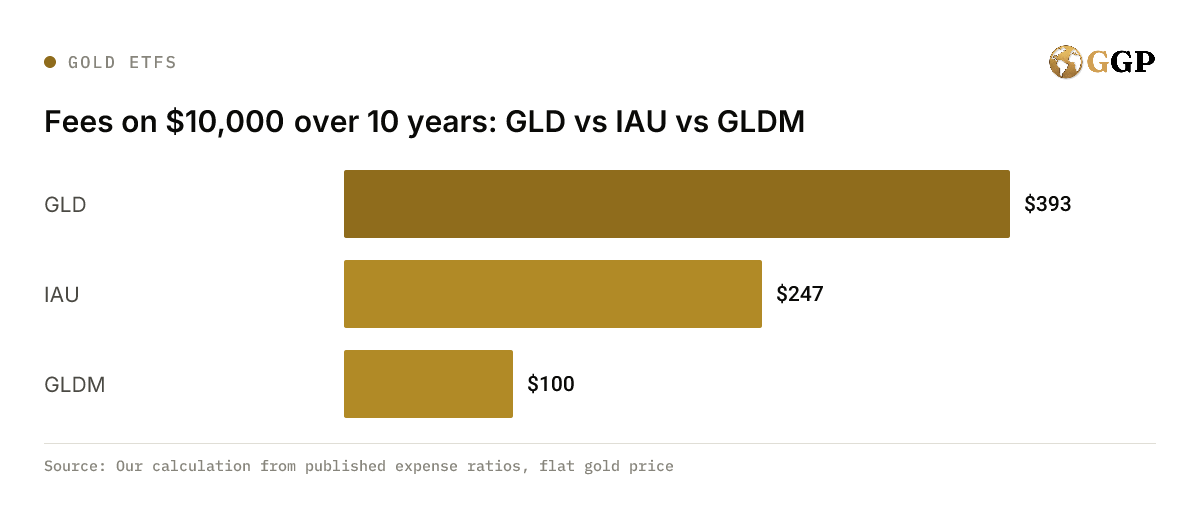
- Over 10 years, fees on $10,000 cost about $393 in GLD, $247 in IAU and $100 in GLDM, by our calculation
- The three hold about 91% of US gold ETF assets we track, roughly 1,750 tonnes of gold
- GLD's edge is trading volume and options; for buy-and-hold investors the cheaper funds keep more gold
GLD vs IAU is the most common comparison in gold ETFs, and GLDM makes it a three-way choice: all three hold physical gold in vaults and track the same London price, but they charge 0.40%, 0.25% and 0.10% a year. That is $40, $25 and $10 on every $10,000 you hold.
So the real question is what you are paying for. GLD's extra fee buys the deepest market and the biggest options book in gold ETFs. IAU and GLDM give up some of that for a lower cost. Which matters more depends on how long you hold and how you trade.
GLD vs IAU vs GLDM: the three gold ETFs at a glance
| GLD | IAU | GLDM | |
|---|---|---|---|
| Full name | SPDR Gold Shares | iShares Gold Trust | SPDR Gold MiniShares Trust |
| Sponsor | State Street | BlackRock | State Street |
| Launched | Nov 2004 | Jan 2005 | Jun 2018 |
| Fee a year | 0.40% | 0.25% | 0.10% |
| Fee on $10,000, 1 year | $40 | $25 | $10 |
| Fee on $10,000, 10 years | $393 | $247 | $100 |
| Assets | $145.2bn | $63.8bn | $31.3bn |
| Gold held (our estimate) | about 1,060 t | about 466 t | about 228 t |
| Gold per share | 0.0915 oz | 0.0188 oz | 0.0198 oz |
| Value of that gold today | $373 | $77 | $81 |
| Listed options | Deep, very active | Active | Much smaller |
Fees are the sponsors' published expense ratios. Assets are from the end of September, from our ETF holdings table. Gold held, gold per share and 10-year fee cost are our calculations: assets and NAV divided by our London gold price on the same day, and fees compounded at a flat gold price. Today's value uses our latest close of about $4,072 an ounce.
For every large US fund side by side, see our gold ETFs compared page.
Is GLD or IAU the cheaper gold ETF?
IAU is cheaper. Its 0.25% fee is $15 a year less than GLD's on every $10,000, and GLDM's 0.10% is $30 a year less. Fees compound because they are taken in gold, so the gap grows: over 10 years at a flat gold price, by our calculation, $10,000 in GLD gives up about $393, IAU about $247 and GLDM about $100.
| Item | Value |
|---|---|
| GLD | $393 |
| IAU | $247 |
| GLDM | $100 |
Put another way, a GLDM holder keeps roughly $293 more of their gold over a decade than a GLD holder with the same $10,000. If the gold price rises over that decade, the dollar gap rises with it, since the fee is a percentage of the gold.
You can see the fee in the funds themselves. GLD launched with one-tenth of an ounce of gold behind each share. By our calculation it now holds about 0.0915 oz, so about 8.5% of the original gold has gone on fees in 22 years.
Why is GLD's share price so much higher if the gold is the same?
The share price only reflects how much gold each share was set up to hold. GLD started at one-tenth of an ounce a share; IAU and GLDM each hold about one-fiftieth of an ounce. So a GLD share costs around $370, and IAU and GLDM shares cost around $77 to $81.
It does not make one fund dearer than another. Ten thousand dollars buys the same amount of gold in each, less the fee. The lower share price does help small accounts and brokers without fractional shares, since one share of IAU or GLDM is a much smaller step.
Liquidity, spreads and options on gold ETFs
GLD is the biggest gold ETF in the world and holds about 55% of the assets in the ten US funds we track. It trades millions of shares a day, and its bid-ask spread is usually a cent or two on a share worth hundreds of dollars.
Its real edge is options. GLD has by far the most active options market of any gold fund, which is why traders, hedge funds and banks use it to bet on or hedge the gold price. If you write covered calls or buy puts to protect a gold position, GLD's range of strikes and expiries is hard to match.
IAU is also heavily traded, with a working options market of its own. GLDM's options market is much thinner. For a buy-and-hold investor placing a limit order during US market hours, any of the three will fill at a fair price.
Spreads matter more than fees only if you trade often. Someone buying and selling $10,000 of GLD once a week pays the spread 52 times a year; someone holding for a decade pays it twice.
Does it matter who holds the gold?
All three hold allocated bars that meet London good delivery rules, and all three value their gold at the LBMA Gold Price each afternoon. The differences are in the banks and the vaults.
GLD's custodian is HSBC Bank USA, with the gold in London. IAU's custodian is JPMorgan Chase Bank, through its London branch, and its filings allow vaults in London, New York and Toronto. GLDM was set up with ICBC Standard Bank as custodian, and State Street added a second custodian in December 2023 with vaults in London, New York and Zurich.
None of the three lets ordinary holders swap shares for bars; only authorized participants create and redeem in large blocks. Our guide to allocated vs unallocated gold explains what allocation means for your claim on the metal.
How closely do GLD, IAU and GLDM track gold?
All three track the gold price closely, and the gap is about the fee. Over the year to 6 November 2026, our gold price rose 2.15%. GLD's share price rose 1.76%, IAU's 1.88% and GLDM's 2.06%, leaving them 0.39, 0.27 and 0.09 points behind gold: almost exactly their fees of 0.40%, 0.25% and 0.10%. Fund prices come from Yahoo Finance closes in our ETF table.
Each fund's NAV is set from the same London price, so differences in tracking come almost entirely from fees. Market prices can stray a little above or below NAV within the day, usually by a small fraction of a percent, and dealers close the gap by creating or redeeming shares.
Which gold fund suits whom
None of these is a recommendation to buy; they are three ways to hold the same gold.
- GLD suits active traders and options users. The 0.40% fee matters little over a few weeks: $10,000 held for a month costs about $3.
- IAU suits investors who want a large, long-running fund from a second sponsor at a lower cost than GLD, with options still available.
- GLDM suits long-term holders who mainly care about cost. It keeps the most gold per dollar of the three over time.
Two other funds belong in the same conversation. The iShares Gold Trust Micro (IAUM) charges 0.09%, and a share costs around $41. Our guide to the best gold ETFs ranks all ten US funds.
All three are taxed the same way in a taxable US account: the IRS treats long-term gains on physical gold funds as collectibles, taxed at up to 28%. Our tax guide sets out how gold ETFs are taxed and how an IRA changes that.
Switching gold funds: GLD to GLDM or IAU
Selling one fund to buy another is a taxable sale in an ordinary brokerage account, so a holder with a large gain may pay more in tax than they would save in fees for years. Inside an IRA or 401(k) the switch has no immediate tax cost.
The other cost is the spread on two trades. For a long-term holder with no gain, a 0.30-point fee saving covers that within a few weeks. Our earlier piece on mini funds taking 15% of the market shows how many investors have already made that move.
Frequently Asked Questions
+Is IAU better than GLD?
IAU is cheaper, at 0.25% a year against GLD's 0.40%, so a long-term holder keeps about $146 more on $10,000 over 10 years, by our calculation. GLD has more trading volume and a much deeper options market.
+Why is GLDM cheaper than GLD when both are from State Street?
GLDM was launched in June 2018 as a low-cost fund for long-term investors and charges 0.10% a year. GLD, launched in 2004, keeps a 0.40% fee because traders and institutions value its liquidity and options.
+Do GLD, IAU and GLDM hold the same gold?
They all hold allocated London good delivery bars and value them at the LBMA Gold Price, but at different custodian banks. GLD's gold is in London with HSBC Bank USA as custodian; IAU and GLDM also use vaults in New York and other centers.
+Which gold ETF has options?
GLD has by far the most active options market of any gold ETF, and IAU has a working one of its own. GLDM's options market is much thinner.
+Are GLD, IAU and GLDM taxed differently?
No. All three hold physical gold, so in a taxable US account the IRS treats long-term gains as collectibles gains, taxed at a maximum of 28%. Held in an IRA, gains are not taxed each year.
More From the Flows & Data Desk
All Flows & Data stories →Related Reading
- Resolute Mining guidance rests on $4,000 gold
Resolute Mining's 2026 guidance assumes a $4,000 gold price, about 3% above Friday's close, though its mines in Mali and Senegal still clear their costs by about $1,380 an ounce on our numbers.
- Gold 2x ETF and 3x funds: how leveraged gold works
Gold rose about 2% over the past year, but a fund resetting to twice the daily move would have lost about 3%, and a 3x fund about 13%, on our price data. Here is why, and which leveraged gold funds trade today.
- Gold ETF India guide: costs, tax and how they compare
Indian gold ETFs charge about 0.44% to 0.81% a year, ₹440 to ₹810 on every ₹1 lakh, with 24 carat gold near ₹12,300 a gram at the world price. How they compare with Sovereign Gold Bonds, gold funds and jewellery.