
GLD explained: SPDR Gold Shares price, fee and gold
One GLD share holds about 0.0915 oz of gold, worth about $373 with gold near $4,072, which is why the share price is not the gold price. The 0.40% fee costs $40 on every $10,000 a year.
Key points
- GLD, the SPDR Gold Shares, is the world's largest gold ETF, with about $145 billion in assets
- Each share holds about 0.0915 oz of gold, worth about $373 at the latest close, by our calculation
- The fee is 0.40% a year, $40 on every $10,000; about 8.5% of each share's gold has gone on fees since 2004
- The share price is roughly one-eleventh of the price of an ounce of gold
GLD is the ticker of the SPDR Gold Shares, a trust listed on NYSE Arca that holds physical gold bars in London and splits them into shares. One share holds about 0.0915 troy ounces of gold, worth about $373 at today's price of about $4,072 an ounce, and the trust charges 0.40% a year.
It was the first gold ETF in the United States when it launched in November 2004, and it is still by far the biggest. This guide covers why its share price is not the gold price, what you pay, where the gold is, and how the fund compares with cheaper rivals.
What is the SPDR Gold Shares fund?
The SPDR Gold Shares is a grantor trust sponsored by State Street. It does one thing: it holds gold. It does not lend the metal, buy futures or invest in miners, and its stated aim is to follow the gold price, minus what the trust spends to run itself.
The trust held about $145 billion at the end of September, according to our ETF holdings table. That is about 55% of the assets in the ten US gold funds we track, and by our estimate about 1,060 tonnes of gold. Our gold ETFs compared page shows how it stacks up against every other large US fund.
Why is the GLD price not the gold price?
Because one share was never meant to equal one ounce. When the trust launched, each share was backed by one-tenth of an ounce of gold, so the share price was about a tenth of the gold price. The fee has trimmed that a little every year since.
The rule of thumb today: take the gold price and multiply by about 0.0915. At an ounce price near $4,072, that puts a share's gold at about $373. If the gold price rises $100, a share's value rises about $9.
That figure is our calculation. We divided the trust's latest published net asset value (NAV) per share by our London gold price on the same day. The trust also publishes its exact ounces per share every day on its own site, which is the figure to check before you trade.
The market price can also sit slightly above or below NAV. Gold trades around the clock, but the shares trade only during US market hours, so at the open the share price can be a little out of line with the overnight gold move. Large dealers called authorized participants close the gap by creating new shares when the price is above NAV and redeeming shares when it is below.
| Gold price per ounce | Value of the gold in one share |
|---|---|
| $3,500 | $320 |
| $4,000 | $366 |
| $4,072 (latest close) | $373 |
| $4,500 | $412 |
| $5,000 | $458 |
| $5,426 (January record) | $496 |
The table uses our estimate of 0.0915 oz per share and holds it fixed, so it shows the value of the gold, not a forecast of the share price.
How the 0.40% fee works
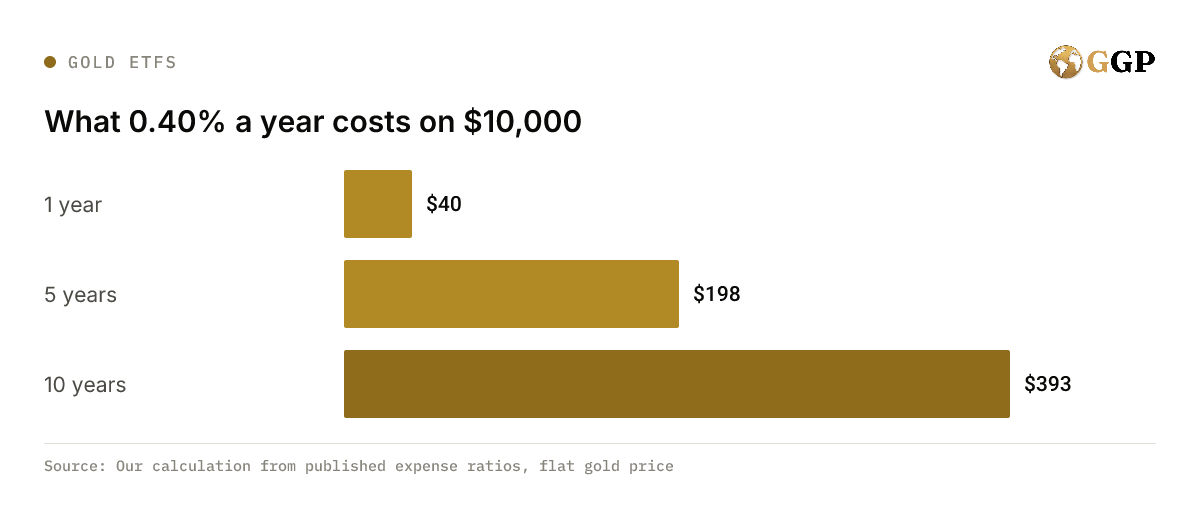
The expense ratio is 0.40% a year, which is $40 on every $10,000 you hold. You never see a bill. The trust sells a little gold each month to pay its sponsor and costs, so the amount of gold behind each share slowly shrinks.
On our figures that works out to about $1.50 per share per year at today's gold price. Over time it adds up:
| Holding period | Fee on $10,000 (flat gold price) |
|---|---|
| 1 year | $40 |
| 5 years | $198 |
| 10 years | $393 |
The longest view is in the trust's own history. A share held 0.1000 oz at launch and about 0.0915 oz now, so roughly 8.5% of the original gold has been sold to pay fees over 22 years. Over the same period the gold price rose from about $442 on the first trading day to about $4,072 now, on our price data, which is why holders still did well.
| Item | Value |
|---|---|
| 1 year | $40 |
| 5 years | $198 |
| 10 years | $393 |
Where is the gold kept?
The gold is held in London vaults, with HSBC Bank USA as custodian, according to the trust's filings with the SEC. Each bar is allocated, meaning specific numbered bars belong to the trust, and each meets the London good delivery standard of roughly 400 troy ounces.
The trust publishes a full bar list, with serial numbers, refiners and weights, so holders can see exactly which bars back their shares. Every day it values that gold at the LBMA Gold Price set in London in the afternoon. Our guide to how the gold price is set explains that benchmark.
Ordinary shareholders cannot swap their shares for bars. Only authorized participants can create or redeem shares, and they do it in large blocks. If you want to hold metal yourself one day, a fund such as the VanEck Merk Gold ETF (OUNZ), which offers delivery for a fee, or physical coins may suit you better. Our explainer on allocated vs unallocated gold covers what allocated storage means for your claim.
Trading the fund: volume, spreads and options
The trust trades heavily: trading volume has recently averaged around 11 million shares a day, according to broker quote data. Its bid-ask spread is usually a cent or two on a share worth hundreds of dollars, so the cost of getting in and out is tiny.
It also has the deepest options market of any gold fund. Traders use calls and puts on it to bet on the gold price or to protect a holding, and the wide range of strike prices and expiry dates is a big reason institutions keep using it despite the fee. Options carry their own risks, including losing the whole premium paid. Each standard contract covers 100 shares, so one contract controls the gold in 100 shares, about 9.15 ounces, worth roughly $37,300 at today's price.
If you buy shares, a limit order during regular US hours is the simple way to avoid paying more than you meant to. Most US brokers now charge no commission on ETF trades.
GLD vs cheaper gold ETFs
The same gold can be held for much less. The iShares Gold Trust (IAU) charges 0.25%, the SPDR Gold MiniShares Trust (GLDM), from the same sponsor, charges 0.10%, and the iShares Gold Trust Micro (IAUM) charges 0.09%.
| Fund | Fee a year | Fee on $10,000, 10 years | Gold per share | Assets |
|---|---|---|---|---|
| SPDR Gold Shares | 0.40% | $393 | 0.0915 oz | $145.2bn |
| iShares Gold Trust | 0.25% | $247 | 0.0188 oz | $63.8bn |
| SPDR Gold MiniShares Trust | 0.10% | $100 | 0.0198 oz | $31.3bn |
| iShares Gold Trust Micro | 0.09% | $90 | 0.0100 oz | $8.0bn |
Fees are the sponsors' published expense ratios; 10-year cost and gold per share are our calculations. Assets are from the end of September.
So who still uses the most expensive one? Mostly traders and institutions, for whom liquidity and options matter more than a fee they pay for only a few weeks. A $10,000 position held for one month costs about $3. For someone holding for a decade, the cheaper funds keep hundreds of dollars more of the gold. We set out the full comparison in our guide to GLD vs IAU vs GLDM.
A short history of the first US gold ETF
The trust began trading on 18 November 2004, when gold was about $442 an ounce on our price data. It was the first US-listed fund to give ordinary brokerage customers a share of vaulted bars, and it grew quickly: buying a share was easier than buying a coin, and pension funds and advisers could hold it in an ordinary account.
Rivals followed fast. The iShares Gold Trust launched in January 2005, the fund now called abrdn Physical Gold Shares (SGOL) in September 2009 and the Sprott Physical Gold Trust in February 2010, according to the launch dates in our ETF table. For years the original fund's lead looked unassailable.
The low-fee era started in 2018. State Street launched the SPDR Gold MiniShares Trust (GLDM) in June 2018, giving its own customers a cheaper version of the same product, and BlackRock answered with the iShares Gold Trust Micro (IAUM) in June 2021. Our earlier piece on low-fee mini funds taking 15% of the market tracks how quickly money has moved to them.
Through all of it the original fee has stayed at 0.40%, and the fund has stayed on top. It still holds about 55% of the assets in the ten US funds we track, roughly twice as much as its nearest rival, the iShares Gold Trust, with about $64 billion. Its trading volume and options market are why: for a bank or hedge fund moving hundreds of millions of dollars in a day, a deep market is worth far more than 0.30 points of fee.
For a household investor, the balance tips the other way the longer the holding period. Over 10 years, by our calculation, the fee gap to GLDM is worth about $293 on every $10,000. Over 20 years at a flat gold price it grows to about $572 as the fees compound.
How the fund is taxed in the US
In a taxable US account, the IRS treats a long-term gain on a physical gold trust like this one as a gain on collectibles, taxed at a maximum of 28% rather than the 15% or 20% that applies to most stocks. Short-term gains, on shares held a year or less, are taxed as ordinary income.
The monthly gold sales that pay the fee are also, strictly, small sales of your share of the gold, and the trust reports them to holders. Held in an IRA, the shares are not treated as a purchase of collectibles, according to an IRS private letter ruling, and gains are not taxed year by year. Our guide to how gold ETFs are taxed covers the details. This is general information, not tax advice.
Is GLD a good way to own gold?
It is the most liquid way to own gold through a US brokerage account, and its structure is simple: allocated bars, a known custodian, a published bar list. The trade-off is cost. At 0.40% a year it charges four times what GLDM charges for the same gold.
On our data gold is about 25% below its January record and up about 2% over the past year. The fund passes those moves on almost exactly, less its fee: over the year to 6 November 2026 its share price rose 1.76% against 2.15% for our gold price, a gap of 0.39 points, close to the 0.40% fee. What moves the gold price itself, from real yields to central bank buying, is covered in our guide to what moves the gold price.
Frequently Asked Questions
+How much gold is in one GLD share?
About 0.0915 troy ounces, by our calculation from the trust's latest NAV and our London gold price. Each share started with 0.1000 oz in 2004, and the fee has trimmed it since.
+Why does GLD cost less than an ounce of gold?
Because a share was set up to hold one-tenth of an ounce, not a full ounce. Multiply the gold price by about 0.0915 to get the value of a share's gold: about $373 at $4,072 an ounce.
+What is GLD's expense ratio?
0.40% a year, or $40 on every $10,000. It is paid by selling a little of the trust's gold each month, so you never receive a bill.
+Who holds GLD's gold?
HSBC Bank USA is the custodian, and the bars are held in London vaults, according to the trust's SEC filings. The trust publishes a full list of its bars.
+Does GLD pay a dividend?
No. The trust holds only gold, which earns no income. Your return is the change in the gold price, less the 0.40% yearly fee.
More From the North America Desk
All North America stories →Related Reading
- Resolute Mining guidance rests on $4,000 gold
Resolute Mining's 2026 guidance assumes a $4,000 gold price, about 3% above Friday's close, though its mines in Mali and Senegal still clear their costs by about $1,380 an ounce on our numbers.
- Gold 2x ETF and 3x funds: how leveraged gold works
Gold rose about 2% over the past year, but a fund resetting to twice the daily move would have lost about 3%, and a 3x fund about 13%, on our price data. Here is why, and which leveraged gold funds trade today.
- Gold ETF India guide: costs, tax and how they compare
Indian gold ETFs charge about 0.44% to 0.81% a year, ₹440 to ₹810 on every ₹1 lakh, with 24 carat gold near ₹12,300 a gram at the world price. How they compare with Sovereign Gold Bonds, gold funds and jewellery.