

Gold IRA vs a gold ETF in your IRA: costs and rules
A gold IRA can cost $2,000 or more over 10 years on a $10,000 holding once storage and custody are added, against about $100 to $393 for a gold ETF in an ordinary IRA. Here is how the IRS rules and the fees compare.
Key points
- A gold IRA holds coins or bars in an IRS-approved depository; an ETF in an ordinary IRA holds shares
- On $10,000, fees over 10 years run about $100 to $393 for the big gold ETFs, by our calculation
- The same $10,000 in a metals IRA costs about $2,000 at the cheapest quoted fees, before any dealer markup above 2%
- IRS rules ban home storage: a Tax Court case in 2021 turned home-kept coins into a taxable payout
A gold IRA is a self-directed individual retirement account that owns physical gold, held for you by a trustee in an approved vault. The alternative most US investors overlook is simpler: buy a gold exchange-traded fund inside the IRA you already have. Both shelter gains from tax until you withdraw. The fees are where they part ways: over 10 years the gap can be $1,600 or more on every $10,000 you put in.
What is a gold IRA, and how is it different from a gold ETF?
It is an ordinary traditional or Roth IRA with one difference: its custodian allows physical metal. You open the account with a specialist custodian, fund it with a contribution, a transfer or a rollover from a 401(k), and then buy coins or bars through a dealer. The metal goes to a depository, and the custodian keeps the records the IRS requires.
A gold ETF is a share that trades on the stock market and is backed by bars in a vault. The largest, SPDR Gold Shares (GLD), held about $145 billion at the end of September, according to the fund data behind our gold ETFs compared table. You can buy it at any brokerage that offers an IRA, in the same account as your stock and bond funds.
So the question is less "gold or no gold" and more "which wrapper". One gives you title to specific coins or bars. The other gives you a share of a trust's bars, with the fund doing the storage and insurance.
What the IRS allows an IRA to hold
The rule starts with a ban. Under section 408(m) of the Internal Revenue Code, when an individually directed retirement account buys a collectible, the IRS treats the cost as a distribution to you, taxable in that year. Metals and coins sit on the list of collectibles, next to art, rugs, gems and stamps.
Then come the exceptions. The IRS says the ban does not cover gold, silver, platinum or palladium bullion of a set minimum fineness, as long as a bank or an approved nonbank trustee keeps physical possession of it. Certain US-minted coins are also named in the law. For gold, the fineness test follows what a regulated futures contract will accept, which dealers and custodians read as 99.5% pure. American Gold Eagle coins are the well-known exception: they are 22 karat (22K) but allowed by statute.
Three practical consequences follow:
- Collector coins, numismatic pieces and most jewelry cannot go into an IRA at all.
- You cannot buy coins with your own money and "contribute" them. Contributions are cash, and the IRA buys the metal.
- The metal must sit with the trustee or its depository, never with you.
Can you keep gold IRA metal at home?
No. The clearest warning is McNulty v. Commissioner, a 2021 US Tax Court case. A couple set up IRAs that owned an LLC, used it to buy American Eagle coins and kept them in a home safe. The court held that their physical possession made the coins a taxable distribution, and press reports put the tax bill near $270,000 on about $730,000 of coins, before penalties.
Promoters still sell "home storage" or "checkbook" metals IRAs. The IRS position and the McNulty ruling are why most custodians refuse them.
Can a gold ETF go in an ordinary IRA?
Yes, and this is what most brokerage IRAs already allow. The IRS addressed it in private letter rulings in 2007 and again in 2014 (PLR 201446030): an IRA buying shares of a trust that holds gold is buying a share in a trust, not acquiring a collectible itself. A private ruling only binds the taxpayer who asked for it, but the major gold trusts rely on this reading, and their shares sit in millions of retirement accounts.
One detail matters. If you redeem trust shares for physical bars, the IRS treats that as acquiring the metal, so the collectibles rule comes back. Inside an IRA, stick to buying and selling the shares.
Gold IRA fees compared with a gold ETF
The costs of holding metal in an IRA come in layers. Fee surveys from consumer finance sites put them in these ranges:
| Cost | Metals IRA (typical quoted range) | Gold ETF in an ordinary IRA |
|---|---|---|
| Account setup | $50 to $300, sometimes waived | Usually $0 at large brokers |
| Annual custodian or admin fee | $75 to $300 | Usually $0 |
| Storage and insurance | $100 to $300 a year | Inside the fund's expense ratio |
| Buying the gold | Dealer markup about 2% to 10% over spot | Bid-ask spread, often a cent or two a share |
| Fund fee | None | 0.09% to 0.40% a year |
Source: fee ranges from consumer finance surveys (see sources); fund fees from issuers; our calculations.
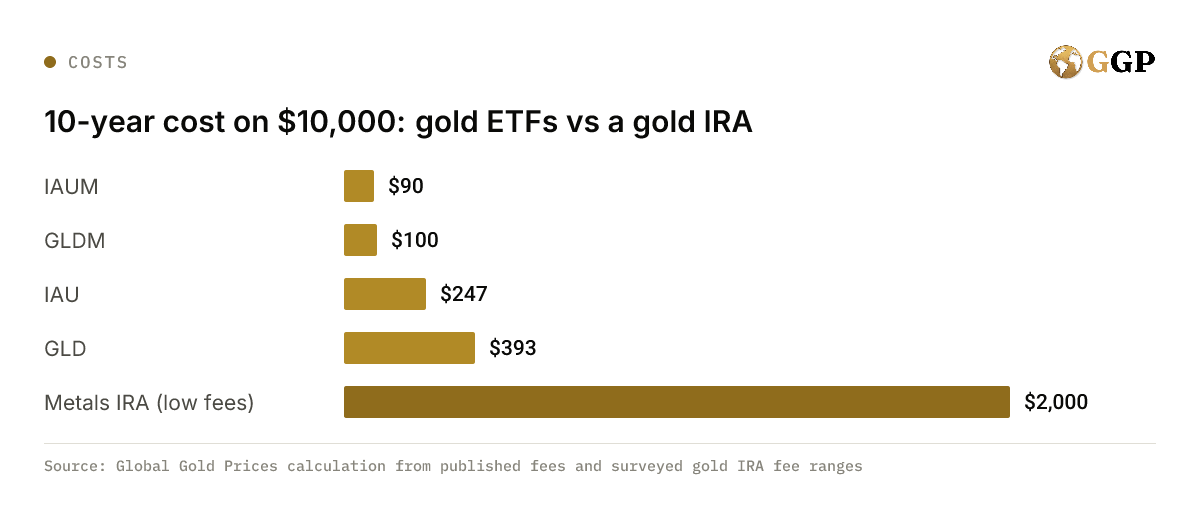
Here is what that means on $10,000, held for 10 years at a flat gold price. Our calculation uses each fund's published expense ratio compounded over the period, and for the metals account the cheapest end of each range above: $50 to open, $75 a year to the custodian, $100 a year for storage and a 2% dealer markup.
| 10 years on $10,000 | Fee | Total cost |
|---|---|---|
| iShares Gold Trust Micro (IAUM) | 0.09% a year, $9 on every $10,000 | about $90 |
| SPDR Gold MiniShares (GLDM) | 0.10% a year, $10 on every $10,000 | about $100 |
| iShares Gold Trust (IAU) | 0.25% a year, $25 on every $10,000 | about $247 |
| SPDR Gold Shares (GLD) | 0.40% a year, $40 on every $10,000 | about $393 |
| Metals IRA, cheapest quoted fees | $175 a year plus setup and 2% markup | about $2,000 |
| Metals IRA, top of quoted ranges | $600 a year plus setup and 10% markup | about $7,300 |
Source: our calculation from published fees; metals IRA ranges from consumer finance surveys.
| Item | Value |
|---|---|
| IAUM | $90 |
| GLDM | $100 |
| IAU | $247 |
| GLD | $393 |
| Metals IRA (low fees) | $2,000 |
Two things narrow the gap. Flat custodian and storage fees hurt less on a larger account: on $100,000, $175 a year is 0.175%, close to an ETF fee. And some custodians charge storage as a percentage of the metal's value, so check the schedule before you sign.
The dealer markup is the cost people notice last. A 5% markup on coins means the gold price has to rise 5% before you are back to even, and you will usually sell back below spot. Our guide to why you pay more than spot shows how wide those spreads can be on coins.
Storage: segregated or commingled?
Depositories offer two kinds of storage. Commingled storage pools your coins or bars with other customers' metal of the same type, and you get back equivalent pieces. Segregated storage keeps your exact items apart, and fee surveys put it at about $50 to $150 a year more.
Gold ETFs hold large 400-ounce bars in London or New York vaults, owned by the trust and listed bar by bar in the fund's records. For the difference between owning named bars and owning a claim on a pool, see our explainer on allocated and unallocated gold.
Why many investors choose a gold ETF in their IRA
The case for the ETF route comes down to four things.
Cost. On the numbers above, a gold ETF costs a fraction of a small metals IRA. The cheapest funds charge $9 or $10 a year on every $10,000.
Selling. ETF shares trade from 9:30 am to 4 pm New York time on any market day, at a price close to the value of the gold behind them. Selling coins from a self-directed account means a dealer quote, often below spot, and a few days for the custodian to settle.
Paperwork. A gold ETF sits in the same IRA as your other funds, with one statement and one set of contribution and distribution rules. A metals IRA is a second account with its own custodian and its own fees.
Fewer sales traps. The Commodity Futures Trading Commission and FINRA have warned buyers about precious metals IRA pitches built on fear and hidden markups. In some cases, the CFTC says, victims lost a third to a half of their savings to markups, fees and commissions.
When a gold IRA can still make sense
The coin route fits a narrower group: people who want specific coins or bars they could one day take as an in-kind distribution, who distrust any financial intermediary between them and the metal, or whose balances are large enough that flat fees shrink to a small share. If that is you, ask for every fee in writing, the dealer's buyback price on the same day as the sale price, and the name of the depository.
Gold IRA tax rules and contribution limits
An IRA that holds metal follows the same tax rules as any IRA. The 2026 contribution limit is $7,500, plus a $1,100 catch-up for savers aged 50 and over. Traditional IRA owners must start required minimum distributions at 73. With metal, that can mean selling coins to raise cash or taking coins out in kind, which counts as taxable income at their market value.
Outside an IRA, physical gold and gold trust ETFs are taxed as collectibles, with long-term gains taxed at up to 28%, according to the IRS. Inside an IRA, neither pays tax on gains until money comes out, and a Roth IRA can make qualified withdrawals tax-free. On our London gold price, $10,000 put into gold five years ago would be worth about $22,600 today, a gain of about $12,600 that an IRA shelters until withdrawal.
How to compare offers before you buy
- Ask for the total yearly cost in dollars at your balance, including storage and insurance.
- Ask for the buy price and the buyback price for the same coin on the same day.
- Check that the depository is named and that the metal meets the IRS fineness rule.
- Compare that with a gold ETF's fee in your existing IRA: 0.09% to 0.40% a year, with no setup or storage bill.
Fees for the ETFs here were checked on the issuers' published figures in November 2026, and fees change. Our gold ETFs compared page lists every US fund by fee and size. This guide is general information, not tax or investment advice.
Frequently Asked Questions
+What is a gold IRA?
It is a self-directed IRA whose custodian lets it own physical gold coins or bars, stored by a trustee in an approved depository. It has the same tax rules and the same 2026 contribution limit of $7,500 as any IRA, plus fees for custody, storage and the dealer markup.
+What gold can I hold in an IRA?
The IRS treats most metals and coins as collectibles, which an IRA may not buy. The exceptions are bullion of a set minimum fineness, read as 99.5% for gold, held by a bank or approved trustee, and certain coins named in the law such as the American Gold Eagle.
+Can I store my IRA gold at home?
No. The metal must be in the physical possession of the trustee or its depository. In McNulty v. Commissioner in 2021, the Tax Court treated coins kept in the owners' home safe as a taxable distribution.
+Is a gold ETF in an IRA cheaper than holding coins in an IRA?
Usually, by a wide margin on small accounts. By our calculation, 10 years of fees on $10,000 cost about $90 to $393 in the large gold ETFs, against about $2,000 for a metals IRA even at the cheapest fees quoted by consumer surveys.
+Can I roll a 401(k) into a self-directed metals IRA?
Yes. A direct rollover or trustee-to-trustee transfer moves money from a 401(k) or another IRA into a self-directed IRA without tax, and the new custodian then buys the metal. Taking the money out yourself and missing the 60-day redeposit window can make it taxable.
+How are gold IRA withdrawals taxed?
Withdrawals from a traditional metals IRA are taxed as ordinary income, whether you take cash or coins, and required minimum distributions start at 73. Qualified withdrawals from a Roth version are tax-free.
More From the North America Desk
All North America stories →Related Reading
- Resolute Mining guidance rests on $4,000 gold
Resolute Mining's 2026 guidance assumes a $4,000 gold price, about 3% above Friday's close, though its mines in Mali and Senegal still clear their costs by about $1,380 an ounce on our numbers.
- Gold 2x ETF and 3x funds: how leveraged gold works
Gold rose about 2% over the past year, but a fund resetting to twice the daily move would have lost about 3%, and a 3x fund about 13%, on our price data. Here is why, and which leveraged gold funds trade today.
- Gold ETF India guide: costs, tax and how they compare
Indian gold ETFs charge about 0.44% to 0.81% a year, ₹440 to ₹810 on every ₹1 lakh, with 24 carat gold near ₹12,300 a gram at the world price. How they compare with Sovereign Gold Bonds, gold funds and jewellery.