

Poland gold reserves hit 700 tonnes, and buying goes on
The National Bank of Poland reached its target after buying about 27 tonnes in October, and the governor sees no reason to stop.
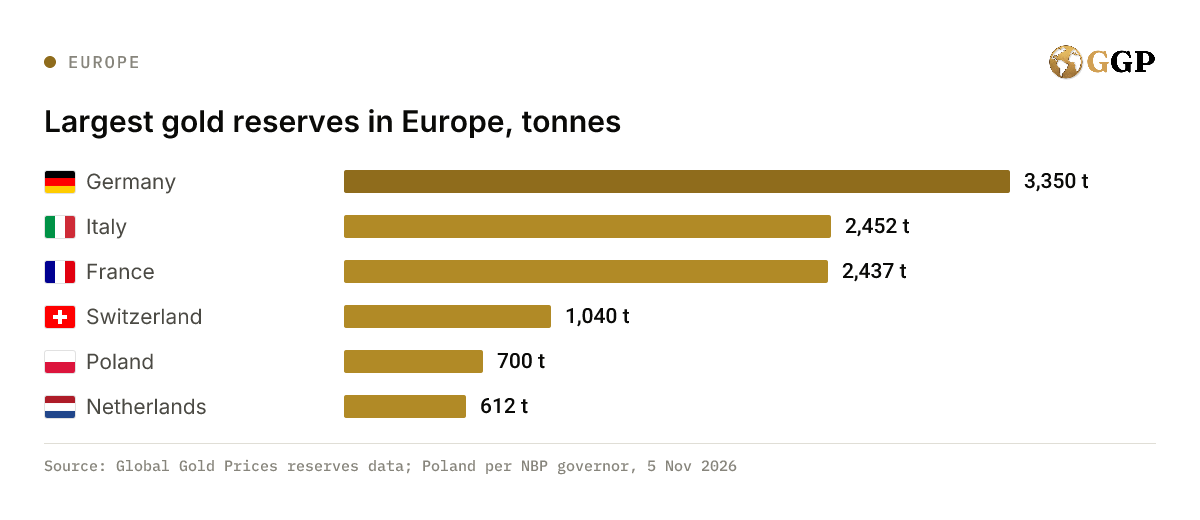
Poland gold reserves have reached 700 tonnes, central bank governor Adam Glapinski said on Thursday, hitting the target the National Bank of Poland set itself. He left the door open to more. "I see no reason why we should stop buying gold," he said, Reuters reported. Figures cited in the same report imply the bank bought about 27 tonnes in October alone.
How fast has Poland been buying?
Very fast. On our reserves table, Poland held about 632 tonnes at the start of June and was the biggest buyer of any central bank in the quarter to June, adding 51 tonnes. Glapinski put the holding at 672 tonnes in October. Reaching 700 tonnes means the bank has added roughly 68 tonnes since June, by our calculation.
In July, Glapinski said the bank had bought 82 tonnes so far in 2026, Bloomberg reported. It has kept buying through the autumn even as the price fell, much like the People's Bank of China, which said on Saturday it had added gold for a 24th straight month.
At Friday's close of about $4,072 an ounce, 700 tonnes are worth about $91.6bn, by our calculation. The bank's holding is worth about 356 billion zlotys, according to the same report.
Where does Poland rank in Europe?
Poland now holds more gold than the Netherlands and more than twice as much as the UK, on our reserves table.
| Country | Tonnes |
|---|---|
| Germany | 3,350 |
| Italy | 2,452 |
| France | 2,437 |
| Switzerland | 1,040 |
| Poland | 700 |
| Netherlands | 612 |
| United Kingdom | 310 |
Worldwide, that puts Poland in the top ten official holders, behind Japan's 846 tonnes and India's 881. Germany, Italy and France built their reserves decades ago and have barely changed them since; Poland has built most of its pile in the past few years. Our piece on Germany's gold reserves showed how swings in the price move the value of those older hoards.
| Item | Value |
|---|---|
| Germany | 3,350 t |
| Italy | 2,452 t |
| France | 2,437 t |
| Switzerland | 1,040 t |
| Poland | 700 t |
| Netherlands | 612 t |
| United Kingdom | 310 t |
Why does Poland want so much gold?
Glapinski has argued that gold protects the country's reserves against crises and against the risk of relying on any one currency. "Our gold reserves should grow in line with our overall reserves," he said this week. Our explainer on why central banks buy gold sets out the wider case.
There is also a storage plan. The bank's long-term aim is to keep a third of its gold at the Federal Reserve Bank of New York, a third at the Bank of England in London and a third in its own vault at home. For now most of it sits in London, because that is where the recent purchases took place, Glapinski said.
Will Poland keep buying?
The governor's words suggest so, but at a slower pace. Linking gold to the size of total reserves means purchases will follow the growth of Poland's foreign currency holdings rather than a fixed tonnage. With the 700-tonne target met, the bank no longer has a number to hit before a set date.
That matters for the market. Poland was the biggest official buyer in the quarter to June on our data, adding 51 tonnes. A shift from a target-driven pace of 20 to 30 tonnes a month to something smaller would remove one of the steadiest buyers of the past two years.
What does it mean for the gold price?
Two central banks, Poland and China, added more than 50 tonnes between them in October, a month when gold fell about 7%. That kind of steady official buying helps explain why gold found a floor near $3,876 at the end of October. Readers in the euro area can follow the gold price in euros on our live page.
More From the Europe Desk
All Europe stories →Related Reading
- Resolute Mining guidance rests on $4,000 gold
Resolute Mining's 2026 guidance assumes a $4,000 gold price, about 3% above Friday's close, though its mines in Mali and Senegal still clear their costs by about $1,380 an ounce on our numbers.
- Gold 2x ETF and 3x funds: how leveraged gold works
Gold rose about 2% over the past year, but a fund resetting to twice the daily move would have lost about 3%, and a 3x fund about 13%, on our price data. Here is why, and which leveraged gold funds trade today.
- Gold ETF India guide: costs, tax and how they compare
Indian gold ETFs charge about 0.44% to 0.81% a year, ₹440 to ₹810 on every ₹1 lakh, with 24 carat gold near ₹12,300 a gram at the world price. How they compare with Sovereign Gold Bonds, gold funds and jewellery.