

Gold ETF UK guide: physical gold ETCs, fees and ISAs
The cheapest London-listed gold ETCs charge 0.12% a year, £12 on every £10,000, with the gold price near £3,050 an ounce. How SGLN, SGLD, WGLD, PHAU and RMAU compare, and how ISAs and Capital Gains Tax apply.

Key points
- UK investors buy gold through ETCs, exchange-traded commodities, listed on the London Stock Exchange
- The cheapest charge 0.12% a year, £12 on every £10,000; the dearest common one charges 0.39%
- One SGLN share holds about 0.0194 troy ounces, worth about £59 at today's price, by our calculation
- Gains outside an ISA or SIPP face Capital Gains Tax at 18% or 24% above a £3,000 allowance
A gold ETF UK investors can buy is almost always a gold ETC: an exchange-traded commodity, a security listed in London that is backed by gold bars in a vault and tracks the gold price. You buy it through a share-dealing account, a stocks and shares ISA or a SIPP, in pounds, during London market hours.
The products look alike, but fees run from 0.12% to 0.39% a year, the vaults differ and so do the issuers. This guide compares the main London-listed funds, alongside the US funds on our gold ETFs compared page, and sets out the tax rules from HMRC.
Gold ETF or gold ETC: what is the difference in the UK?
The difference is legal, not practical. European rules for funds (UCITS) require spreading money across several holdings, so a fund holding only gold does not qualify. Issuers instead sell gold as an ETC, which is a debt security: a note from a special-purpose company, backed by allocated bars held by a custodian bank.
For you as a buyer, it trades like a share. The price follows the gold price, the issuer takes a yearly fee by shrinking the gold behind each share a little every day, and you can sell at any time the market is open, 8 am to 4:30 pm UK time.
The thing to check is the backing. Every fund in this guide holds physical gold in London Bullion Market Association (LBMA) Good Delivery bars, allocated to the product, rather than relying on derivatives. Allocated bars are owned by the product outright, which matters if a bank fails: unallocated gold is only a claim on the bank.
The main London-listed physical gold ETCs compared
| Fund (London ticker) | Yearly fee | Cost on £10,000 a year | Custodian and vault | Issuer |
|---|---|---|---|---|
| iShares Physical Gold ETC (SGLN) | 0.12% | £12 | JPMorgan Chase, London | BlackRock |
| Invesco Physical Gold ETC (SGLD) | 0.12% | £12 | JPMorgan Chase, London | Invesco |
| WisdomTree Core Physical Gold (WGLD) | 0.12% | £12 | HSBC, London | WisdomTree |
| Amundi Physical Gold ETC (GLDA) | 0.12% | £12 | HSBC, London | Amundi |
| Royal Mint Physical Gold ETC (RMAU) | 0.25% | £25 | The Royal Mint, Llantrisant | HANetf |
| WisdomTree Physical Gold (PHAU) | 0.39% | £39 | HSBC, London | WisdomTree |
Source: issuer pages and fact sheets, checked in November 2026; Amundi's fee from its Fidelity fact sheet and its custodian from Amundi's London listing; cost by our calculation.
Some of these trade in more than one currency. SGLN is the pound line of the iShares product, and its US dollar line trades under IGLN. Buying the pound line saves a currency conversion at your platform, but the gold underneath is priced in dollars either way, so a weaker pound still lifts the price you see.
iShares Physical Gold ETC (SGLN)
The largest in London, at about £29 billion according to market data sites. Its gold sits in a London bank vault, and iShares publishes the metal behind each security daily: about 0.0194 troy ounces in October.
Invesco Physical Gold ETC (SGLD)
One of the oldest, launched in June 2009, at the same 0.12% fee and also held in London vaults by the same custodian bank as SGLN. It is a common pick on platforms that offer cheaper dealing on Invesco products.
WisdomTree Core Physical Gold (WGLD) and WisdomTree Physical Gold (PHAU)
WisdomTree runs two. WGLD, launched in November 2020, charges 0.12%. PHAU, the older and larger product, charges 0.39%, more than three times as much for the same kind of London-vaulted gold. Investors who bought PHAU years ago often still hold it, which is why it remains big.
Royal Mint Physical Gold ETC (RMAU)
The only one whose bars are held by The Royal Mint itself, in segregated accounts at its vault in Llantrisant, Wales. It charges 0.25% and lets holders redeem for physical gold, which most others limit to large authorised participants.
How much gold is in one share?
Each share holds a fixed but slowly shrinking amount of metal. For SGLN, iShares put it at about 0.019392 ounces per security in October. At our latest London gold price of about $4,072 an ounce, that is worth about $79, or about £59 at today's exchange rate of about 0.748 pounds per dollar, by our calculation. The gold price in the UK is about £3,047 an ounce on the same basis.
The amount falls a little each day as the fee is taken. At 0.12% a year, a share holds about 1.2% less gold after 10 years than it started with. At 0.39%, it holds about 3.8% less.
What the fees cost in pounds
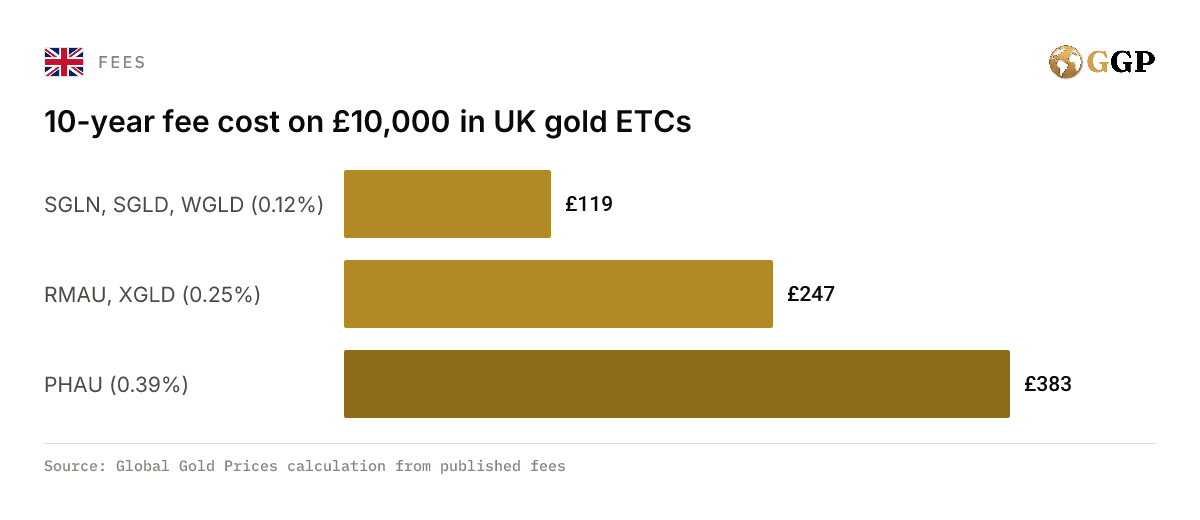
Fees look small as percentages. In pounds, over time, the gap adds up. Our calculation compounds each fee on £10,000 at a flat gold price:
| Yearly fee | 1 year | 5 years | 10 years |
|---|---|---|---|
| 0.12% (SGLN, SGLD, WGLD, GLDA) | £12 | £60 | £119 |
| 0.25% (RMAU) | £25 | £124 | £247 |
| 0.39% (PHAU) | £39 | £193 | £383 |
Source: our calculation from published fees.
| Item | Value |
|---|---|
| SGLN, SGLD, WGLD (0.12%) | £119 |
| RMAU, XGLD (0.25%) | £247 |
| PHAU (0.39%) | £383 |
Platform charges come on top. UK platforms charge either a percentage of what you hold or a flat fee, plus a dealing charge each time you buy or sell. Which? suggests that people with smaller pots usually pay less on a percentage fee, and those with larger ones on a flat fee.
Can you hold a gold ETC in a stocks and shares ISA?
In most cases, yes. HMRC's rules for stocks and shares ISAs allow securities admitted to trading on a recognised stock exchange, and the London Stock Exchange is one. That is the basis on which the issuers above list their London ETCs as ISA-eligible. Your ISA provider decides which products it offers, so check before you buy.
The ISA allowance is £20,000 for the 2026 to 2027 tax year, which you can split across ISA types. Gains and income inside an ISA are free of UK tax, so gold held there never faces Capital Gains Tax. Many self-invested personal pension (SIPP) platforms list the same ETCs, with tax relief on the way in instead.
Capital Gains Tax on gold ETCs outside an ISA
Outside an ISA or pension, a gold ETC is a chargeable asset. When you sell, you pay Capital Gains Tax on any gain above your annual exempt amount, which HMRC sets at £3,000 for 2025 to 2026 and 2026 to 2027.
Since 30 October 2024, the rates for assets other than homes are 18% for basic-rate taxpayers and 24% for higher and additional-rate taxpayers. On a £10,000 gain, that means tax of about £1,260 at 18% or £1,680 at 24% after the £3,000 allowance, by our calculation.
UK gold coins work differently. HMRC treats sterling currency as outside Capital Gains Tax, which is why gains on legal tender coins such as Sovereigns and Britannias are exempt. Foreign coins and bars are not. If tax-free gains matter more to you than easy trading, coins inside your allowance are the alternative; inside an ISA, the ETC route is already tax-free.
Is the gold behind a UK gold ETC safe?
The gold belongs to the product, not to the issuer's own balance sheet. Each issuer uses a custodian bank and publishes a list of the bars it holds. If the issuer failed, a trustee would sell the gold or hand it back for the holders.
Risks remain. ETCs are debt securities, so their legal structure matters, and the custodian is a single point of failure. There is also the gold price itself: it is down about 25% from January's record in dollars, on our data.
How to buy a gold ETC on a UK platform
The steps are the same as buying any London-listed share:
- Open a share-dealing account, a stocks and shares ISA or a SIPP with a UK platform, and add money.
- Search for the ticker, such as SGLN, SGLD or WGLD, and check you have the pound line if you invest in pounds.
- Choose an order type. A limit order sets the most you will pay; a market order buys at the best price available.
- Check the dealing charge before you confirm. On a £1,000 purchase, a £10 dealing fee costs more than eight years of a 0.12% fee.
Buying monthly through a regular investing plan, where platforms offer one, spreads purchases across different gold prices and often costs less per trade.
Gold ETCs vs gold bars and coins for UK buyers
An ETC is the cheapest way to follow the gold price in the UK, but it is not the only one. Physical bars and coins cost more up front: dealers charge a premium over the gold value, often a few per cent on coins, and buy back below it. Our guide to gold premiums shows how wide that spread can get.
What bars and coins offer is direct ownership, with no issuer or custodian between you and the metal, and in the case of Sovereigns and Britannias, no Capital Gains Tax. What an ETC offers is low cost, a price within pennies of the gold value and a sale at the click of a button. Many UK investors hold both.
Currency: why the pound matters for UK gold investors
Gold is priced in dollars around the world, so a UK investor's return depends on two things: the dollar gold price and the pound against the dollar. When the pound weakens, gold in pounds rises even if the dollar price stays still.
Some issuers sell pound-hedged gold products that try to remove that currency effect, usually at a higher fee. Most UK investors buy the unhedged pound lines in this guide, which give the full gold price converted into pounds each day.
How to choose a gold ETF in the UK
- Fee. At 0.12% a year, SGLN, SGLD and WGLD cost £12 on every £10,000. PHAU at 0.39% costs more than three times as much.
- Size and trading. Larger funds tend to trade on tighter spreads, so you lose less between buying and selling.
- Where the gold sits. London bank vaults for most; The Royal Mint in Wales for RMAU.
- Your platform. Check which products your ISA or SIPP provider lists, and what it charges to deal.
For comparison, the cheapest US-listed gold ETFs charge 0.09% to 0.10% a year, close to the London ETCs. Fees change, so check the issuer's page on the day. This guide is general information, not tax or investment advice.
Frequently Asked Questions
+Are gold ETFs in the UK actually ETCs?
Yes, almost always. European fund rules require diversification, so a single-commodity fund is sold as an exchange-traded commodity, a debt security backed by allocated gold bars. It trades on the London Stock Exchange like a share.
+What is the cheapest physical gold ETC in the UK?
Several London-listed ETCs charge 0.12% a year, £12 on every £10,000, including iShares Physical Gold (SGLN), Invesco Physical Gold (SGLD) and WisdomTree Core Physical Gold (WGLD). WisdomTree Physical Gold (PHAU) charges 0.39%.
+Can I hold a gold ETC in a stocks and shares ISA?
Usually, yes. HMRC allows securities admitted to trading on a recognised stock exchange in a stocks and shares ISA, and issuers list their London gold ETCs as eligible; the 2026 to 2027 allowance is £20,000.
+Do I pay Capital Gains Tax on a gold ETC?
Outside an ISA or pension, yes. Gains above the £3,000 annual exempt amount are taxed at 18% for basic-rate taxpayers and 24% for higher-rate taxpayers, under HMRC rates in force since 30 October 2024.
+Should I buy the pound or the dollar line of a gold ETC?
If you invest in pounds, the pound line such as SGLN saves a currency conversion at your platform. The gold is priced in dollars either way, so the pound's moves against the dollar affect your return on both lines.
More From the Europe Desk
All Europe stories →Related Reading
- Resolute Mining guidance rests on $4,000 gold
Resolute Mining's 2026 guidance assumes a $4,000 gold price, about 3% above Friday's close, though its mines in Mali and Senegal still clear their costs by about $1,380 an ounce on our numbers.
- Gold 2x ETF and 3x funds: how leveraged gold works
Gold rose about 2% over the past year, but a fund resetting to twice the daily move would have lost about 3%, and a 3x fund about 13%, on our price data. Here is why, and which leveraged gold funds trade today.
- Gold ETF India guide: costs, tax and how they compare
Indian gold ETFs charge about 0.44% to 0.81% a year, ₹440 to ₹810 on every ₹1 lakh, with 24 carat gold near ₹12,300 a gram at the world price. How they compare with Sovereign Gold Bonds, gold funds and jewellery.